Meaning at a glance
Galaxy jewelry meaning combines documented artistic traditions of celestial imagery with contemporary personal and cultural interpretations; this article separates historical evidence from modern uses, explains common design and gemstone choices, and gives practical guidance for selecting and caring for galaxy-themed pieces.
What the historical evidence shows (and who documents it)
Museum collections and scholarship document a long-standing interest in celestial imagery across many regions and periods. The Victoria and Albert Museum curates examples and discussions showing that jewelers have used stars, spirals, suns and moon motifs in decorative arts and personal adornment over centuries, with changing meanings depending on time and place. These motifs appear in materials and techniques that reflect each era’s technology and taste rather than a single, unchanging symbolism (Victoria and Albert Museum).
Historically, the appearance of a star, spiral or sun on a brooch, pendant or ring was shaped by local artistic language, religious frameworks and social context. The V&A’s survey of jewellery history emphasizes how motifs gain and lose associations as fashions, patronage and technologies change; for instance, a motif that served as a status marker in one court could be adopted later for sentimental or decorative reasons in another period (Victoria and Albert Museum).
Gemstones themselves carried reputations and meanings that shifted over time. Curatorial and reference material on gemstones indicate that particular stones were prized for qualities that evoked sky, light or mystery—qualities later sellers and wearers associated with celestial themes. The Victoria and Albert Museum’s guide to gemstones outlines how stones such as opal and moonstone have historically been linked to luminous effects and nocturnal associations, which makers exploited in celestial or “galaxy” designs (Victoria and Albert Museum).
Separating documented historical meanings from modern interpretations
Documented historical meanings are those explicitly recorded in inventories, patron correspondence, religious texts, or museum provenance and cataloguing. For example, museums like the Victoria and Albert Museum provide object histories and contextual analysis that show how certain motifs functioned in particular places and times—often as markers of wealth, devotional imagery, or courtly fashion (Victoria and Albert Museum). These are the claims supported by surviving objects and curatorial research.
Modern personal interpretations, by contrast, are contemporary readings layered onto those motifs. In the 20th and 21st centuries, a galaxy pendant might be marketed as a token of wonder, a symbol of scientific curiosity, or a metaphor for personal growth. Those meanings are valid as personal or cultural usage today, but they are not direct continuations of every historical meaning and should not be presented as universal or ancient facts.
When you see statements such as “galaxy jewelry represents destiny” or “the universe watches over you,” treat them as contemporary symbolic readings unless they are backed by documentary evidence tied to a specific culture or historical source. In short, documented historical meanings come from object records and scholarship; modern meanings often reflect fashion, spirituality, fandom or marketing.
How the galaxy motif and related gemstones appear in jewelry
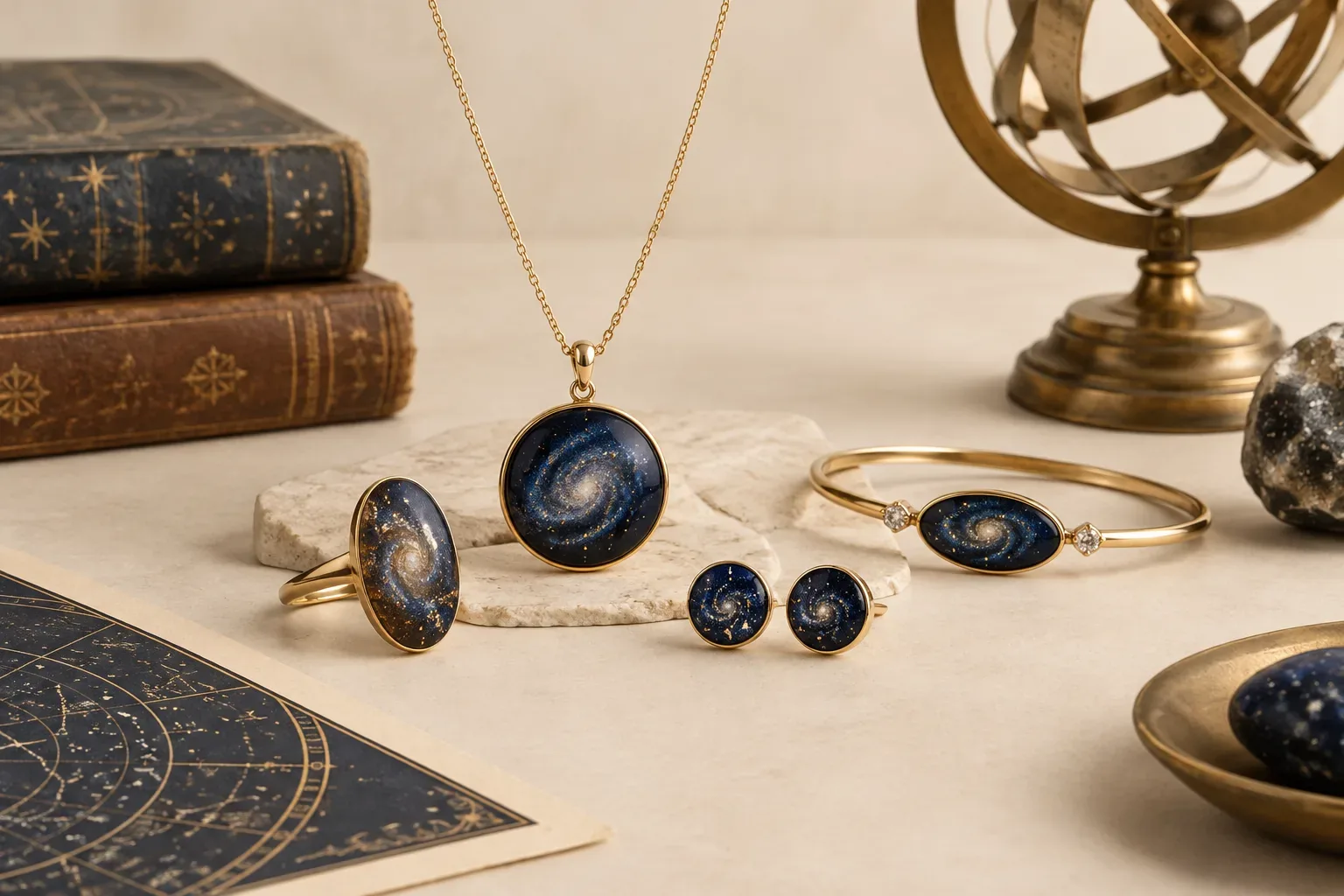
Designers use a range of visual shorthand to suggest galaxies or celestial fields: spiral forms that echo spiral galaxies, clustered settings that mimic starfields, pavé or micro-pavé that create shimmering backgrounds, dark backgrounds with scattered bright stones to suggest depth, and enamel or patination to suggest sky tones. These are design choices rather than fixed symbolic formulas; the same spiral can be decorative, astronomical, or symbolic depending on context and maker intent.
Gemstones commonly used to evoke cosmic effects are those with internal fire, iridescence, or deep color. Historically referenced stones with such optical qualities include opal and moonstone for their play of light and sapphire or deep blue stones for their association with the night sky (Victoria and Albert Museum). Contemporary makers also use black onyx, labradorite, tourmaline, and treated or composite materials to achieve galaxy-like visual effects.
Metalwork and setting techniques support the motif: cluster settings and millegrain can suggest a scattering of stars, while openwork and spun metal may evoke spirals and motion. In museum pieces, lapidary and setting styles are informative about the era and technology; modern makers adapt historical techniques and combine them with new materials to create explicitly “galaxy” pieces for contemporary tastes (Victoria and Albert Museum).
Practical guidance for selecting and gifting galaxy-themed jewelry
Be explicit about intent. If you select a galaxy motif for symbolic reasons—such as expressing encouragement, curiosity, or a shared interest in astronomy—state that intention when gifting so the recipient understands whether the piece is sentimental, aesthetic, or both. If the piece is intended to mark a religious or cultural belief, confirm that the recipient is comfortable with that symbolism.
Consider the recipient’s style, metal preferences and any metal sensitivities. Choose finishes and metals (sterling silver, gold vermeil, solid gold, or platinum) that match everyday wearability and maintenance preferences. For sensitive skin, look for nickel-free or hypoallergenic alloys and check item descriptions or ask sellers about metal composition.
Check gemstone authenticity and disclosures. The Federal Trade Commission advises that sellers must disclose treatments, synthetics and imitations for gemstones. If you value a natural stone for its history or perceived meaning, request written disclosure of any treatments (cutting, dyeing, resins, doublets/ triplets) and confirmation of whether the stone is natural, synthetic, or assembled (Federal Trade Commission).
Think about longevity and care. Pieces with many small stones or delicate enamel require more careful wear. If the recipient is active or wants an everyday piece, prefer sturdier settings and harder gems. If the piece is a keepsake or occasional-wear item, you can prioritize intricate detail or fragile effects.
Personalize respectfully. Adding engraved dates, initials, or a short message can anchor a contemporary symbolic reading to a personal story without presuming ancient or universal meanings. Use personalization to explain the modern interpretation you want the piece to carry rather than asserting it as an ancient truth.
When in doubt, choose quality and documented provenance. Buy from reputable sellers who provide clear information on materials and origins, and consult museum resources or specialist guides if you wish to understand historical precedents and craftsmanship (Victoria and Albert Museum; Federal Trade Commission).
Care, authenticity and further research
Caring for galaxy-inspired jewelry follows the same practical rules as caring for other fine or fashion jewelry: store pieces to avoid abrasion, keep delicate stones away from chemicals, and follow any seller instructions for cleaning. For pieces with iridescent or layered stones (for example, assembled opal doublets or triplets), ask about safe cleaning methods to avoid damage.
If historical or cultural authenticity matters to you—if you are collecting or commissioning work informed by a specific period—use museum catalogues and curatorial publications as primary references. The Victoria and Albert Museum’s collections and essays are good starting points to understand how motifs and materials were used in historical contexts (Victoria and Albert Museum).
For purchasing and disclosure concerns, consult the Federal Trade Commission’s guidance on buying gemstones, diamonds, and pearls to understand labeling and treatment disclosure practices (Federal Trade Commission).
Concluding note
Galaxy jewelry meaning is a productive intersection of history, visual metaphor and personal expression. Recognize distinct layers: documented uses in historical contexts (best understood through museum research), and contemporary symbolic readings that reflect modern tastes, spirituality, and science-inspired wonder. With clear intent, good sourcing and respectful gifting, galaxy motifs can be meaningful in ways that are both personally resonant and informed by the craft and history behind them.
Frequently asked questions
Is the galaxy motif an ancient symbol with a single meaning?
No. The galaxy motif and related celestial imagery have appeared in many times and places, but their meanings varied with local context and period. Museum research shows motifs often served decorative, status, devotional or sentimental roles depending on culture and era (Victoria and Albert Museum). Modern readings are additional, not universally ancient meanings.
Which gemstones are traditionally used to evoke a galaxy or night-sky effect?
Stones historically used for luminous or nocturnal effects include opal and moonstone, and deep-blue stones such as sapphire have long been associated with the night sky. Contemporary makers also use labradorite, black onyx, and treated or assembled materials to create galaxy-like visual effects (Victoria and Albert Museum).
How can I be sure a gemstone in a galaxy piece is natural and untreated?
Ask the seller for written disclosure about treatments and whether a stone is natural, synthetic, or assembled. The Federal Trade Commission requires sellers to disclose treatments and imitations; reputable dealers will provide clear information and, where appropriate, certification (Federal Trade Commission).
Is it appropriate to give galaxy-themed jewelry as a symbolic gift?
Yes, provided you are clear about your intent and respectful of the recipient’s beliefs and tastes. State whether the gift is meant as a sentimental token, an aesthetic choice, or a reflection of shared interests. Personalization, such as an engraving, can help communicate modern symbolic meanings without assuming historical universality.
How should I care for delicate galaxy-effect stones or settings?
Follow seller care instructions and avoid harsh chemicals, ultrasonic cleaners and abrasive cloths for iridescent or assembled stones. Store delicate pieces separately to prevent abrasion and consider professional cleaning for intricate settings; when in doubt, consult the maker or a trusted jeweller.
Sources and further reading
- Bedazzled: A History of Jewellery — Victoria and Albert Museum
- An A-Z of Gemstones — Victoria and Albert Museum
- Buying Gemstones, Diamonds, and Pearls — Federal Trade Commission