Meaning at a glance
This article explains the documented history and changing contexts of meteor motifs and meteoritic materials in jewellery, distinguishes recorded cultural meanings from later popular interpretations, and gives practical guidance for choosing and gifting meteor-inspired pieces.
What the historical record shows
The Victoria and Albert Museum's surveys of jewellery history emphasize how jewellers and patrons have long valued objects made from rare or exotic materials and imagery drawn from the heavens. The V&A's exhibition and writings trace shifting materials, technologies, and social reasons for wearing jewellery across many periods, from ancient to modern, and show that motifs inspired by stars, comets and other celestial phenomena appear repeatedly as jewellery fashion and devotional imagery rather than as a single universal belief.
Museum scholarship documents that unusual metals and stones—whether prized for their origin, rarity, colour, or pattern—were incorporated into personal and ceremonial objects to mark status, identity, or memory. The V&A's resources on gemstones likewise explain how certain stones and visual motifs were associated with specific social meanings in particular contexts, and how those meanings changed over time as technologies, tastes, and beliefs evolved.
Identifying cultures and periods in the record
Broadly speaking, the documentary record assembled by museum curators and historians shows recurrent themes rather than a single fixed meaning: in ancient and medieval contexts unusual materials could be treated as precious or sacred; in early modern Europe celestial imagery was revived within learned and decorative culture; and in the 18th and 19th centuries European and American jewellers used astronomical motifs as fashion and as symbols of sentiment. The Victoria and Albert Museum's historical overview is the principal source for this description of changing social contexts and symbolic use in jewellery.
Documented meanings versus modern personal interpretations
Documented meanings in the museum record are context-specific. Where curators and historians have evidence, meanings are recorded as tied to social rank, religious function, commemorative practice, or the novelty of a material. Museums stress that an object's meaning depends on who made it, who commissioned and wore it, and the cultural expectations of the time.
Modern interpretations—how an individual wearer understands a meteor motif today—are largely personal and contemporary. Common modern associations include resilience, sudden change, wonder at the cosmos, and the idea of carrying 'something other' with personal significance. Those are meaningful to many wearers but are not presented in the scholarly record as universal historical meanings.
How the meteor motif and meteoritic materials appear in jewellery
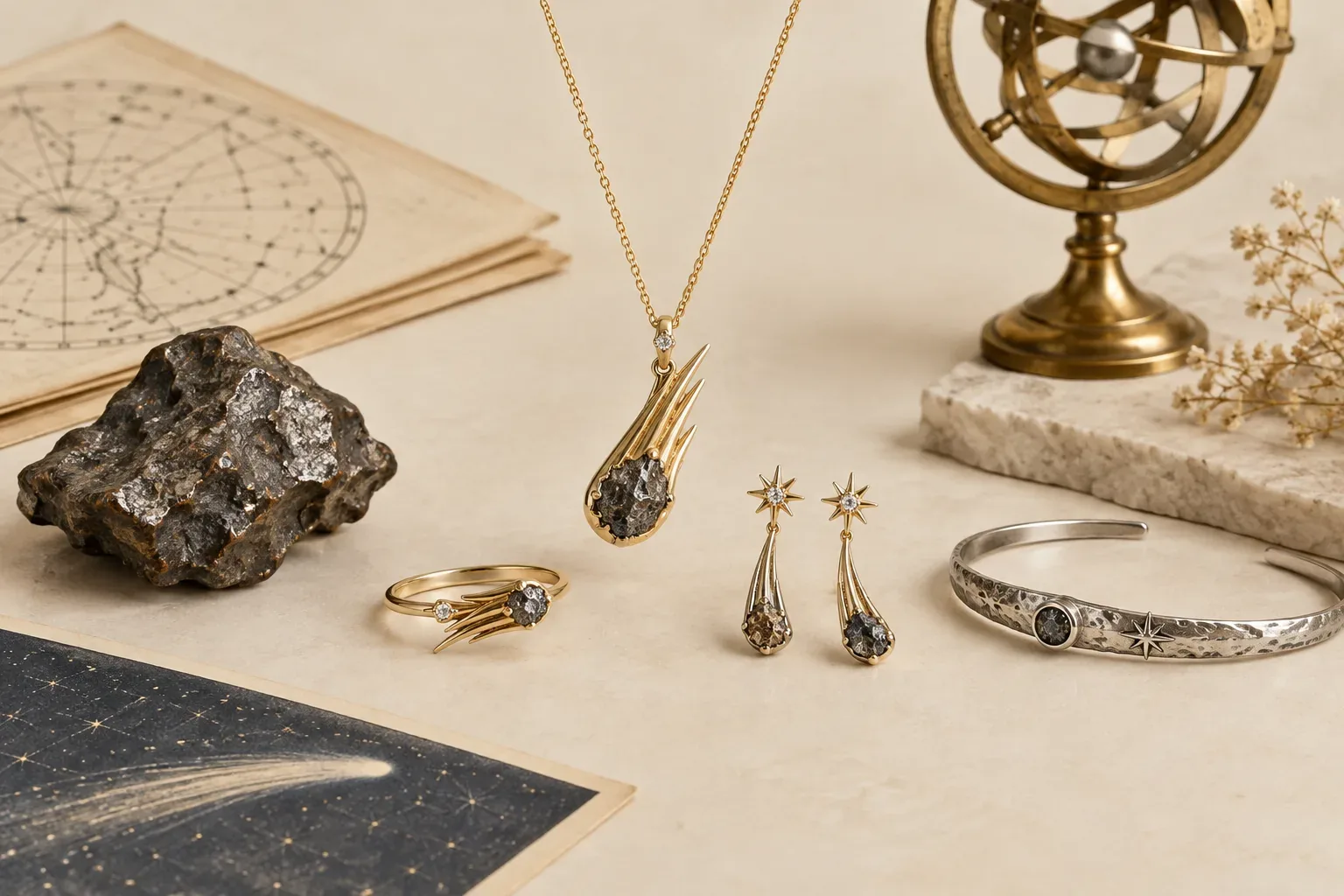
Design motifs that reference meteors show up in jewellery as shooting stars, starbursts, comet-like trails, and textured or irregular ‘core’ forms meant to suggest a piece of space rock. Silversmiths and jewellers use those images to evoke movement and the sky, often combining small stones such as diamonds or sapphires to represent stars or tails.
Separately, makers sometimes incorporate actual meteorite material. Contemporary pieces may use slices of meteoritic iron that show metallic patterns, or miniature fragments set into rings, pendants, and cufflinks. Because meteorite iron may develop surface oxidation or require stabilizing treatments to be wearable, responsible sellers typically disclose whether a meteorite has been sealed, treated, or stabilized for jewellery use.
Material and authenticity questions buyers should ask
Ask whether a piece contains actual meteorite material or whether it is purely a meteor-inspired motif. If meteorite metal or stone is claimed, request documentation and clear information about treatments, stabilisation, and long-term care. The Federal Trade Commission advises buyers to ask sellers about treatments, imitations, and disclosure practices when purchasing gemstones and unusual materials; similar scrutiny is appropriate for meteorite material.
Also confirm the metal stamp and any hallmark for the mount, learn whether included gemstones are natural, lab-grown, or simulants, and check return or certification policies. A reputable seller will be able to explain how the meteorite was sourced, whether it has been stabilized or coated, and how to care for the finished object.
Choosing and gifting meteor jewellery respectfully
If you are buying meteor-themed jewellery as a gift, start from the recipient’s values: do they prefer literal materials, like a piece that contains a meteor fragment, or symbolic design that evokes the cosmos? Match the choice to their everyday wear—delicate starburst pendants suit layered minimal looks, while a textured meteor core pendant can be a statement piece.
Be mindful of cultural or religious contexts. Meteor imagery is widespread and generally secular in contemporary fashion, but some celestial symbols may carry particular meanings in specific communities; if you are unsure, choose a neutral design or ask discreetly. When the piece contains authentic meteorite, include the seller’s documentation and care instructions with the gift so the recipient understands the object’s nature and maintenance needs.
Care, longevity, and ethical considerations
Meteorite iron can be chemically reactive when exposed to moisture and salts, so many contemporary jewellers stabilise fragments with coatings or mount them in protective settings. Ask about maintenance and storage recommendations from the seller. For mounted gemstones and other components, follow the maker’s cleaning guidelines and avoid harsh chemicals that can damage coatings or finishes.
Consider the ethics of sourcing. Genuine meteorite material is finite and often recovered by field collectors; responsible sellers should be transparent about provenance. If you prioritise sustainability, you can also choose ethically produced designs that use meteor-inspired motifs in recycled metals or lab-grown stones that evoke celestial colours.
Frequently asked questions
What does meteor jewellery symbolize?
Historically, jewellery made from rare or unusual materials and sky-inspired motifs has signified status, memory, or novelty in specific cultural contexts; contemporary wearers commonly choose meteor motifs to express wonder, sudden change, or personal resilience. The precise meaning depends on the maker, wearer, and cultural moment.
Is meteorite material safe for jewellery?
Meteorite material is used in modern jewellery but can be chemically reactive; reputable sellers will stabilise, coat, or otherwise treat fragments for wear and provide care guidance. Ask the seller about treatment and maintenance before purchasing.
How can I tell if a piece contains a real meteorite?
Request documentation and a clear description from the seller. A trustworthy vendor will disclose whether a piece uses authentic meteorite fragments or is a meteor-inspired design and will explain any treatments or stabilisation applied.
Should I be concerned about treatments or imitations?
Yes. Follow the Federal Trade Commission’s guidance by asking whether gemstones or meteorite material are natural, lab-grown, treated, or simulated and by requesting written disclosure of any enhancements.
Is meteor jewellery appropriate as a gift?
Meteor-inspired jewellery can be a meaningful gift when chosen with the recipient’s tastes and values in mind. If the piece contains authentic meteorite, include provenance and care instructions and consider whether a bold or subtle design better suits the intended wearer.
How should I care for meteorite jewellery?
Follow the jeweller’s care instructions. In many cases avoid prolonged exposure to water and chemicals, store the piece dry, and clean gently. If the meteorite has been coated or stabilised, do not use abrasive or solvent cleaners that could damage the treatment.
Sources and further reading
- Bedazzled: A History of Jewellery — Victoria and Albert Museum
- An A-Z of Gemstones — Victoria and Albert Museum
- Buying Gemstones, Diamonds, and Pearls — Federal Trade Commission