Meaning at a glance
Comet jewelry meaning centers on a documented history of celestial imagery in decorative arts, changing social contexts recorded by museum collections, and a wide range of modern personal interpretations; choose and gift comet pieces by clarifying intended meaning, checking materials and disclosures, and respecting cultural or religious sensitivities.
What the historical record shows
Museum scholarship places comet and other celestial motifs within a long history of jewellery design and changing social functions. The Victoria and Albert Museum (V&A) treats celestial imagery as one strand in the evolving language of ornament, showing examples from antiquity through later European periods where stars, suns and related shapes were incorporated into personal adornment and court dress. The V&A emphasises that meanings for decorative motifs shift with fashion, technology, and social context rather than remaining fixed.
Because museum catalogues and exhibitions collect objects rather than always recording the owner’s private intentions, the documentary record most reliably shows what forms and materials were used and how popular certain motifs were in particular places or periods. For example, the V&A documents the prevalence of starbursts, sunbursts and other radiating forms in European jewellery collections, and it situates those pieces within broader shifts in taste across the Renaissance, Georgian and Victorian eras. Those attributions are about style and social practice; they do not by themselves establish a single symbolic meaning for comets across cultures.
Archaeological and textual evidence beyond what is available in general surveys sometimes records specific cultural beliefs about celestial events. However, within the scope of museum summaries like the V&A’s 'Bedazzled: A History of Jewellery', the emphasis is on how jewelers used light‑reflecting stones and radiating settings to evoke brilliance or spectacle in dress rather than on cataloguing uniform spiritual meanings attributed to comets in a single culture. In short, the historical record preserved in museum collections documents designs, materials and fashion cycles precisely, but it shows that symbolic interpretations varied by time and place.
Separating documented historical meanings from modern interpretations
Documented meanings seen in museum records and catalogues are primarily about social function, fashion and material symbolism. The V&A’s work makes clear that decorative motifs could signal status, demonstrate access to particular gemstones or techniques, or participate in fashionable sets of references (for example, a series of pieces using radiating motifs during a particular reign or court). When a jewelled object is clearly part of memorial or mourning jewellery, museums will document that function on the object label or in provenance notes. Those are concrete, evidence‑based attributions tied to the object’s use or recorded purpose.
By contrast, many contemporary claims about comet symbolism—where a comet represents personal change, prophetic messages, or spiritual guidance—are modern personal or popular interpretations rather than meanings consistently documented in historical museum records. These modern meanings are valid as personal symbolism, but they are distinct from the documentary claims museums make about an object’s original social role or function. The V&A’s approach helps us distinguish the object’s historical context from the meanings people attach to the comet motif today.
How the comet motif and related gemstones appear in jewellery
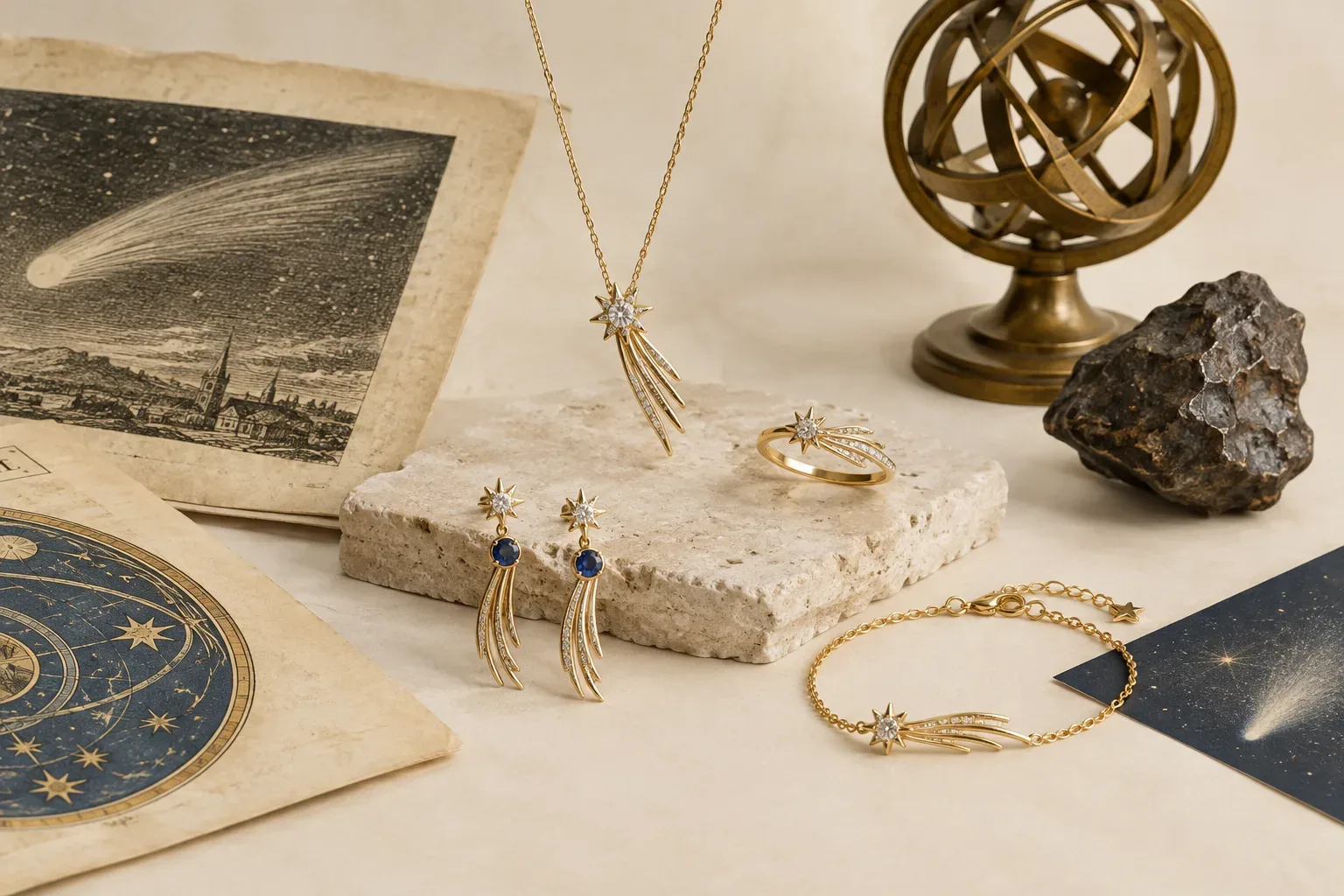
Design vocabulary: In jewellery, a "comet" motif is typically expressed through a radiant or tailing form—a central bright point with tapering rays or a trailing line of stones. Museums such as the V&A show many examples of starbursts and radiating clusters where craftsmen used symmetry and graduated stones to suggest motion and brilliance. The motif appears on brooches, pendants, earrings and watch covers where the composition emphasizes direction or a trailing suggestion rather than a static round form.
Gemstones and materials: The V&A’s A–Z discussion of gemstones outlines that jewellery makers historically chose bright, highly reflective stones and settings to convey sparkle and light. Diamonds, rock crystal, white paste (glass), seed pearls and light‑coloured gems have been used to suggest a luminous core, while smaller accent stones or metal work create the tail or rays. Which exact stones are used in any given piece depends on period, budget and taste; museums record many permutations from haute court jewellery to costume variants.
Construction techniques and motifs: Typical techniques include graduated settings where stones decrease in size along a line to suggest motion, asymmetric arrangements to portray a fleeting trajectory, and metalwork creating engraved rays. In later periods, jewellers also used gem cuts and mounting styles to amplify reflected light. Museum descriptions document these technical choices as part of an object's design history.
Modern personal meanings and cultural sensitivity
Contemporary wearers commonly adopt comet imagery to express ideas such as change, a decisive life event, hope, the memorable arrival of someone, or simply an admiration of the night sky. These are perfectly valid personal meanings but should be presented as personal or contemporary interpretations rather than historical facts when discussing an object’s provenance.
Because celestial phenomena can have different cultural or religious resonances, treat symbolic attributions respectfully. If you are commissioning or gifting a piece tied to ritual or community identity, ask or research first rather than assuming the comet motif will be accepted in the same way everywhere. The V&A’s curatorial practice of situating objects within their historical contexts demonstrates why caution is prudent: an ornament that signified fashionable cosmopolitan taste in one period may have very different connotations in another cultural setting.
Practical guidance for choosing, wearing or gifting comet jewellery
Clarify intent: Decide whether the piece is meant as a fashion object, a sentimental token, or a work of historical reproduction. If you intend a personal message—commemoration, encouragement, or a private code—make that explicit to the recipient in a note or card so the symbolic intention travels with the jewellery. If the piece is presented as an historical or cultural artefact, avoid attributing modern spiritual meanings as if they were historical facts.
Materials and disclosure: Use museum and consumer guidance when evaluating materials. The V&A’s A–Z on gemstones is useful for learning which stones historically read as luminous in jewellery, and the Federal Trade Commission (FTC) warns buyers to ask for full disclosure of treatments, enhancements, and imitations. For example, confirm whether stones are natural or lab‑grown, whether they have been heat‑treated or fracture‑filled, and whether settings are solid precious metal or plated. Request written information from the seller and retain receipts.
Budget and style choices: For daytime, subtle comet motifs in small studs or pendants can read as personal talismans. For statement pieces, look for graduated stone settings and directional compositions that suggest motion. Consider durability and lifestyle: secure settings and harder stones are better for everyday wear. If historical authenticity matters, ask for provenance or maker information and for any conservation history recorded by the seller.
Respect and research: If the gift is intended to reference a historical period or cultural practice, do basic research or consult specialists. The V&A demonstrates how contexts shape meaning; likewise, a historically styled comet brooch may carry particular associations when reproduced. If uncertain, frame the gift as "inspired by" rather than as a reproduction of a specific cultural artefact.
Care and maintenance: Treat bright, complex settings with the same care recommended for mixed‑stone jewellery: avoid harsh chemicals, have regular professional checks of prongs and settings, and clean according to the stone types indicated by the vendor. Keep documentation about gemstone treatments and origin with the piece for future valuation or conservation needs.
Conclusion
Comet jewellery meaning sits at the intersection of documented design history and contemporary personal symbolism. Museum sources like the Victoria and Albert Museum document the use of radiating and celestial motifs across periods and explain how materials and fashion shaped those designs, while consumer guidance from the Federal Trade Commission helps buyers navigate material disclosures and treatments. Historic uses tell us what jewellers made and why certain materials were chosen; modern wearers decide what comets mean to them now. Choosing or gifting comet jewellery thoughtfully means recognizing both strands: the object’s documented context and the personal symbolism you wish to communicate.
Frequently asked questions
Is a comet motif historically associated with omens?
Museums like the Victoria and Albert Museum record comet and celestial designs principally as fashion and decorative motifs rather than as uniformly documented omens; specific beliefs about comets vary by culture and are not consistently established across museum catalogue notes. Personal or cultural beliefs that treat comets as omens are modern or cultural interpretations and should be presented as such.
Which gemstones work best for a comet design?
Historically and stylistically, bright, reflective stones have been used to suggest a luminous nucleus with trailing stones for a tail. The V&A’s resources discuss diamonds, rock crystal and light‑coloured gems in this context. Choose stones based on the look, wearability and budget, and ask sellers about treatments or imitations as recommended by the Federal Trade Commission.
Can I claim a comet piece is 'historic' if it looks old?
If an item is being presented as historic, ask for provenance and maker information. Museums document provenance carefully; reproduction pieces or historically inspired designs should be described as such. Sellers are obliged to disclose treatments and whether gems are natural, synthetic or imitations, so request documentation before purchase.
How should I gift comet jewellery if I want it to have meaning?
Be explicit about the meaning you intend—write a note explaining why you chose the motif. If the symbolism references a culture or religious practice, research or ask the recipient to avoid unintended offense. Treat the piece as either a fashion object, a sentimental token, or a historical reproduction and communicate that clearly.
Sources and further reading
- Bedazzled: A History of Jewellery — Victoria and Albert Museum
- An A-Z of Gemstones — Victoria and Albert Museum
- Buying Gemstones, Diamonds, and Pearls — Federal Trade Commission