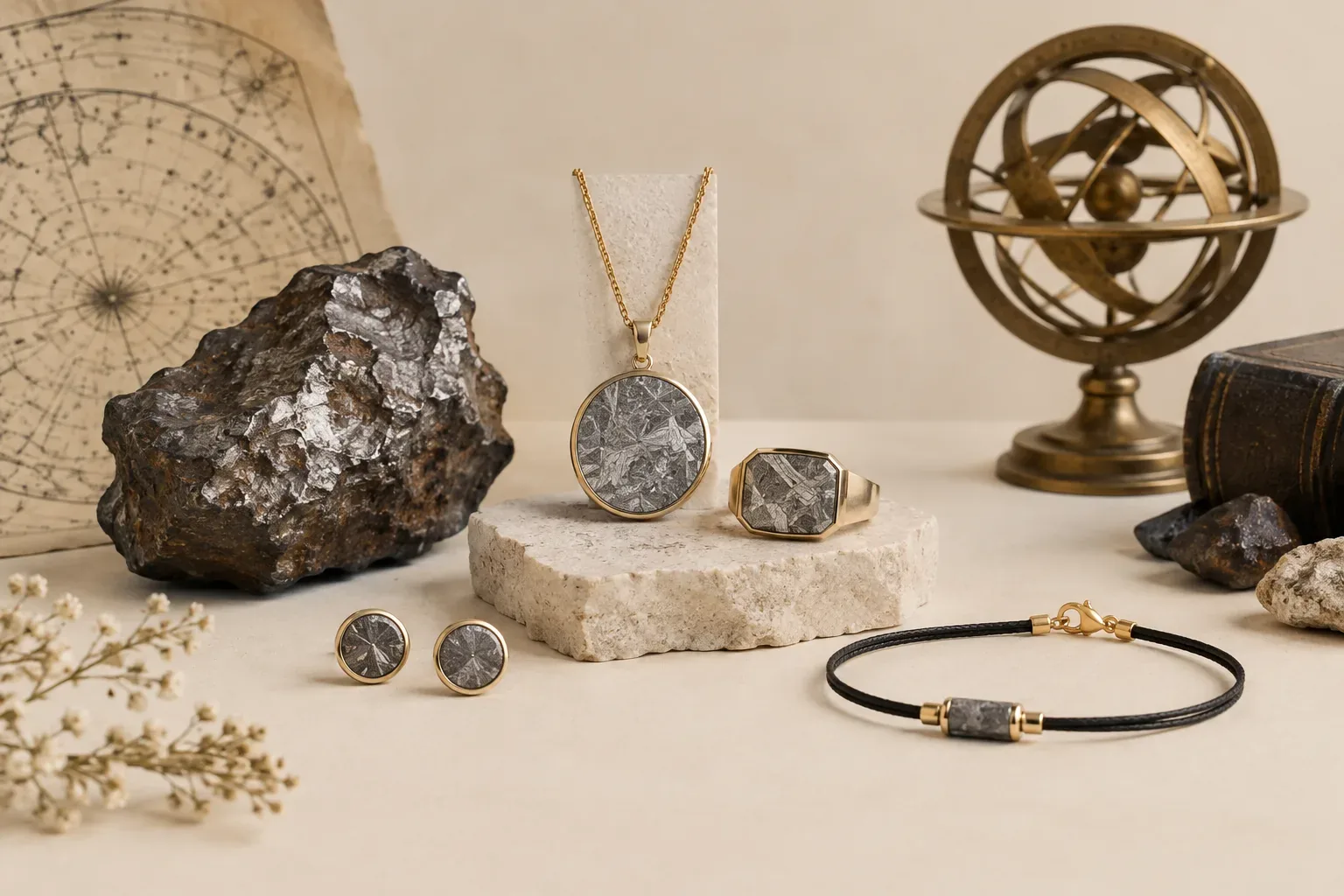
Meaning at a glance
Document the historical record and changing contexts for meteorite material in jewelry, distinguish museum-supported historical evidence from later personal meanings, and offer practical guidance for selecting and gifting meteorite jewelry.
Short answer
Meteorite jewelry meaning depends on context: museums and jewellery historians show that materials and motifs gain new social meanings across time, but specific, consistent symbolic uses of meteorites in historical religious traditions are not well documented in the museum literature. Today, meteorite material is primarily valued for its extraterrestrial origin and aesthetic characteristics; modern symbolism—connection to the cosmos, rarity, or personal narratives about travel and fate—is largely contemporary and personal rather than a single documented historical tradition.
What meteorites are (a brief astronomical context)
Meteorites are objects from space that have reached Earth’s surface. In everyday and museum contexts this extraterrestrial origin is the defining fact that sets meteorites apart from terrestrial minerals and gemstones. That extraterrestrial provenance is the reason the material attracts cultural interest, but disciplined accounts in museum and gemological literature treat meteorite material as another class of material whose story must be documented rather than assumed to carry a single universal meaning.
Documented history in jewellery: what museums record
The Victoria and Albert Museum and its published guides emphasize that jewellery’s meanings change with social context and material innovation. Museum studies recorded by the Victoria and Albert Museum show that jewellers and consumers have long experimented with non-traditional materials, and that new materials acquire symbolic associations through fashion, technology, and personal use rather than by automatic, uniform cultural assignment.
Applied to meteorite material, that museum approach implies caution: while jewellers have used unusual natural materials across eras, the scholarly record preserved in major museum collections does not support a single, continuous religious or symbolic tradition for meteorite jewellery spanning multiple cultures. Instead, meteorite material appears in modern collections and contemporary design narratives mainly because of its novelty, provenance, and the meanings that modern makers and wearers attach to it.
Separating documented historical meanings from modern interpretation
Documented historical meanings are assertions about what a material meant to people in a particular time and place and must be supported by primary evidence or reliable curatorial scholarship. The Victoria and Albert Museum emphasises the importance of contextual evidence when tracing jewellery meanings, and this discipline shows limited direct historical evidence for meteorite-specific symbolism in the long-term museum record.
Modern interpretations are different: many contemporary wearers describe meteorite jewellery as symbolizing connection to the heavens, uniqueness, luck, or resilience. These meanings are legitimate personal or cultural readings of the material today, but they are not the same as a documented continuous symbolic tradition. Treat contemporary symbolism as newly layered meaning-making rather than as an established ancient ritual or universally accepted symbol.
How the motif and material appear in jewellery
In contemporary jewellery, meteorite material is used as a visible component—set as a central stone or inlay—or as an accent combined with gold, silver, or other gems. Jewelers and designers usually identify the material’s origin as part of the piece’s story, because provenance is central to how modern buyers understand meteorite pieces.
Museums and gemstone guides note that collecting and displaying unusual natural materials follows wider patterns in jewellery history: novelty, technical possibility, and market demand determine how a material is used. Whether a jeweller presents a raw fragment or a polished slice, the physical character of meteorite material and how it is worked become part of the piece’s aesthetic and the wearer’s intended meaning.
Practical guidance for choosing and gifting meteorite jewellery
Ask for clear provenance and authenticity information. The Federal Trade Commission advises buyers of gemstones and rare materials to request disclosure about treatments, imitations, and origins. For meteorite material, ask the seller whether the piece is genuine, how the material was treated or stabilized for wear, and whether any coatings or stabilizing agents were applied.
Understand durability and care. Meteorite material can be physically different from traditional gemstones; some pieces may be sensitive to moisture or require specific conservation methods. Ask the seller or a qualified jeweller about expected wear, cleaning recommendations, and any preventative maintenance needed to preserve the piece.
Be explicit about symbolic intent when gifting. Because modern meanings are largely personal, explain the intended symbolism—whether you mean to suggest cosmic connection, rarity, or a story about travel—and recognise that the recipient may read the piece differently. If the recipient has cultural or religious commitments that might interpret extraterrestrial material in a particular way, check respectfully before gifting.
Seek disclosure about treatments and imitations. The FTC guidance that applies to gemstones also applies here: reputable sellers should disclose whether a piece contains genuine meteorite, whether the material has been treated, and whether any components are simulated. If you need a formal appraisal or laboratory report for insurance or legal reasons, ask the vendor whether independent testing is available.
Consider ethical and conservation factors. Because meteorite material is finite and sometimes marketed on provenance narratives, ask about sourcing practices and any documentation provided by the seller. For heirloom value, choose pieces with clear provenance and written documentation so future owners can understand the origin story.
When historical accuracy matters (and when personal symbolism is enough)
If you want a historically grounded symbolic meaning, rely on curatorial or scholarly sources. Museum documentation and reputable gemological references are the proper basis for claims about how a material was used or understood in the past. The Victoria and Albert Museum’s work on jewellery history demonstrates the importance of that approach.
If you prize personal or contemporary symbolism, be transparent about it. Modern meteorite jewellery often carries meanings chosen by maker or wearer—connection to exploration, a gift marking an astronomical event, or an aesthetic appreciation of a rare natural object. Those modern meanings are valid, and in many contexts they are precisely the point of selecting meteorite material.
Frequently asked questions
Is meteorite jewelry historically linked to a specific religion or culture?
Museum-based scholarship shows limited direct evidence of a single continuous religious or cultural tradition for meteorite jewellery. The Victoria and Albert Museum’s work on jewellery history highlights that materials gain meanings in different social contexts, but it does not document a universal ancient ritual or symbol tied specifically to meteorite material.
How can I tell if a meteorite piece is genuine?
Ask the seller for provenance and documentation; reputable vendors should disclose whether the material is genuine and whether it has been treated or stabilized. The Federal Trade Commission advises buyers to request clear disclosure about treatments, imitations, and origin when purchasing rare materials and gemstones.
Are there specific care requirements for meteorite jewellery?
Care depends on how the meteorite material was prepared and set. Some meteorite pieces are stabilized or coated for wear, while others may be more fragile. Ask the maker or seller for cleaning and maintenance recommendations and whether the material requires special storage to prevent corrosion or damage.
What symbolism does meteorite jewellery usually carry today?
Contemporary symbolism is varied and personal; common modern themes include connection to the cosmos, uniqueness, travel, or a commemorative link to an astronomical event. These are modern, often individual meanings rather than historically documented symbolic functions.
Should I be concerned about treatments or imitations?
Yes. The FTC guidance for buying gemstones applies: vendors should disclose treatments and any simulated components. If authenticity is important to you, ask for written disclosure, independent testing if available, and clear information about which parts of a piece are meteorite and which are other materials.
Sources and further reading
- Bedazzled: A History of Jewellery — Victoria and Albert Museum
- An A-Z of Gemstones — Victoria and Albert Museum
- Buying Gemstones, Diamonds, and Pearls — Federal Trade Commission