Meaning at a glance
Mesopotamian jewelry symbols have distinct historical contexts that vary by culture and period; museum evidence documents many motifs and materials while modern use layers new personal meanings. This article separates documented historical uses from later interpretations and offers practical buying and gifting guidance.
What the historical evidence shows (and where it comes from)
Most of what we call Mesopotamian jewelry symbols — rosettes, animals, winged figures, the tree of life, and celestial emblems — are known through archaeological objects now in museum collections and described by museums such as the Victoria and Albert Museum. The V&A's work on jewellery history emphasizes that designs, materials and social uses change between cultures and over time, and that museum collections are a primary source for our knowledge of those changes.
Museum catalogues and exhibitions record that different Mesopotamian polities and artistic traditions produced distinctive forms. For clarity: references to 'Sumerian' generally point to the southern city-state cultures, while 'Akkadian' names the imperial arts associated with rulers from the central Mesopotamian regions, and 'Babylonian' and 'Assyrian' refer to later political and cultural traditions in the same geographic area. The Victoria and Albert Museum contextualizes many of these developments within a long history of how jewellery signaled rank, identity and belief, and how motifs were adapted into changing fashions.
Objects in museum collections—beads, gold work, engraved seals and inlaid plaques—provide the direct evidence for motifs and materials. The V&A frames these artifacts as part of broader social practices: jewellery could be personal adornment, a diplomatic gift, a votive offering, or an indicator of social status. That institutional context is the basis for the historical claims made here rather than later literary or popular sources.
Documented historical meanings versus modern interpretations
When we discuss 'meaning' for ancient Mesopotamian symbols, it is important to separate what the archaeological and museum records directly support from what later commentators or modern wearers may infer. Museum documentation commonly links motifs to social roles, ritual contexts or aesthetic conventions. For example, animal and hybrid creatures on seals and plaques are documented as protective or emblematic images within administrative or cultic objects, and rosette or star emblems often appear in association with divinity and celestial imagery in curated collections described by the Victoria and Albert Museum.
Beyond those contextual attributions, many contemporary readings of Mesopotamian symbols are modern reinterpretations. People today may wear a winged disk or stylized tree of life as a statement of spiritual affinity, historical interest, or fashion; those personal meanings are valid for the wearer, but they are not the same as the documented social or cultic functions recorded in museum descriptions. The V&A emphasises that jewellery's meanings shift across time and audiences, and that modern uses frequently reframe ancient motifs to express individual identity or modern beliefs.
Avoid assuming universality. The same motif could have different connotations in Sumerian and Assyrian contexts, and museum evidence generally points to functional or symbolic variability rather than a single fixed meaning across all Mesopotamian cultures.
How motifs, gemstones, and traditions appear in jewelry (historical and modern)
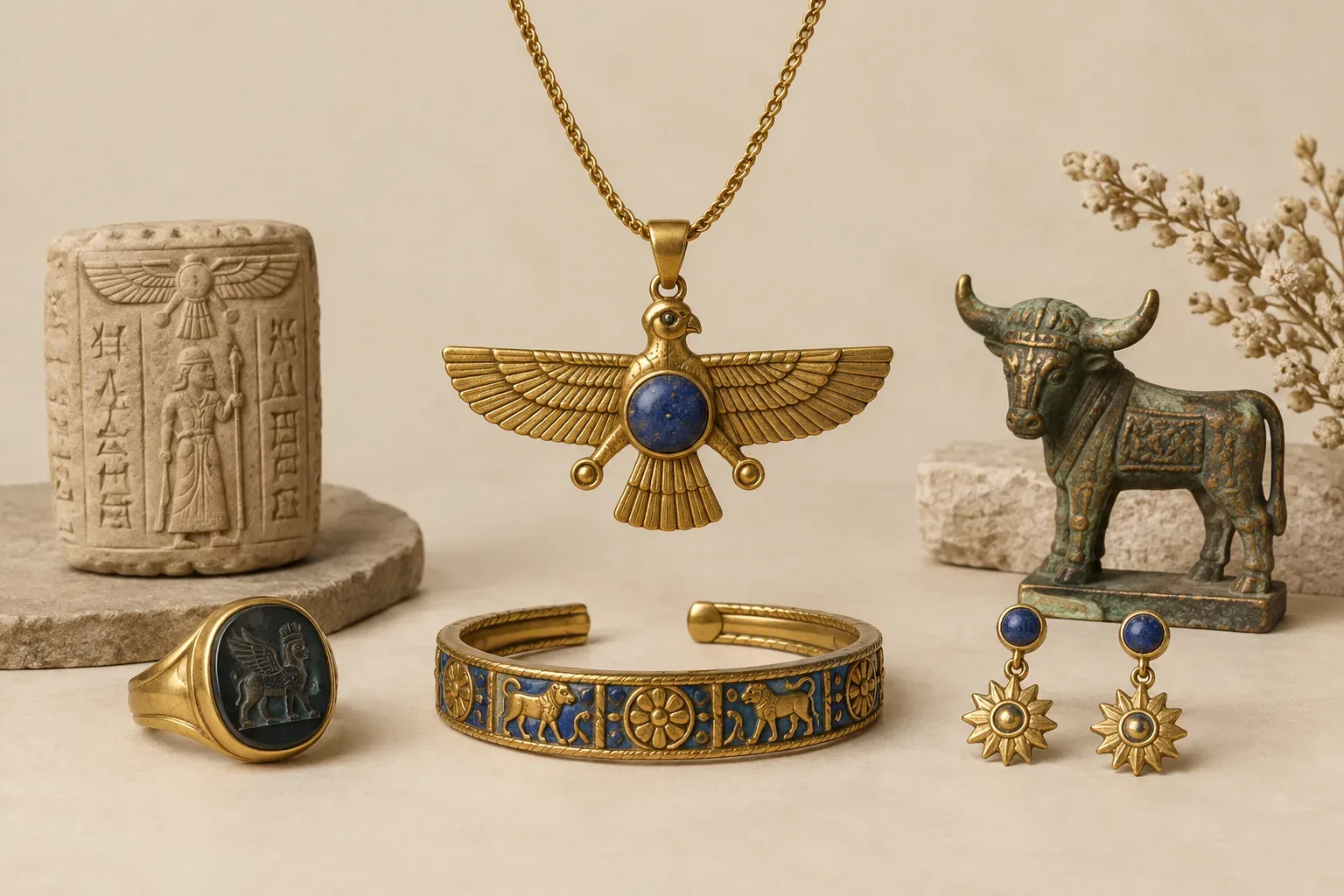
In museum collections, Mesopotamian motifs appear across a range of object types: carved cylinder seals, bead necklaces, gold earrings, inlaid plaques and metalwork. Motifs include geometric patterns, stylised plants, rosettes, animals and composite beings. These motifs occur in both organic materials (shell, ivory) and worked metals and stones. The Victoria and Albert Museum's exhibition materials and articles on jewellery history document how these motifs were part of broader decorative repertoires and how they were adapted in craft techniques over time.
Specific gemstones and materials commonly associated with ancient Mesopotamian jewelry are represented in museum descriptions and in gemstone reference guides. Lapis-lazuli, carnelian, agate and various semi-precious stones are frequently found in beadwork and inlays, and goldsmithing is a well-attested practice in the archaeological record. The V&A's 'An A–Z of Gemstones' provides historical context for how certain stones were valued and used in jewellery-making and trade, and notes that stone choice could indicate trade links, wealth, or symbolic preference in different periods.
In the modern commercial and craft markets, designers reuse these ancient motifs in contemporary settings: pendants that echo a carved seal, rings and cufflinks with stylised rosettes or winged figures, and necklaces that combine lapis or carnelian with modern metalwork. Such pieces range from archaeological reproductions to freely interpreted designs influenced by Mesopotamian artistry. When ancient motifs are used today, material choices, manufacturing techniques and presentation often change the perceived function from ritual or status marker to personal adornment or fashion statement.
Practical and respectful selection or gifting guidance
If you are choosing or gifting jewelry with Mesopotamian symbols, begin by clarifying your intent: are you seeking historical authenticity, symbolic resonance, or simply an attractive design? If historical authenticity matters, prioritize pieces from reputable museum sources, certified antiques dealers, or jewelers who document their design sources and provenance. Museum descriptions and exhibitions such as those by the Victoria and Albert Museum help you identify historically grounded motifs and techniques.
Check material disclosure and treatment information. When buying gemstones, expect transparent information about treatments, imitations, or enhancements: governmental guidance such as the Federal Trade Commission's guidance on buying gemstones, diamonds and pearls explains why dealers should disclose treatments and how consumers can verify what they are purchasing. Ask sellers for written confirmation when treatments or composite materials are present.
Consider cultural sensitivity and avoid claiming a single, ancient 'meaning' for any symbol. If you wish to highlight historical connections, say that a piece is 'inspired by' or 'referencing' Mesopotamian motifs and, where appropriate, reference the culture (for example, Sumerian or Assyrian) connected with a design. When giving a gift, explain whether the gesture refers to an aesthetic appreciation of ancient art, a specific historical idea, or a modern personal meaning, so the recipient understands the context you intend.
For budget and durability, know that traditional materials like gold and lapis-lazuli differ in cost and care from modern alternatives such as gold vermeil and dyed stones. If authenticity or longevity is important, confirm metal karat, gemstone identity and whether stones are natural or treated. If you value ethical sourcing, ask sellers about sourcing and any conflict-free assurances; reputable dealers and museum shops can often provide this information or direct you to certified options.
If you want a faithful reproduction for study or display, look for jewelers who base designs directly on catalogued museum pieces and who cite their sources. If you prefer a contemporary reinterpretation, choose designers who acknowledge the inspiration and avoid marketing claims that conflate modern meanings with documented ancient beliefs.
Final considerations
Mesopotamian jewelry symbols are rich in visual language because they were developed over centuries and used by different societies within the Mesopotamian region. Museum collections and interpretive work, especially as presented by the Victoria and Albert Museum, are the principal evidentiary base for identifying motifs, materials and social roles. The modern revival or reuse of these symbols is creative and legitimate, but it is different from the specific social or ritual meanings recorded in archaeological contexts.
When wearing or giving Mesopotamian-inspired jewelry, a respectful approach acknowledges historical nuance, avoids universalizing ancient meanings, and prioritizes transparent information about materials and provenance. Doing so honours both the original cultural contexts and the modern wearer’s personal expression.
Frequently asked questions
Are Mesopotamian jewelry symbols universally the same across ancient Mesopotamia?
No. Museum evidence indicates that motifs and their uses varied across cultures and periods within Mesopotamia. Sumerian, Akkadian, Babylonian and Assyrian contexts each have distinct artistic traditions, and museums such as the Victoria and Albert Museum stress that meanings and functions changed over time.
Can I assume a particular symbol had a religious meaning in ancient Mesopotamia?
Not automatically. Some motifs are found in ritual or cultic contexts and may be associated with divinity or protection according to museum records, but the same symbol can appear in secular or administrative objects. Always check the object’s archaeological context in museum catalogues before attributing a single religious meaning.
Which gemstones were commonly used in Mesopotamian jewelry?
Museum descriptions and gemstone reference guides such as the Victoria and Albert Museum’s 'An A–Z of Gemstones' note that stones like lapis-lazuli, carnelian and agate appear in ancient Mesopotamian beadwork and inlays, often alongside worked metals such as gold.
How should I verify what I’m buying when purchasing a Mesopotamian-inspired piece?
Ask the seller for clear disclosure about materials, treatments and provenance, and look for written confirmation. The U.S. Federal Trade Commission recommends that dealers disclose gemstone treatments and any imitations, so use those guidelines when evaluating authenticity and value.
Is it respectful to wear Mesopotamian motifs as fashion items?
Yes, provided you avoid claiming inaccurate ancient meanings and show awareness of historical context. If a piece is inspired by a specific culture, identify that culture and, when relevant, prefer makers who acknowledge sources and provenance.
Where can I find historically accurate reproductions?
Look for museum shops, reputable dealers or craftspeople who cite museum pieces and provide provenance or reproduction notes. Museum exhibitions and catalogues, such as material from the Victoria and Albert Museum, are useful references when seeking historically grounded designs.
Sources and further reading
- Bedazzled: A History of Jewellery — Victoria and Albert Museum
- An A-Z of Gemstones — Victoria and Albert Museum
- Buying Gemstones, Diamonds, and Pearls — Federal Trade Commission