Meaning at a glance
Museum scholarship shows Mesopotamian jewelry used specific materials and motifs to signal status, religious role, and regional connections across Sumerian, Akkadian, Babylonian and Assyrian contexts; modern uses of the motifs are largely personal reinterpretations. This article separates documented historical evidence from later meanings, explains how motifs and gemstones appear in wearable objects, and gives practical, respectful selection and gifting advice grounded in museum and consumer-protection guidance.
What the historical evidence shows (and where it comes from)
Our understanding of Mesopotamian jewelry comes primarily from archaeological collections, museum cataloguing and object studies that place items in funerary, temple and domestic contexts. The Victoria and Albert Museum frames this kind of evidence as part of a wider history that links jewellery to changing social contexts rather than a single fixed meaning, and its exhibitions and articles show how museums interpret ancient objects through provenance, material study and comparative typology.
Scholars working with material culture separate finds by culture and context: broadly speaking, objects attributed to Sumerian city-states (often excavated from southern Mesopotamia), Akkadian-period assemblages, Babylonian contexts and Assyrian workshop and palace groups show differences in style, manufacture and typical use. Museums and catalogues group objects by these cultural or archaeological attributions so that viewers can see how designs and materials vary with region and elite practice, and how the social role of jewellery shifts between civic, royal and religious settings.
Materials and techniques documented by museum collections
Ancient Mesopotamian jewellery is documented in museum collections as combining metals and a wide range of inlaid and drilled materials. Metalwork—predominantly gold, silver and copper alloys—appears alongside worked stones and manufactured materials. Museum overviews of jewellery history and of specific gemstones help interpret these assemblages by identifying lapidary types, glazing techniques and trade networks that supplied raw materials.
Museum-based studies emphasize technical evidence: sheet and cast metalwork, granulation and filigree-like decoration where present, bead-stringing and drilled inlay work, and the use of glazed faience and other man-made materials. This technical picture helps explain why jewellery functions as a social marker: the time, skill and imported materials visible on an object are the kinds of details museums use to justify attributions of status or specialized production.
Motifs, documented meanings, and later interpretations
Museums anchor meaning to context: when jewellery appears in royal tombs or temple deposits, curators and archaeologists interpret a role connected to status, office or ritual. The Victoria and Albert Museum, in its presentations of jewellery history, underscores that meanings shift with social context, and that labels such as "status" or "votive" reflect interpretation of find contexts rather than guaranteed, universal symbolism.
Separately, many motifs or materials that appear on ancient Mesopotamian objects have been reinterpreted in modern times. Contemporary designers, spiritual movements and popular descriptions frequently assign protective, astrological or spiritual properties to ancient forms; those modern attributions are personal or cultural reuses rather than documented ancient beliefs unless specifically supported by textual or contextual evidence. Always treat modern claims about ancient religious functions cautiously unless a museum catalogue or primary source explicitly supports them.
How motifs and gemstones appear in wearable pieces
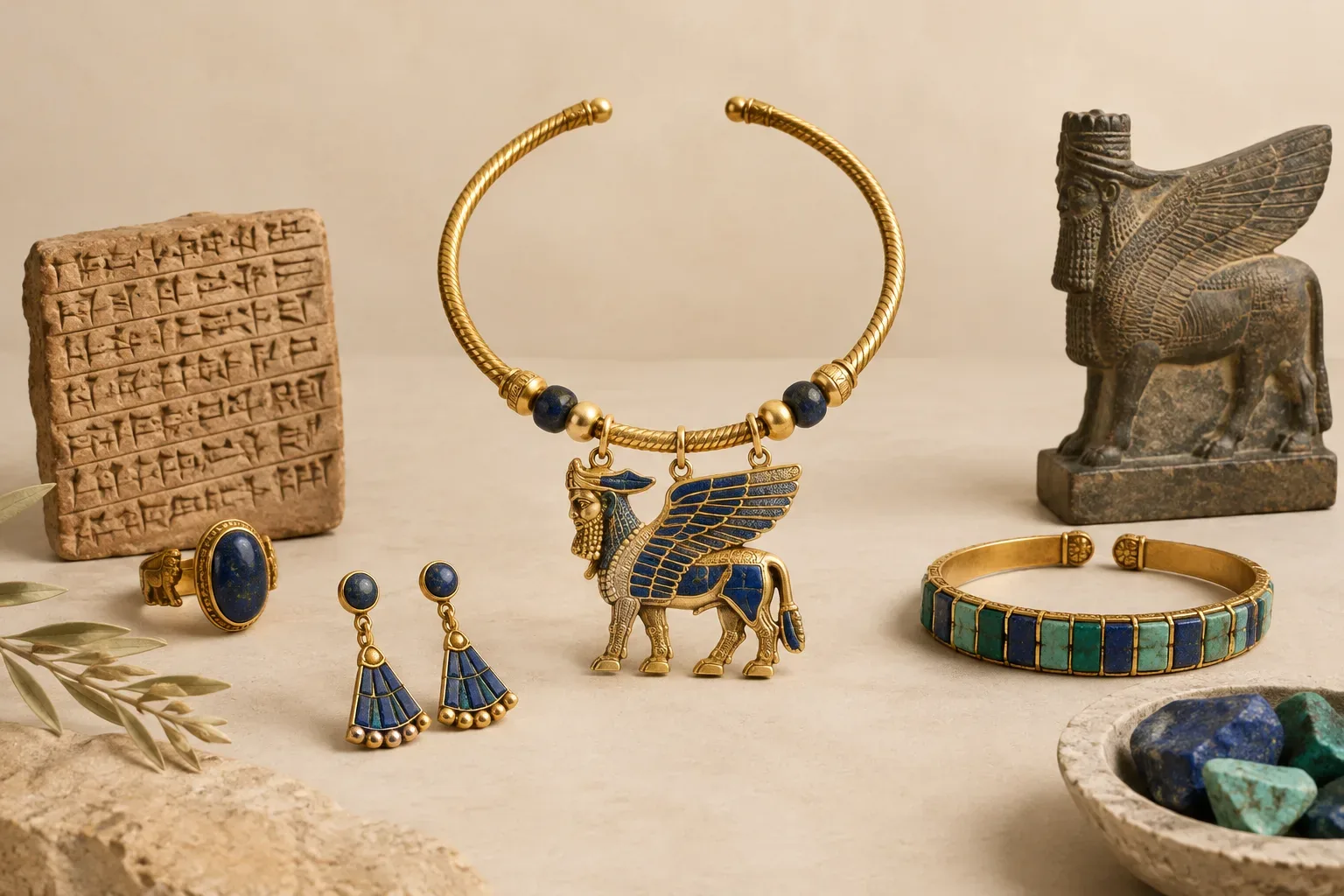
In wearable objects, motifs and materials appear in several consistent ways that museums use for identification. Motifs—whether geometric rosettes, animal figures, or stylized vegetal forms—may be stamped or chased into metal, modelled in relief, or set as inlays. Stones and glazed materials commonly appear as drilled beads, inlaid cabochons, or components of composite pendants and collars.
Gemstones and manufactured materials are also telling. Museum discussions of gemstones emphasize identification and historical context: some materials travel long distances and their presence in an object indicates trade connections, while locally produced materials or faience signal local technologies. Where available, museum object entries and gemstone guides help separate natural stones from imitations and explain common working techniques used to incorporate them into necklaces, diadems, earrings and pectorals.
Practical and respectful guidance for selecting or gifting Mesopotamian-inspired jewellery
If you are choosing or gifting jewellery inspired by Mesopotamian forms, do so with attention to provenance, craftsmanship and cultural respect. Prefer pieces from sellers who explain the inspiration, note whether a piece is an archaeological original, a museum reproduction or a contemporary design inspired by ancient forms, and provide clear documentation of materials and treatments.
When buying gemstones or items advertised as ancient or having historical provenance, follow consumer-protection best practices: ask for written disclosure of any treatments, enhancements, or imitation materials, and request provenance documentation where applicable. The Federal Trade Commission provides guidance on buying gemstones, diamonds and pearls that emphasizes disclosure of treatments and honest advertising. If you value ethical sourcing and legal ownership, seek vendors who can demonstrate legal, documented supply chains or who work with reputable museum reproduction programs.
Consider cultural context when gifting. Explain why you chose the motif, whether your piece is historically accurate or a contemporary homage, and avoid claims that a modern reproduction carries the original religious power or communal authority of the object unless clear documentary evidence supports that claim. Framing a gift with information about its inspiration and about museum resources encourages appreciation without appropriation.
Caring for materials and assessing authenticity
Different materials require different care. Metalwork benefits from gentle cleaning and dry storage; drilled beads and inlays can be vulnerable to abrasion and chemicals. If a piece includes glazed faience or softer gemstones, avoid ultrasonic cleaners and harsh solutions and consult a conservator for significant or valuable objects. Museums use conservation standards to preserve objects and often publish basic care advice for owners.
To assess authenticity and value, look for clear labelling. Museum-quality reproductions or contemporary artisan pieces should be described as such. For archaeological items, require provenance paperwork and, if possible, independent certification. Modern sellers frequently offer high-quality historically inspired jewellery without claiming it is ancient; those are often the best choice for ethical collectors who want historical association without the legal and moral complications of owning excavated antiquities.
Final note on interpretation and respect
Mesopotamian jewellery history is best approached as a set of material, stylistic and archaeological facts interpreted by museum professionals and scholars. The Victoria and Albert Museum’s materials on jewellery history remind readers that objects change meaning over time and that museum interpretation is a cautious, evidence-based process. Where meaning interests you, primary museum entries and gemstone guides are the responsible starting point for learning and for choosing jewellery that acknowledges its sources.
Frequently asked questions
What evidence shows that Mesopotamian jewellery signaled social status?
Museum studies interpret jewellery found in palaces, tombs and temple deposits as indicators of rank or office when those objects occur alongside other elite goods. The Victoria and Albert Museum frames such interpretations as context-driven: the association of fine materials and skilled manufacture with elite contexts supports status-based readings.
Were specific gemstones used for religious protection in ancient Mesopotamia?
Claims that particular stones had religious protective properties must be supported by textual or contextual evidence; museum scholarship treats such functions cautiously and generally attributes ritual or votive uses when objects occur in temple or votive contexts rather than assigning universal spiritual properties to materials.
How can I tell if a Mesopotamian-style piece is an authentic antiquity or a modern reproduction?
Authentic antiquities should come with provenance documentation and, for high-value items, independent certification; reputable sellers will clearly label reproductions. For guidance on material disclosure and common treatments, the FTC’s consumer advice on buying gemstones, diamonds and pearls is a useful resource.
Is it cultural appropriation to wear jewellery inspired by Mesopotamia?
Wearing historically inspired jewellery is not inherently disrespectful, but cultural respect improves when the wearer acknowledges the source, purchases from ethical makers, avoids claiming sacred attributes without evidence, and chooses pieces transparently labelled as modern or reproduced rather than presenting them as ancient relics.
How should I care for jewellery that uses materials common to ancient Mesopotamia?
Care depends on materials: metalwork benefits from dry storage and gentle cleaning, while glazed faience and softer gems should avoid ultrasonic cleaners and harsh chemicals. When in doubt, consult a conservator or follow museum care recommendations for similar materials.
Where can I learn more about specific Mesopotamian objects and their contexts?
Start with museum catalogues and exhibition materials that document find contexts and technical details. The Victoria and Albert Museum’s resources on jewellery history and gemstones provide accessible, evidence-based introductions to material and contextual study.
Sources and further reading
- Bedazzled: A History of Jewellery — Victoria and Albert Museum
- An A-Z of Gemstones — Victoria and Albert Museum
- Buying Gemstones, Diamonds, and Pearls — Federal Trade Commission