Meaning at a glance
This article explains the documented history and changing contexts of mesopotamian jewelry techniques, distinguishes archaeological and museum evidence from later popular interpretations, describes how motifs and gemstones appear on objects, and offers practical guidance for selecting or gifting jewelry inspired by Mesopotamia.
Direct answer — the concise thesis
Museums and scholarship document a set of technical practices, material choices, and trade patterns associated with ancient Mesopotamian jewelers, and those practices have been repurposed in later designs; this article explains that documented history and changing contexts, separates cultural or religious evidence from modern interpretations, and gives practical guidance for choosing and wearing the motif in contemporary jewelry. The account that follows draws on museum research and authoritative consumer guidance to stay within documented evidence.
What the historical evidence shows and which cultures and periods it covers
Archaeological finds, museum collections, and exhibition scholarship provide the primary evidence for how jewelry was made, worn, and traded in ancient Mesopotamia. The Victoria and Albert Museum frames jewellery history as a sequence of changing social contexts and techniques, and museums preserve the material traces that underpin our understanding of Mesopotamian craftsmanship. When discussing the region we mean the cultural landscapes often labeled in modern scholarship as Sumerian, Akkadian, Babylonian, and Assyrian, as well as later Neo-Assyrian and Neo-Babylonian periods, each of which contributed to the archaeological record that museums study and display.
Objects in museum collections show repeated technical approaches and material combinations across these periods. Evidence commonly cited in museum literature includes worked gold and silver, beads and necklaces, inlays and intaglios, and items made from faience and worked stone. Collections and exhibitions interpret those objects in their social contexts rather than presenting a single, unchanged 'Mesopotamian' style. That interpretive work is what allows us to say, with museum-based caution, that certain techniques and materials recur in the region’s artefacts.
Documented techniques, materials, and the role of trade
Museum descriptions and curatorial overviews identify a set of recurring techniques in ancient Mesopotamian jewellery: bead-making and stringing, metalworking that includes hammering and shaping sheet metal, casting for small elements, granulation and applied decoration, inlay work combining stone, shell, and glassy materials, and the production of glazed faience. These techniques are visible in the material remains conserved by museums and summarized in exhibition narratives about jewellery history.
The available gemstones and decorative materials tell a parallel story of exchange. Gemstones and semi-precious materials commonly found in Mesopotamian objects include deep-blue materials often identified in museum inventories, warm-red chalcedony and carnelian, agates, and worked shells and faience. Museum resources on gemstones place such materials in a broader historical context and note that long-distance networks brought materials to Mesopotamian workshops. In short, technique and trade are linked: artisans used both local metals and imported stones, and museums interpret many objects as evidence of far-reaching exchange.
How motifs and meanings are documented — and how later interpretations differ
Museum labels and scholarly descriptions typically describe motifs as they appear on objects — for example, stylized animals, rosettes, geometric patterns, and cylinder seals that bear scenes and inscriptions. Those sources emphasize contextual evidence: who wore the object, where it was found, and any inscriptions or iconography that help associate an object with royal, funerary, or ritual contexts. The Victoria and Albert Museum highlights how jewellery’s social meanings change over time and depend on context rather than assuming an intrinsic, unchanging symbolism.
Modern popular accounts sometimes project universal spiritual or protective meanings onto motifs seen in Mesopotamian objects. Those later interpretations are cultural reuses or reinventions and should be treated as contemporary meanings rather than as documented ancient beliefs. Where museum documentation links a motif to an ancient ritual, political identity, or funerary practice, that link is based on archaeological context and curatorial interpretation; where no such context exists, modern symbolic attributions are modern personal or commercial interpretations rather than direct continuations of ancient religious doctrine.
How the motif, gemstone, and tradition appear in jewellery objects
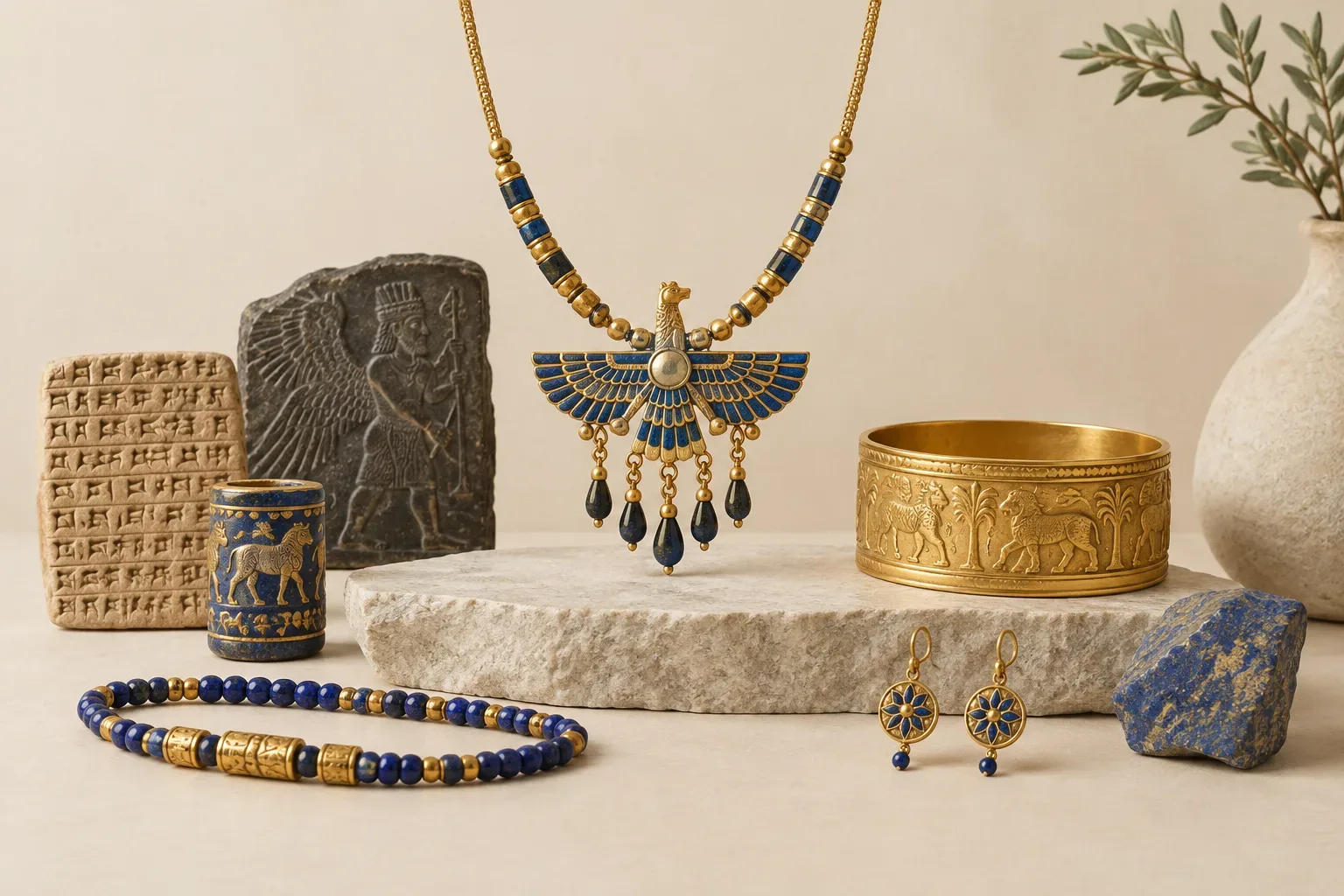
Motifs appear in a range of forms across surviving artefacts. Cylinder seals carry miniature scenes and are often strung on necklaces; rosettes and geometric bosses decorate metalwork; animal figures and anthropomorphic forms occur as pendants, appliqués, or seal impressions. These appearances are what museums and researchers record in object catalogues and exhibition texts when assigning typologies and describing function.
Gemstones and materials feature in both simple and elaborate combinations. Museum accounts of historic gemstones explain how lapis-like blue materials, red chalcedonies, and various agates were used as intaglios, beads, and inlay. Faience provided a low-cost, vividly coloured substitute for some stones and was often glazed in blues and greens. The visual effect in a finished object comes from a deliberate joining of technique, material and motif — for example a gold necklace with inlaid stone beads or a pendant with a carved stone set into a metal surround — and museums document many such pairings in their collections.
How to choose or gift jewellery inspired by Mesopotamian techniques and designs
If you are choosing or gifting jewellery inspired by Mesopotamian techniques and motifs, do so with attention to provenance, labeling, and respectful usage. Museums and curators emphasize the value of contextual knowledge: if an item is marketed as an 'antique' or 'ancient' Mesopotamian piece, ask for documentation from the seller. Reputable sellers will provide clear provenance statements and condition reports. The Victoria and Albert Museum’s approach to jewellery history underscores that meaning accrues from context; asking questions about context is part of responsible collecting.
Respectful gifting also means distinguishing between authentic antiquities and modern designs that are 'inspired by' Mesopotamian art. If the piece is a modern creation, consider its maker’s acknowledgement of inspiration and whether the design attributes or claims ancient ritual significance. Modern interpretations can be meaningful, but they are contemporary layers, not certified continuations of ancient religious practice.
For gemstone identification and treatment disclosure, follow consumer-protection guidance. The Federal Trade Commission recommends that buyers ask about treatments, synthetics, and imitations and that sellers disclose such facts. If a buyer wants an effect similar to a museum piece, inquire whether the stone is natural, treated, or synthetic and ask for any available documentation. Ethical sourcing and transparent treatment disclosure are as important today for trustworthy enjoyment as museum cataloguing is for scholarship.
Practical considerations on authenticity, conservation, and cultural sensitivity
Authentic ancient Mesopotamian jewellery is rare and typically found in museums or in properly documented private collections. When considering purchases, verify provenance and prefer items accompanied by expert reports. Museums and academic catalogues are the baseline for verifying authenticity; asking for a professional appraisal is prudent.
Think about cultural sensitivity before wearing or gifting motifs with religious or funerary associations. The archaeological record that museums interpret can include objects connected to ritual or elite identity. Wearing a replica or motif inspired by a funerary or sacred object without acknowledging its context can be distressing to some people with cultural ties to the region. A respectful approach includes clear labeling, education about the object’s source and context, and an awareness that contemporary symbolic readings are modern.
Frequently asked questions
What are typical Mesopotamian jewellery techniques?
Museum evidence shows that typical techniques include bead-making and stringing, metalworking such as hammering, casting and applied decoration, inlay of stone and shell, and the production of glazed faience. These practices are documented in museum collections and exhibition narratives that study ancient material culture.
Which gemstones are associated with Mesopotamian objects?
Collections and museum resources commonly identify deep-blue materials, carnelian and other chalcedonies, agates, shells and faience among materials used in Mesopotamian objects. Museum accounts place these gemstones in the context of long-distance trade that brought non-local materials into Mesopotamian workshops.
How can I tell if a piece is a genuine ancient object?
Authentic ancient pieces are rare and should have clear provenance documentation. Museums and specialists base authenticity on archaeological context, scientific analysis and published cataloguing. If you are considering a purchase, ask for provenanced records and an expert appraisal rather than relying on seller descriptions alone.
Is it appropriate to wear motifs from Mesopotamian jewellery?
Wearing motifs from Mesopotamian art can be appropriate if done respectfully and transparently. Distinguish between genuine antiquities and modern pieces inspired by ancient designs, acknowledge the source and context, and be sensitive to possible cultural or religious associations the motif may have for descendant communities.
What should buyers ask about gemstones and treatments?
Follow consumer guidance by asking sellers to disclose whether stones are natural, treated, synthetic, or imitations. The Federal Trade Commission recommends that buyers request clear information about treatments and provenance, and that sellers provide transparent disclosures about the material's nature.
Sources and further reading
- Bedazzled: A History of Jewellery — Victoria and Albert Museum
- An A-Z of Gemstones — Victoria and Albert Museum
- Buying Gemstones, Diamonds, and Pearls — Federal Trade Commission