Meaning at a glance
Medusa jewelry may refer to the ancient gorgoneion, a confronting image commonly interpreted as apotropaic, or to modern themes such as defiance, survival, and female power. Because Medusa's stories and appearance changed across periods, no single meaning should be presented as universal or timeless.
The short answer: Medusa jewelry has several layers
A Medusa pendant, ring, or earring can carry more than one message. In ancient Greek and Roman art, the frontal Gorgon head—called a gorgoneion—was widely used as a forceful image that could confront danger. Modern wearers may instead choose Medusa for resilience, anger, independence, survival, or resistance to being controlled. These readings can coexist, but they come from different historical settings.
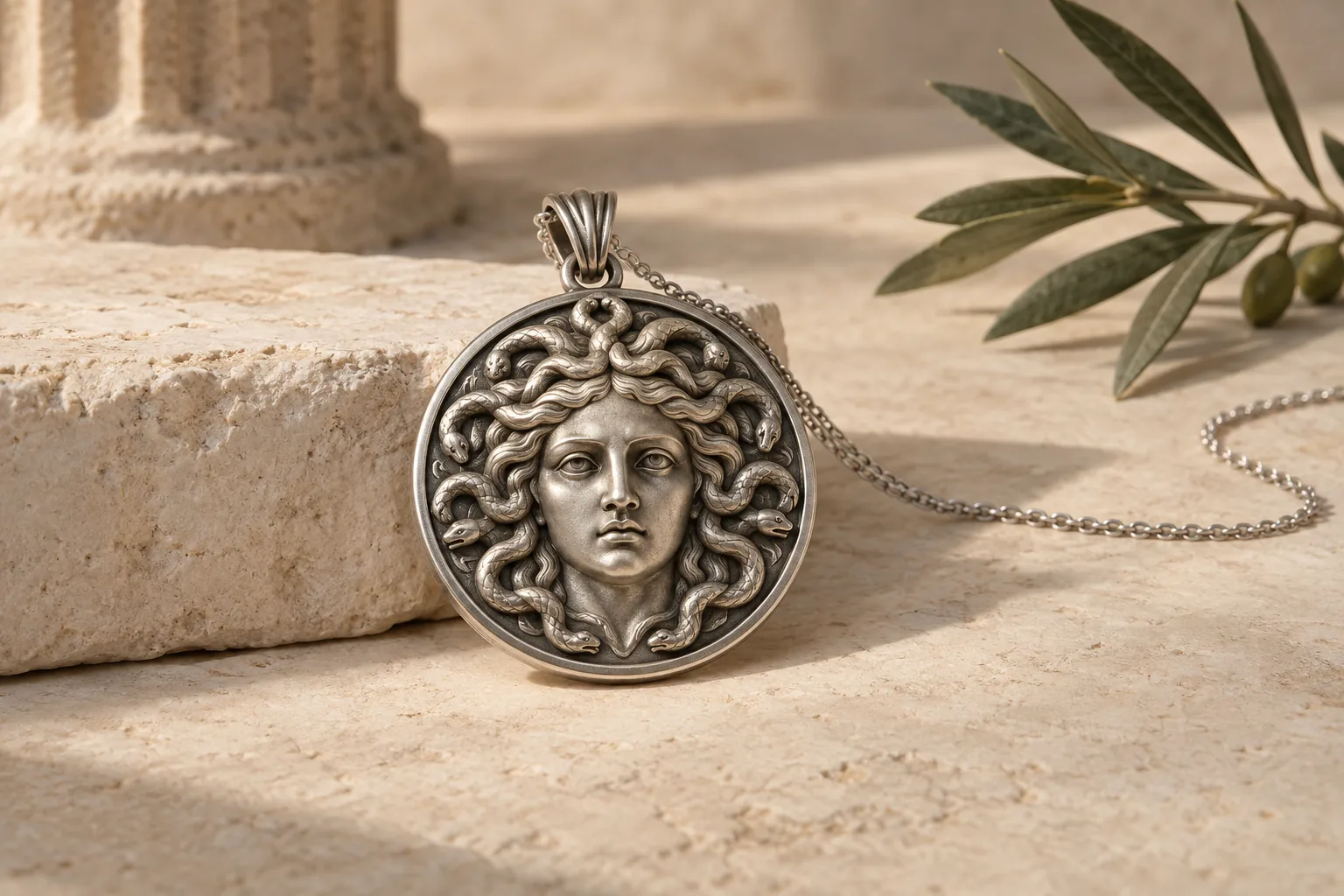
The safest way to understand the motif is to ask two questions: which Medusa image is being used, and which tradition does the explanation describe? A round, staring Gorgon face resembles the ancient gorgoneion more closely than a contemporary portrait of a beautiful woman with flowing snakes. A product description that moves between the two without explanation may be selling a mood rather than presenting history.
Medusa jewelry should not be described as guaranteeing supernatural protection. It can function as a personal reminder, a reference to ancient apotropaic imagery, or a statement about a modern experience. Clear wording allows the wearer to value the symbol without converting belief or artistic tradition into an unsupported promise.
Who was Medusa in ancient Greek tradition?
Medusa was one of the three Gorgon sisters. In Hesiod's account, she alone was mortal, while Stheno and Euryale were immortal. The best-known story follows Perseus, who approaches with divine assistance, avoids her deadly gaze by using a reflective shield, and removes her head. Pegasus and Chrysaor emerge after her death, and the Gorgon head eventually becomes associated with Athena's aegis.
There is no single ancient biography that contains every familiar detail. Greek poets and artists emphasized different episodes and features. A much later account by the Roman poet Ovid presents Medusa as a beautiful woman whose encounter with Poseidon in Athena's temple leads to her transformation. That influential version should not be projected backward as the only or earliest Greek story.
The differences matter when jewelry is sold as historically authentic. An ancient-style gorgoneion refers primarily to a visual tradition of the Gorgon face. A modern portrait may draw more heavily on later literature, Renaissance art, cinema, fashion, or contemporary social interpretation. Both can be meaningful, but they are not the same historical object.
The gorgoneion as a protective image
The Metropolitan Museum of Art describes the gorgoneion as a prolific motif and notes that Medusa is commonly interpreted as apotropaic—an image intended to turn away or repel harm. Her terrifying face could act as a threat against other threats. The idea is paradoxical: danger is displayed in order to deter danger.
The motif appeared in architecture, pottery, armor, metalwork, and personal ornaments. The circular shape of the staring head suited shields, vessels, pendants, earrings, and rings. On armor and Athena's aegis, the direct gaze and monstrous features communicated force. On jewelry, the same compact image could be carried on the body, although the exact intention of every surviving object cannot be known from appearance alone.
Calling the gorgoneion protective is historically grounded when carefully phrased. Claiming that a modern necklace will literally prevent harm is not. A responsible description might say that the design refers to ancient apotropaic imagery or that the wearer uses it as a personal reminder of strength and boundaries.
How Medusa changed from monster to beautiful woman
Archaic representations could show a broad frontal face with glaring eyes, a protruding tongue, teeth or tusks, and sometimes a beard. These images do not always match the elegant snake-haired woman familiar from modern popular culture. Their combination of human, animal, masculine, and feminine features made the Gorgon unsettling and immediately recognizable.
From the Classical period onward, artists increasingly humanized and feminized Medusa. Her face became calmer and more conventionally beautiful even while supernatural features and the dangerous gaze remained. The Met's Dangerous Beauty exhibition traced this transformation and showed that visual change is part of Medusa's history rather than a later error that can be reduced to one explanation.
Modern jewelry inherits this long visual range. Some pieces revive a fierce mask; others show an idealized woman's profile surrounded by snakes. The first may emphasize warning or protection, while the second may invite readings about beauty, danger, injustice, or autonomy. Design details influence interpretation, so the seller should show the piece clearly and avoid presenting one modern form as the only authentic Medusa.
Modern meanings: survival, defiance, and female power
Today Medusa is often used as a symbol of refusing silence, surviving violence, reclaiming anger, or resisting the way powerful women are labeled dangerous. These interpretations respond to later versions of her story as well as to modern debates about gender, control, and victim-blaming. They can be deeply important to a wearer, but they are contemporary uses of an ancient figure.
Not every person wearing Medusa jewelry is making the same statement. Someone may be interested in classical art, identify with the idea of guarded boundaries, enjoy the visual tension between beauty and threat, or simply prefer the design. It is intrusive to assume that the wearer is disclosing trauma. Meanings related to sexual violence or survival should be discussed sensitively and never assigned to another person without consent.
The motif also appears in fashion and branding, where its meaning may depend more on identity, luxury, spectacle, or visual recognition than on a specific myth. A useful guide separates personal interpretation, modern culture, and ancient evidence rather than ranking one as the only legitimate reason to wear the image.
How to choose and wear Medusa jewelry thoughtfully
Start with the design. Decide whether you want an ancient-style gorgoneion, a narrative scene with Perseus or Athena, or a modern portrait. Ask the seller what inspired the piece and whether words such as Greek, Roman, protective, or feminist describe documented references or only marketing. If historical accuracy matters, compare the design with museum objects and scholarship.
Check ordinary jewelry facts as carefully as symbolic claims. Confirm the metal, finish, dimensions, weight, chain, clasp, stone identity, treatment disclosure, care instructions, and return policy. A detailed close-up can make a pendant appear much larger or heavier than it is. If the face contains fine relief, consider how easily the recesses can be cleaned and whether plating will wear on raised areas.
Think about context when giving the motif as a gift. Medusa can be empowering, but her story includes violence and decapitation, and modern survivor meanings may be emotionally charged. Choose it for someone who already connects with the image or explain your intention without telling them what their experience should mean. A neutral message about courage, boundaries, or an interest in classical art is often more respectful than a dramatic claim.
What the symbol can mean to you
A historically informed interpretation does not remove personal meaning. It gives the wearer better choices. You might value the ancient gorgoneion as a confronting image that turns danger back on itself, the changing face of Medusa as evidence that stories are continually reshaped, or a modern portrait as a statement of autonomy.
Keep the wording precise: the ancient motif was used in apotropaic contexts; modern jewelry can represent protection to its wearer; no pendant can promise physical safety. Early Greek traditions, Ovid's later Roman version, and contemporary feminist or survivor readings should be named separately. This structure respects both historical evidence and present-day experience.
The strongest Medusa jewelry meaning is therefore not a single slogan. It is a transparent relationship among the object, the history it references, and the reason a person chooses to wear it. That approach makes room for protection, warning, beauty, anger, endurance, and personal style without pretending they all meant the same thing in antiquity.
Frequently asked questions
What does Medusa jewelry symbolize?
It may reference the ancient apotropaic gorgoneion or express modern ideas such as boundaries, survival, defiance, and female power. The intended meaning depends on the design, context, and wearer.
Was Medusa a protection symbol in ancient Greece?
The Gorgon head was widely used in apotropaic contexts and is commonly interpreted as an image intended to repel danger. That history does not mean a modern pendant can guarantee literal protection.
Did ancient Medusa always have snakes for hair?
No. Her appearance changed over time. Archaic images could include glaring eyes, tusks, a tongue, wings, or a beard, while later art increasingly humanized and feminized her. Fully serpentine hair became especially prominent in later traditions.
Is Medusa jewelry a feminist symbol?
It can be used that way today, especially in readings about autonomy, anger, survival, or resistance to victim-blaming. That is a modern interpretation and should be distinguished from ancient uses of the gorgoneion.
Sources and further reading
- Medusa in Ancient Greek Art — The Metropolitan Museum of Art
- Everything You Know About Medusa Is Wrong — J. Paul Getty Museum
- Dangerous Beauty in the Ancient World and the Age of #MeToo: An Interview with Curator Kiki Karoglou — The Metropolitan Museum of Art