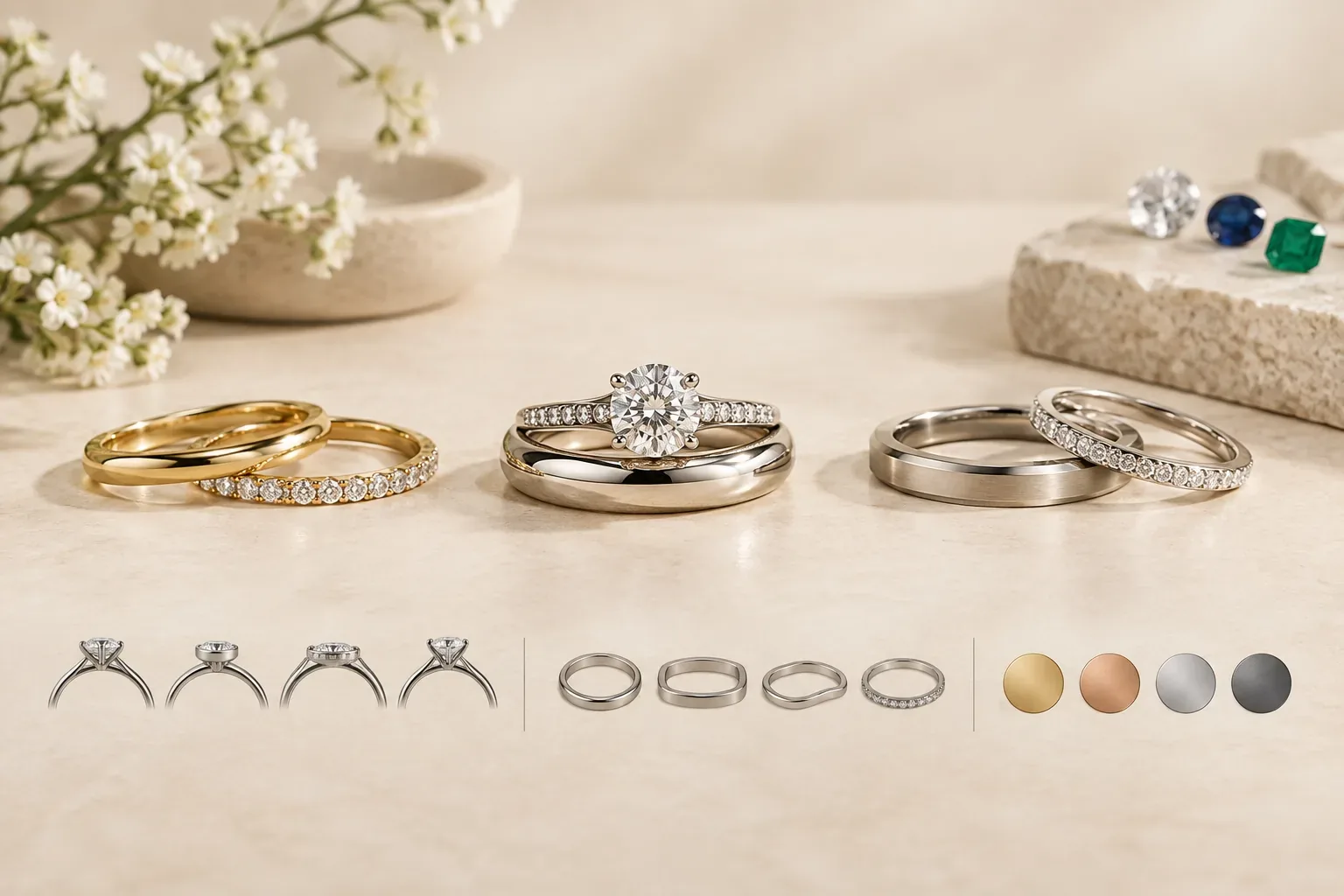
Meaning at a glance
This guide answers the search intent behind "low-profile setting wedding band pairing" by defining low-profile settings, listing decision criteria (shape, gap, metal, comfort, durability), explaining practical trade-offs, outlining safe care and verification limits, and giving selection and gifting guidance supported by consumer and gem-treatment sources.
What we mean by a low-profile setting
A low-profile setting typically places the gemstone and its supporting structure close to the finger plane to reduce snagging and to present a flatter silhouette. In practice this means shorter prongs, bezel or flush treatments, or tension-style settings that keep the center stone within the band’s visual plane. The choice of setting directly affects how a wedding band will sit against the engagement ring because low-profile settings reduce vertical clearance but can widen lateral gaps where the rings meet.
Historical evidence and cultural context
This article is focused on practical pairing today; the approved sources used here are recent industry and regulatory publications rather than primary historical studies. Jewellery histories commonly note that simple metal bands were used in many cultures, including ancient Roman betrothal rings, medieval European posy rings, and Victorian-era matched sets, but that level of historical documentation is outside the scope of the present evidence list. Readers seeking primary-source historical citations should consult museum catalogues and specialized jewelry histories.
Documented historical meanings versus modern personal interpretations
Where there is documented historical meaning—such as specific inscriptions on medieval posy rings or Roman betrothal practices—those are cultural artifacts recorded by historians. Modern meanings attached to ring shapes, low-profile settings, or stacking arrangements are personal and market-driven trends rather than universal symbols. For contemporary consumer trends and the ways people style rings today, Jewelers Mutual identifies demand centers such as modern stacking, gender-neutral styling, and versatility, which explain why low-profile pairings are popular for everyday wear.
How motifs, gemstones, and traditions show up in low-profile jewelry
Motifs and traditions appear in low-profile jewelry as engraved patterns on the band face or inner shank, small flush-set accent stones, and bezel or flush settings that protect gems and keep surfaces smooth. Colored gemstones and modern stacking—documented as current demand by Jewelers Mutual and market visibility data referenced by Imaginaire Digital—are often combined with low-profile settings to keep multiple rings comfortable for continuous wear. Gemstone treatments and their care implications are summarized by the Gemological Institute of America and remain critical: certain treatments change durability and cleaning needs.
Shape and gap considerations: decisions and trade-offs
When pairing a wedding band to a low-profile engagement ring, consider the engagement ring’s profile, shoulder shape, and pavilion projection. A straight wedding band will show a gap if the engagement ring has angular shoulders or a raised center even with a low-profile head. Contoured bands that mirror the engagement ring’s curve close gaps visually but require precise fitting and may limit future resizing options.
Decide whether minimizing the visible gap is more important than comfort or future flexibility. Flush or bezel settings minimize snagging but can make the engagement ring edge thicker horizontally, creating wider contact areas that can feel tight with a straight band. Slim stacking bands emphasize the central stone and keep lateral gaps smaller, but they will show and accumulate dirt in the narrow channel between rings.
Metal choices and practical trade-offs
Choose metals by balancing scratch resistance, color stability, and maintenance. Platinum is durable, hypoallergenic, and resists loss of metal when worn daily but can develop a patina and is more costly. Gold alloys (18k, 14k) vary: higher karats are softer and scratch more easily; lower karats increase hardness but change color. Tungsten and cobalt offer high scratch resistance but are difficult to resize and can be heavier. Precious metal plating hides base-metal color differences but will wear and require re-plating over time.
If matching color exactly is important, select the same metal family and finish. If you choose different metals for contrast, account for differential wear: softer metals next to harder metals will show wear faster. Jewelers Mutual’s trend reporting suggests consumers value versatility and craftsmanship; selecting reputable fabrication with tight tolerances reduces the chance of an unsightly gap or rubbing.
Practical selection and gifting guidance
Measure the engagement ring’s shoulder width, curvature, and the engagement ring’s lowest point above the finger before buying or commissioning a band. If you are gifting a band and cannot access these measurements, choose an adjustable pairing strategy: a slightly tapered or contoured band that reads well with many shapes or a slim, plain band that can be resized or paired later with a custom contour.
Communicate the intended wear style to the maker: whether the wearer prefers a flush, stacked, or mixed-metal look, and whether they value daily durability over a perfect flush aesthetic. Work with a jeweler who documents finish, karat, and alloy composition in writing, because the Federal Trade Commission requires sellers to disclose distinctions among natural, lab-created, treated, and imitation materials and many consumers will want that record.
Care, maintenance, and what you can verify
Routine care for low-profile pairings is similar to other fine jewelry but with emphasis on clearing debris where rings meet. Clean gently with mild soap and warm water, and use a soft brush to remove dirt from narrow gaps. Avoid ultrasonic cleaners for treated stones unless your seller or a gemological laboratory confirms the stone’s treatment is compatible with ultrasonic cleaning. The Gemological Institute of America warns that treatments affect durability and care needs, so request treatment disclosures in writing.
What a shopper can verify without a qualified jeweler or laboratory: you can verify the ring’s hallmarks, visible manufacturer stamps, measured finger size, and the literal feel and fit of two rings together. What requires a professional is verifying stone origin, detecting many treatments, or determining exact alloy composition beyond stamped karat marks. The FTC recommends written seller disclosures for material origin and treatment; for anything beyond that, obtain a qualified jeweler’s appraisal or lab report.
Limits, verification, and recommended professional checks
A buyer cannot reliably detect many gemstone treatments, lab-grown origin, or fine differences in alloy composition by sight alone. For verified claims about a center stone or important accent gems, ask for a gemological laboratory report and an itemized seller disclosure. For custom contoured bands intended to sit flush, a professional jeweler should check fit on the actual engagement ring or create a precise cast or 3D scan so the final band closes gaps as intended.
Final selection checklist
Before purchase or commission, confirm: the engagement ring’s profile and shoulder shape, the preferred final appearance (flush, contoured, or complementary), the metal family and finish, documented disclosures for gemstones and metals, resizing policy and future maintenance needs, and whether a professional fitting or 3D scan will be used to make a custom band. These steps minimize surprises and keep the visual pairing consistent with daily comfort.
Frequently asked questions
Can a low-profile engagement ring be paired with a straight wedding band?
Yes, but expect a visible gap if the engagement ring has angled shoulders, halo elements, or a raised center. A contoured or notched band is usually required to eliminate the gap; for precise flush results, have a jeweler fit the band against the actual engagement ring or a 3D scan.
Which metals are best for daily-wear low-profile pairings?
Platinum and harder gold alloys (e.g., 14k) are common choices for daily wear because they resist deformation better than softer high-karat golds, but platinum can develop a patina and some hard metals are difficult to resize. Consider the balance of scratch resistance, color match, and future maintenance.
How can I tell if a gemstone is treated or lab-grown before buying?
A buyer should request written disclosures and a gemological laboratory report for certainty. The Gemological Institute of America notes that many treatments affect durability and care, and the FTC requires sellers to disclose material origin and treatments in writing; many treatments cannot be identified reliably by unaided visual inspection.
Is a flush or bezel setting safer for everyday wear?
Yes—flush and bezel settings reduce snagging and protect the stone’s girdle, but they change the ring’s edge profile which can increase lateral contact with a wedding band and demand a contoured match to avoid gaps.
What checks should I ask a jeweler to perform before a custom contoured band is made?
Ask for a physical fitting against the engagement ring or a precise cast/3D scan, written material disclosures, a resizing policy, and a guarantee on fit. For gemstones, request reports or documented treatment disclosures if origin or durability are material to your decision.
Sources and further reading
- Imaginaire Digital — Imaginaire Digital
- Jewelers Mutual — Jewelers Mutual
- Gemological Institute of America — Gemological Institute of America
- Federal Trade Commission — Federal Trade Commission