Meaning at a glance
Documented museum records treat labradorite as a gemstone valued for its optical display within changing jewellery fashions rather than as a widely recorded religious symbol; practical buying decisions should prioritize the strength and evenness of the stone’s optical effect, clarity and stable setting, and insist on disclosure of treatments and return protections as recommended by consumer guidance.
What the historical record actually shows
Museum scholarship and exhibition material place gemstones like labradorite within long histories of taste, technology and collecting rather than as single, universal symbolic motifs. The Victoria and Albert Museum’s resources on jewellery history and gemstones emphasize changing social contexts for gems, how tastes and cutting techniques altered display, and how natural-history interest raised awareness of new minerals, without presenting labradorite as a consistently recorded sacred or ritual stone across multiple cultures.
Specifically, the Victoria and Albert Museum documents gemstones in archaeological, decorative and collector contexts in European and North American collections across modern periods, and highlights how gemstones’ uses and meanings have shifted with fashion, industry and personal collecting. That means the best-documented aspects of labradorite in museum records concern its appearance and use in jewellery and decorative objects from the 18th century onward, and the broader phenomenon of gemstone collecting and display, rather than a continuous set of symbolic beliefs attached to labradorite in many ancient religions.
Separating documented history from modern interpretation
Documented historical evidence in museum catalogues and curatorial summaries focuses on material use, provenance and the changing role of gemstones in jewellery, not on uniform spiritual meanings. Where museums like the Victoria and Albert Museum record labradorite, they treat it as a material with attractive optical properties that designers and collectors have used in different periods and styles.
Modern metaphysical or healing claims about labradorite — for example those that assign specific emotional or protective powers — are contemporary interpretations that belong to recent personal and New Age practices, not to the established, documented ritual uses recorded in institutional collections. If you are seeking a piece because of a modern spiritual meaning, that is entirely valid as a personal choice, but it should be kept distinct from what the museum record supports as historical fact.
How labradorite appears in jewellery historically and today
In jewellery and decorative arts, gemstones have been displayed in a range of settings and forms as tastes and technologies changed. The Victoria and Albert Museum’s work on jewellery history demonstrates how stones are chosen, cut and set to showcase desirable optical effects and to match the fashion of the period.
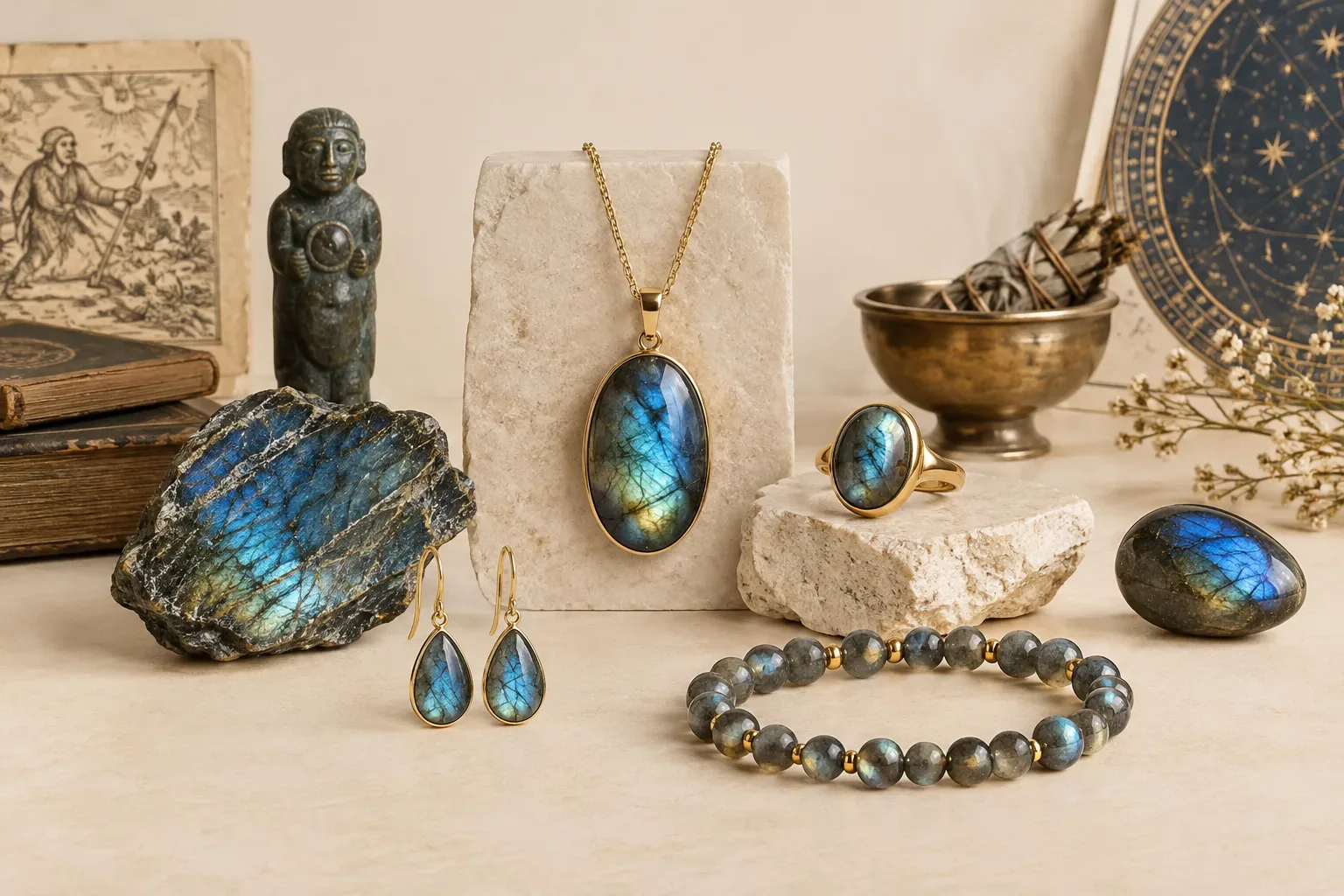
Contemporary jewellery makers typically select labradorite to exploit its color play: stones are cut, oriented and polished so that their optical shimmer is visible when the piece is viewed or worn. Designers use labradorite in pendants, earrings, brooches and beads, and the stone is often placed where movement or light will enhance its visual effect. Historically, the emphasis in museum collections is on the aesthetic and material qualities that made particular stones fashionable, rather than on a single symbolic theme.
Practical quality and value factors to evaluate when buying
Optical effect first: the most important determinant of labradorite’s attractiveness and market desirability is the strength, breadth and evenness of its color play. Look for stones with bright, easily visible flashes of color that move as the stone or light source is turned. A strong, broad band of color across the face of the stone typically commands more interest than a faint or patchy effect.
Cut and orientation: because labradorescence is directional, how the stone is cut and how it sits in a setting matter. Cuts and polishing that align the play-of-color to the piece’s face will increase visual impact. A cut that buries the optical plane or displays it only at awkward angles will reduce perceived quality.
Body color, transparency and clarity: body tone and transparency affect how colors appear. Transparent to translucent material with minimal disruptive fractures or inclusions that interrupt the color play is typically preferred. Surface polish should be even and free of scratches that scatter light and dull the effect.
Size and proportion: larger stones with strong optical effect are visually impressive and can influence price, but small stones with concentrated, brilliant flashes can be just as desirable. Value follows visual quality more than carat weight alone.
Setting and metal: because the optical effect depends on viewing angles and light, settings that allow light to reach the stone and that protect it from abrasion will both preserve appearance and extend wearability. Consider bezel or partially protective settings for everyday rings to limit edge chip risk while still showing the color play.
Treatments, imitations and disclosure: ask the seller about any treatments or stabilizing processes applied to the stone. Consumer-protection guidance from the U.S. Federal Trade Commission makes clear that sellers should disclose material treatments and whether an item is natural, treated, synthetic or an imitation. For significant purchases, insist on clear disclosure and written terms about treatments and returns.
Practical buying and gifting guidance
Buy with your priorities in mind: when choosing for yourself or as a gift, decide whether you prioritize the strongest optical effect, a particular color range, durability for daily wear, or a particular setting style. If the recipient wears rings daily, choose a setting that prioritizes protection; for pendants and earrings, prioritize visual impact and light exposure.
Ask questions and request photos or videos: because labradorescence is dynamic, ask sellers for photos and video taken at different angles or under different light. Inspect how the effect looks in motion if you can. For in-person purchases, move the stone under a light source to test how readily the color play appears.
Request disclosure and a reasonable return policy: follow consumer guidance on gemstone purchases: ask about treatments, whether the stone is natural or lab-grown, and request written confirmation of any claims. Verify the seller’s return policy and warranty before purchase, and keep written receipts and any gem reports for future resale or insurance.
Consider certification for larger purchases: for significant purchases, independent gemological reports or documentation from a known laboratory increase confidence in the stone’s description and disclosures. Museum materials underscore the value of provenance and documentation in understanding an object’s history and authenticity.
Respect the buyer’s beliefs: if you or the gift recipient values the modern symbolic meanings ascribed to labradorite, make that part of the purchase decision as a personal preference. Just be explicit when relying on contemporary spiritual or emotional associations that these are modern interpretations rather than established historical facts recorded by museums.
Care and maintenance
Protective settings and mindful wear will prolong the stone’s appearance. Clean gently with a soft cloth and mild solution suitable for most gemstones; avoid harsh abrasives and rapid temperature changes that may stress the material. Store pieces separately to avoid scratches and check settings periodically to ensure security.
If you are unsure about cleaning or repair, consult a professional jeweller experienced with decorative gemstones. The Victoria and Albert Museum’s approach to jewellery conservation reinforces the importance of professional care for objects with aesthetic and historic value.
Valuing labradorite in the market
Market value is guided principally by visual quality rather than by a single universal metric. Strong, broad, and evenly distributed optical play will typically command higher prices than weaker examples, and attractive settings or designer work will add value beyond the stone itself. Museum attention to craftsmanship and presentation shows that provenance and the quality of mounting can be as significant as the stone.
Be cautious of overstated claims: sellers sometimes use evocative language about healing or ancient significance to increase appeal. Such claims may be meaningful to the buyer, but they are modern interpretive layers rather than widely documented historical attributes according to museum records. Rely on visible quality and clear disclosures about treatments when assessing monetary value.
Frequently asked questions
What is the single most important quality factor for labradorite?
The most important factor is the strength and evenness of the stone’s optical play; a bright, broad, and consistently visible color flash is more valuable than size alone.
Are there historical religious meanings attached to labradorite?
Museum records, such as those from the Victoria and Albert Museum, do not support a single, widely attested religious meaning for labradorite; documented material focuses on use and display rather than universal sacred symbolism.
Should I worry about treatments or imitations?
Yes. Follow consumer guidance from the Federal Trade Commission and ask sellers to disclose any treatments, stabilizing processes or imitations; insist on written information for significant purchases.
Is labradorite suitable for a daily-wear ring?
Labradorite can be used in rings but you should choose a protective setting and be mindful of wear; discuss setting options with your jeweller and consider how the wearer uses their hands when deciding.
How can I evaluate labradorite online?
Request high-quality photos and video from different angles and under different lighting, and ask the seller to show how the stone’s optical effect appears in motion; verify return policies and treatment disclosures before purchase.
When should I consider getting a gem report?
For higher-value purchases, or when treatment and origin claims materially affect price, an independent gemological report provides documentation and greater confidence in the stone’s description.
Sources and further reading
- Bedazzled: A History of Jewellery — Victoria and Albert Museum
- An A-Z of Gemstones — Victoria and Albert Museum
- Buying Gemstones, Diamonds, and Pearls — Federal Trade Commission