Meaning at a glance
Document the historical use of sun imagery and gemstones, distinguish what is recorded by museums from modern personal meanings, and give clear, FTC-backed questions and buying guidance to reveal treatments, synthetics, and imitations when purchasing sunstone or sun-motif jewelry.
What the historical evidence shows — cultures and periods
Museum scholarship traces the use of sun imagery and bright, reflective stones across many cultures and historical periods. The Victoria and Albert Museum (V&A) presents sun and celestial motifs in objects from ancient Egypt, where solar symbols appeared in amulets and royal regalia, through later European periods such as the Renaissance and the nineteenth-century Victorian era, when jewelers reused classical and natural motifs in new sentimental contexts.
The V&A’s surveys of jewellery history emphasize how motifs travel and change meaning across time and place rather than carrying a single, fixed significance. That documentation shows that jewellers and patrons in different eras used sun imagery to signal power, divine association, season, or fashionable ornamentation depending on the social and cultural context of the piece.
Documented historical meanings versus modern personal interpretation
Documented meanings come from primary objects, makers’ records, and museum interpretation. For example, the V&A’s collections and exhibitions link certain motifs to specific cultural practices and fashion trends: a solar disc in ancient regalia may indicate royal or religious association, while a nineteenth-century brooch that borrows the sun motif might reflect Victorian ideas about nature, renewal, or sentimental symbolism.
Modern personal interpretation is different: contemporary wearers may choose a sunstone or a sun-shaped pendant because the image resonates with personal ideas such as optimism, warmth, or astrological associations. Those modern meanings are valid for the wearer but are not the same as the documented historical uses recorded by museums and scholars. Keeping that distinction helps buyers honor provenance while finding personal meaning.
How the sun motif and sunstone appear in jewelry
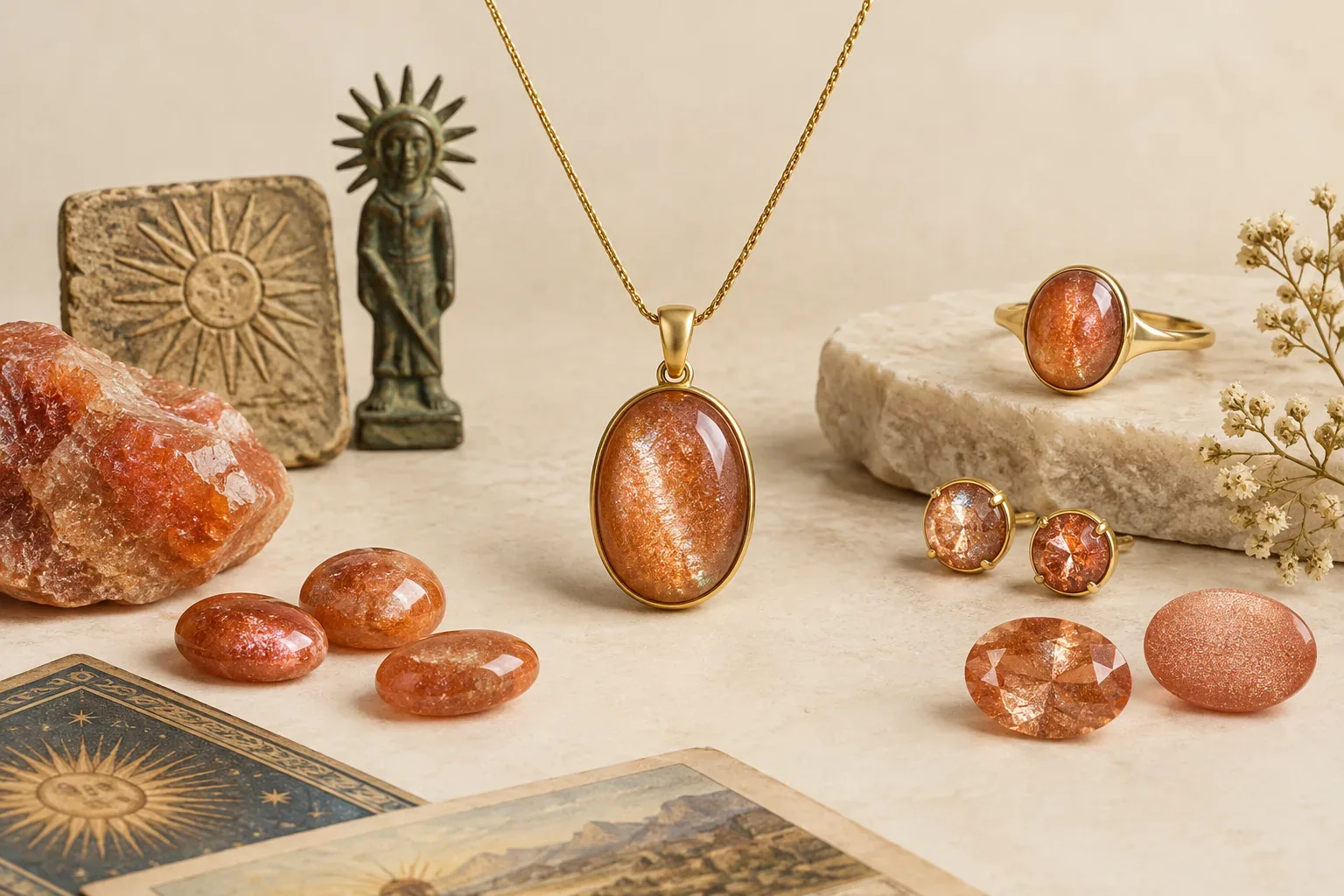
Museums and gemstone references show two related but distinct traditions in jewellery: the motif of the sun as a decorative or symbolic device, and the use of stones named or marketed as sunstone because of their color, shimmer, or optical effects. The V&A documents the sun motif in settings such as brooches, pendants, and ceremonial pieces where metalwork and gem placement emphasize rays or a central disc.
Gemstone guides compiled by institutions such as the V&A group gemstones by optical properties and historical use. Stones marketed as sunstone may be cut as cabochons to emphasize internal shimmer or set as faceted gems to take advantage of color. In modern commercial jewellery the sun motif may appear as enamel, metalwork, mixed materials, or with a central gem marketed as a sunstone; each approach carries different implications for meaning, durability, and value.
Treatments, synthetics, and imitations — how the rules apply
The Federal Trade Commission sets clear expectations for disclosure: dealers should identify material facts about gemstones, including whether a stone is natural, treated, synthetic, or simulated. Treated stones are natural materials whose appearance is altered by a process such as heat or coating; synthetic stones are laboratory-grown but mineralogically equivalent to a natural gem; simulations imitate appearance without being the same material. The FTC guidance applies to all named gemstones and to stones sold by trade names such as “sunstone.”
Because institutional sources emphasize both historical context and material truth, buyers should treat the visual appeal of a sun-like gem separately from its labelling. A gem marketed as sunstone might be a natural feldspar with aventurescence, a different mineral marketed under the same name, a dyed or coated stone, a synthetic, or a glass or composite simulation. Sellers are required to disclose these material facts.
Questions buyers should ask — exact wording to use
Begin with simple factual questions and ask for written confirmation. Ask: Is this stone natural, treated, synthetic, or simulated? If treated, what treatment was applied and is that documented? If synthetic or simulated, how is it described in writing on the sales receipt? Ask whether the seller will provide a gemological report for high-value items and whether there is a return or refund policy if lab testing contradicts the seller’s description. The FTC recommends written disclosure of treatments and imitations; asking for it up front saves confusion later.
Follow-up questions depend on value and intended use. For an item you plan to wear daily or pass down, ask about durability and care. For a high-value piece, request a report from an established laboratory or a reputable independent appraisal, and ask about provenance if the stone’s origin is material to you.
Practical and respectful selection and gifting guidance
Match the object to your priorities. If historical authenticity matters, prioritize documented provenance and museum-grade descriptions; ask whether the piece is period-original, a later revival, or a modern design that borrows historical motifs. If personal meaning or fashion is the priority, you can choose a visually appealing piece so long as the seller makes accurate disclosures about material and treatment.
Be culturally respectful when selecting a piece that uses motifs with documented sacred or cultural significance. The V&A’s work highlights that motifs have specific historical contexts; if a design is described as belonging to a particular culture or ritual use, ask the seller about sourcing and intent. When gifting, include the written details you received from the seller so the recipient understands whether a stone is natural, treated, synthetic, or a simulation.
Finally, set expectations about care and resale. Treated stones and simulations may behave differently over time from untreated natural gems. If insurance, appraisal, or resale value matters, buy from sellers who provide clear documentation and a reasonable return policy.
When to seek testing or a written lab report
If the piece is a significant purchase relative to your budget, if the seller’s description is unclear, or if the provenance seems important to you, obtain a written report from a recognized gemological laboratory or a reputable independent appraiser. The FTC recommends transparency and written disclosure, and a lab report provides objective information about whether a stone is natural, treated, synthetic, or a simulation.
Trustworthy dealers welcome reasonable requests for documentation. If a seller refuses to document material facts or to provide a secure return policy, treat that as a red flag and consider taking your purchase elsewhere.
Putting history and meaning together
Museums such as the Victoria and Albert Museum help buyers and wearers understand how motifs like the sun moved through cultures and fashions. Use that documented history to inform respectful choices: appreciate the historical contexts described by museum scholarship, but allow your own modern interpretation when you wear or gift a piece. The two can coexist when material facts about the object are clearly disclosed and the wearer understands the difference between documented historical meaning and contemporary personal symbolism.
Frequently asked questions
What exactly should I ask a seller about a stone marketed as sunstone?
Ask whether the stone is natural, treated, synthetic, or simulated; request written details of any treatment and the seller’s return policy; and, for higher-value purchases, ask for a gemological report or independent appraisal. The Federal Trade Commission recommends written disclosure of material facts about gemstones.
Is there a historical meaning to sun imagery that I should know when gifting?
Museum documentation shows that sun imagery carried different meanings in different times and places — for example, royal or religious associations in some ancient contexts and natural or sentimental connotations in later European jewellery. Use museum sources to understand historical contexts, and then decide whether a modern personal meaning is appropriate for your gift.
Can a dealer legally sell a treated or simulated stone without telling me?
No. Consumer guidance from the Federal Trade Commission requires sellers to disclose material facts about gemstones, including treatments and whether a stone is a simulation or synthetic. Ask for those disclosures in writing.
Should I get lab testing for a sunstone purchase?
Obtain a lab report if the purchase is a major expense relative to your budget, if provenance matters to you, or if the seller provides unclear information. A recognized gemological report gives independent confirmation of whether a stone is natural, treated, synthetic, or simulated.
Is it disrespectful to wear a sun motif from another culture?
Not necessarily, but be informed. Museum research shows motifs have specific historical meanings in some cultures. If a design is identified as having religious or cultural role, ask about its origin and consider whether wearing it is appropriate in light of that context.
How do treatments affect care and durability?
Different treatments and simulations can change a stone’s hardness, stability, or reaction to heat and chemicals. When buying, ask for care instructions from the seller and consider the likely wear-and-tear before choosing a treated stone or a simulation for everyday jewelry.
Sources and further reading
- Bedazzled: A History of Jewellery — Victoria and Albert Museum
- An A-Z of Gemstones — Victoria and Albert Museum
- Buying Gemstones, Diamonds, and Pearls — Federal Trade Commission