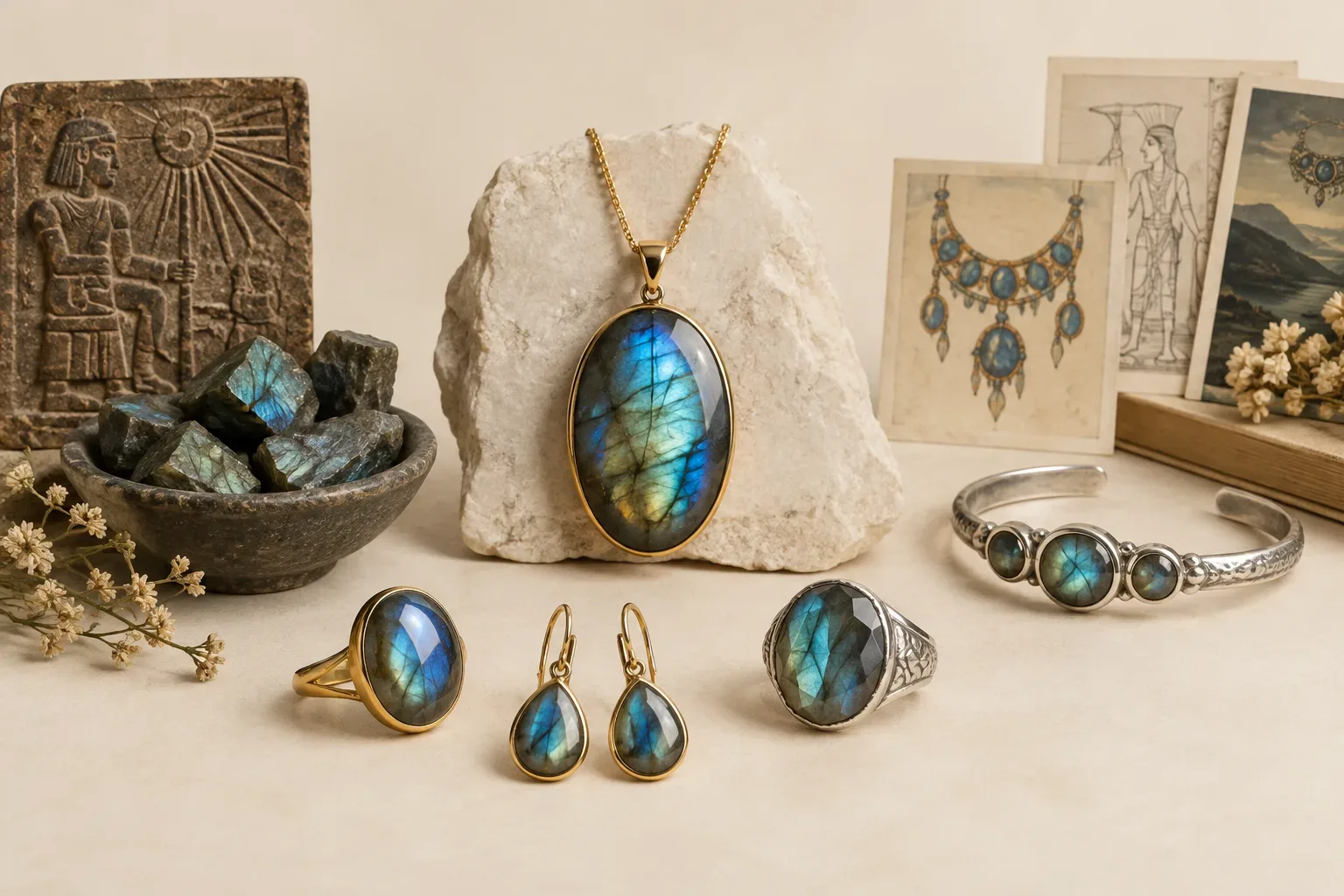
Meaning at a glance
Choose cuts and settings that showcase labradorescence—cabochons and shallow slices for maximum flash—and prefer protective mounts such as bezel or halo settings for durability; separate museum-documented history from later popular or spiritual interpretations and follow consumer-protection guidance when buying.
What historical evidence we can rely on
The Victoria and Albert Museum (V&A) provides the primary museum-based overview used here. The V&A’s exhibition and reference work on jewellery history explain how gem cutting, mounting techniques and tastes changed across named periods such as the Renaissance, Georgian, Victorian, Art Nouveau and later twentieth-century jewellery. Those resources show how changing technology and fashion determined which stones were chosen and how they were set, but they do not attribute a single, continuous cultural meaning to any one gemstone across all places and times.
Museum and curatorial records compiled by the V&A document many specific uses of gemstones in decorative contexts—how cutters and goldsmiths responded to light effects, how settings protected fragile stones, and how motifs shifted with social and technological change. These records make clear that jewellery meanings and choices are historically contingent: a gem chosen in a seventeenth-century European signet ring does not necessarily carry the same social role when the same stone appears in a nineteenth-century brooch.
Separating documented history from modern interpretation
Documented history, as summarized by the V&A, links gemstones and their settings to periods, technologies and fashions. For example, the V&A traces how techniques such as bezel work, openwork settings and later mechanized faceting developed in particular times and places; these are technical and stylistic histories rather than universal symbolic statements about individual gemstones.
Modern personal or spiritual meanings associated with labradorite—for example, attributions that it protects the aura or enhances psychic sight—are contemporary interpretations created and circulated in recent decades. Those meanings are important to many wearers, but they are not the same as museum-documented historical functions or uses. Treat historical evidence and modern belief as separate layers: the first explains how and why jewellers cut and set stones in different eras, the second explains how individuals and groups invest stones with present-day personal significance.
How labradorite appears in jewellery
Labradorite is most often used as a focal or accent stone where its light effects can be clearly seen. In jewellery practice this commonly appears as cabochon stones set into rings and pendants, shallow slices mounted as centrepieces in neckpieces, or beads and inlays that create colour shifts across a surface. Designers place labradorite where movement and light will reveal the stone’s play of colour—on pendants and brooches, and sometimes in earrings where motion helps the stone flash.
Because jewel-setting traditions adapt to the optical character of a material, the same general jewellery forms seen across historical periods are used for labradorite: mounts that protect edges, backings that darken or lighten tone, and settings that expose the top surface to light. The V&A’s surveys of gem and jewellery practice help explain these recurring choices by connecting optical effect, cutter technique and mounting style.
Cuts—how to choose the right one for the effect you want
Cuts for labradorite are chosen to show its labradorescence. Traditional cabochon cutting, where the stone is shaped into a smooth dome with a flat or slightly convex base, is the most common because it presents a broad surface for the stone’s internal reflections to appear. Cabochons can be tall (domed) or shallow; taller domes can intensify flashes when the stone is tilted, while shallower cuts give a more even spread of colour.
Slices and thin slabs are another popular treatment: when cut as a thin slice and sometimes polished only on one face, the stone reveals layered flashes and can be used as a dramatic pendant or set into a bezel as a focal plane. Faceted labradorite is less common because deep faceting can scatter the optical layers that create the play of colour, though shallow, large facets can be used to produce a mix of sparkle and flash for certain designs.
Settings—balancing beauty and durability
Settings influence both appearance and resilience. Bezel settings, which wrap metal around the stone’s edge, are widely used with labradorite because they protect edges and hold polished cabochons and slices securely. A full bezel increases protection for everyday wear. Partial bezels or rim settings offer a balance between protection and visibility when you want more of the stone visible.
Prong settings can showcase more of the stone’s sides and allow more light, but they expose edges to knocks. Guarded prongs—prongs strengthened by a metal collar or supplemented with a bezel lip—add protection while keeping a more open look. For heavily worn pieces such as everyday rings, choose a guarded or full bezel; for occasional-wear pendants or earrings, more open settings can be acceptable if the wearer understands the need for caution.
Practical selection and gifting guidance
Match the cut and setting to the wearer’s lifestyle. If the recipient wears rings or bracelets daily, favour protective settings and lower profiles to reduce the risk of chipping. For someone who prefers bold statement pieces that are worn occasionally, larger cabochons or thin slices in open settings make sense. Consider the piece’s intended use first—pendants and brooches naturally expose the stone to different kinds of wear than rings.
Ask the seller clear questions and look for transparent policies. The Federal Trade Commission (FTC) advises consumers to seek disclosure about treatments, imitations and other material information when buying gemstones. Ask whether the labradorite has been treated, whether it is a single stone or a composite (such as doublets), and what the return or repair policy is. Request clear photographs showing the stone at different angles so you can see how it flashes under movement.
Be culturally and personally respectful when gifting. Don’t assume a single meaning for labradorite across cultures or individuals. If you choose the stone because of a modern spiritual attribution, consider whether the recipient shares or values that meaning. If you are presenting a piece with historical motifs or styles, the V&A’s work on jewellery history can help you explain the technical or stylistic origins to the recipient without claiming unverified ancient symbolism.
Care, verification and consumer protections
Treat labradorite as a gem that benefits from gentle care and occasional professional attention. Avoid hard knocks and abrasive cleaners, and remove jewellery when doing activities that risk impact. If a piece becomes dull, a jeweller experienced with opaque and iridescent stones can clean and, if necessary, re-polish the surface to restore the flash.
When buying, seek sellers who provide clear provenance and treatment information. The FTC’s consumer guidance on buying gemstones, diamonds and pearls emphasizes that sellers should disclose treatments, imitations and other material facts. Request written confirmation of any treatments and keep receipts and photographs for future reference. For high-value purchases, consider an independent appraisal or a lab report when available.
Final note
Labradorite’s appeal lies in its changing flashes of colour and the way those flashes respond to cut, setting and movement. Use museum-documented histories of jewellery to understand why certain cuts and settings became popular in particular periods, and use modern practical guidance—particularly on disclosure and consumer protections—to make confident purchasing and gifting decisions. Keep historical uses and modern personal meanings distinct, and choose the cut and mount that best suit the wearer’s style and daily life.
Frequently asked questions
What cut shows labradorite’s flash best?
Cabochons and thin slices generally show labradorite’s play of colour most effectively because they present broad, uninterrupted surfaces; shallow faceting can work for designs that need some sparkle, but deep faceting often reduces the visible flash.
Which setting is best for durability?
Bezel settings and guarded prongs provide the best protection for labradorite used in everyday jewellery because they shield the stone’s edges and keep it secure; for occasional-wear pieces, more open settings are acceptable if the wearer understands the extra care required.
Are there documented ancient meanings for labradorite?
Museum records, such as those compiled by the Victoria and Albert Museum, document how gems were used in different historical periods, but they do not support a single, continuous ancient meaning for labradorite; many symbolic attributions in circulation today are modern interpretations.
How can I verify a labradorite purchase?
Ask the seller about treatments, whether the item is a single natural stone or a composite, and request clear photos and written purchase terms. The Federal Trade Commission recommends that sellers disclose treatments and material facts; consider a professional appraisal for high-value items.
What should I consider when gifting labradorite?
Consider the recipient’s lifestyle and how often they will wear the piece, whether they value modern spiritual meanings, and whether you can obtain transparent information about treatments and return policies; choose a protective setting for everyday wear and explain any modern attributions if they influenced your choice.
Sources and further reading
- Bedazzled: A History of Jewellery — Victoria and Albert Museum
- An A-Z of Gemstones — Victoria and Albert Museum
- Buying Gemstones, Diamonds, and Pearls — Federal Trade Commission