Meaning at a glance
Explain the documented history and changing contexts of the labradorite treatments and imitations motif, separate cultural or religious evidence from later popular interpretations, and give practical guidance for choosing and wearing the motif in modern jewelry.
Short answer — what buyers should know now
Labradorite is a feldspar group mineral prized for its iridescent flash (commonly called labradorescence). In the marketplace, stones described as labradorite may be left natural, cut and polished as cabochons, stabilized or treated, or represented by imitation materials. Sellers are required to disclose treatments and imitations; buyers should ask directly about treatments, the stone’s origin, and documentation such as an independent gem report before purchase.
What the historical record shows (and what it doesn’t)
Museums such as the Victoria and Albert Museum record how gemstones and jewelry change meaning with fashion, technology and trade. The V&A’s materials on jewellery history and on gemstones describe broad patterns: gemstones have been reshaped, revalued, and remounted over centuries as tastes and techniques evolved, and many modern meanings attached to particular stones are recent developments rather than ancient continuities.
For labradorite specifically, the scholarly and museum literature is more limited than for long-established gem trade stones such as sapphire or diamond. That means most of what circulates in popular books and online about labradorite’s symbolic roles often reflects modern or recent interpretations rather than long-documented religious or cultural uses. The V&A resources are useful for reminding buyers that the cultural significance of a gem today may not reflect an unbroken historical tradition.
Documented history versus modern personal or metaphysical interpretations
Separate the two when you evaluate a claim. Documented history — such as provenance, recorded use in jewelry collections, or museum catalogues — is the kind of evidence museums collect and publish. Modern metaphysical, spiritual, or healing claims are usually personal, community-based, or commercial statements and do not substitute for documented historical proof.
If a seller or source attributes an ancient ritual meaning to labradorite, ask what documentary evidence supports that claim. Sellers can and should specify whether a meaning is a contemporary marketing narrative, a community tradition, or something recorded in historical sources. The Victoria and Albert Museum’s discussions of gemstones and jewellery highlight how meanings change over time, which is a useful reminder that many symbolic claims about stones are newer than they may sound.
How treatments and imitations appear in the market
Gemstone treatments and imitations exist across the jewellery trade. Treatments can include mechanical or chemical processes that change durability, appearance or color; imitations are alternative materials fashioned to look like a gem. The U.S. Federal Trade Commission’s consumer guidance on buying gemstones, diamonds, and pearls explains both the prevalence of treatments and the legal expectation that sellers disclose any material alterations or substitutions.
With labradorite and visually similar stones, the practical forms you will see in jewellery are polished cabochons, beads, inlays, small faceted pieces where the iridescence is subtle, and carved items. Imitations designed to reproduce a pearly or iridescent flash include certain glasses and composite materials. Because labradorite’s distinctive visual effect is optical rather than structural, some imitations rely on coatings or layered construction to mimic the flash.
How labradorite is used in jewellery design
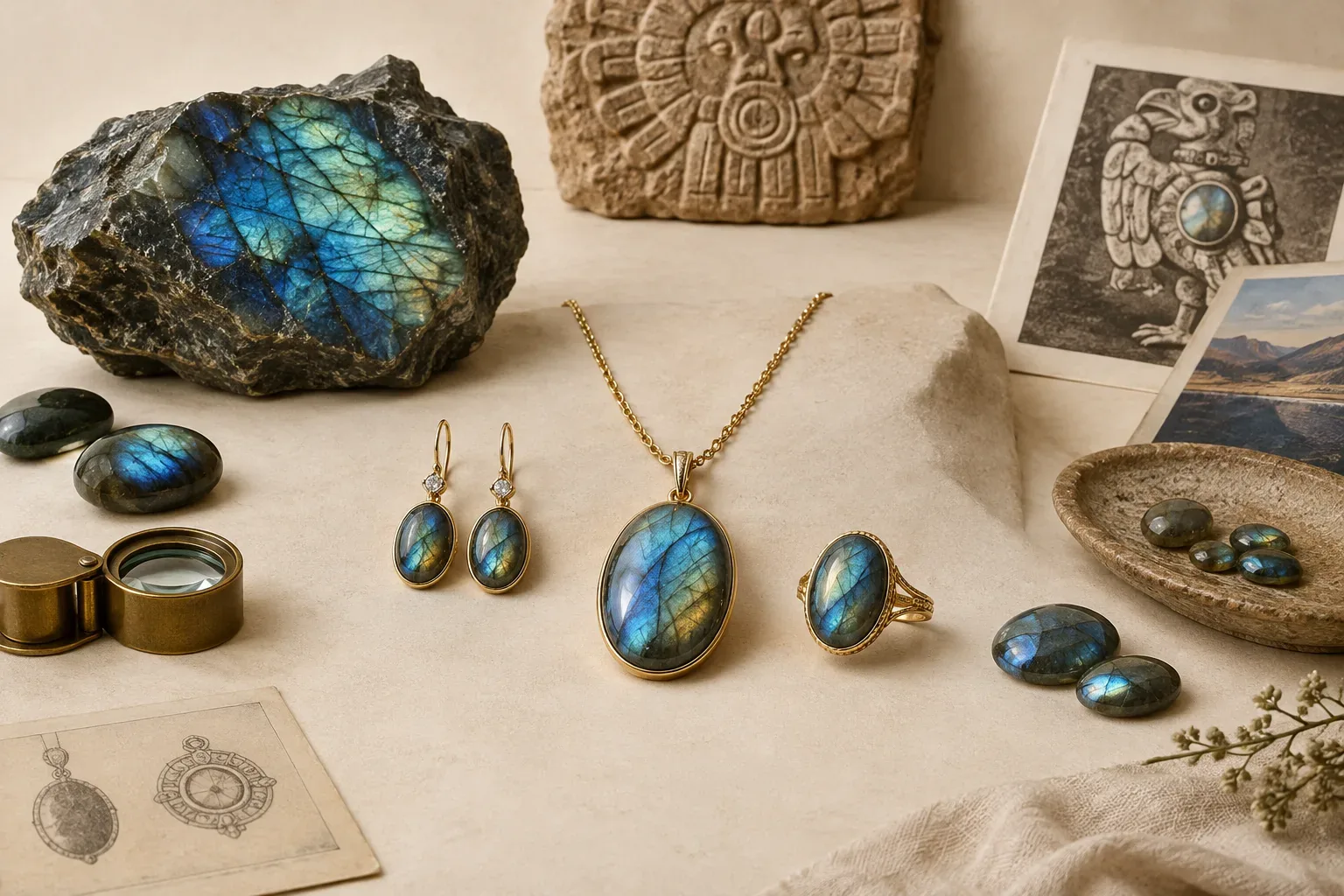
Designers favour labradorite for pieces that show surface color change: the stone is often cut en cabochon or left with a smooth, curved face to display labradorescence. You will find it set in rings, pendants, earrings and beads. In contemporary craft jewellery it is also used for intarsia and mosaic inlay because slabs and slices can be matched for color play.
Because the optical effect is directional, the orientation of the stone in the setting matters for the look of the finished piece. That is why buyers should look at the actual item they will wear—photos that include different viewing angles or, better, in-person inspection—rather than relying solely on a single studio photograph.
Practical questions to ask sellers
Ask whether the stone is natural labradorite, a treated labradorite, or an imitation. If treated or enhanced, ask what specific treatment was used and whether the seller will disclose that fact in writing. The Federal Trade Commission guidance makes clear that disclosure of treatments and imitations is a consumer protection expectation: buyers should not have to guess whether a gem has been altered.
Request the stone’s origin or provenance when available, and ask if an independent gemological report exists for larger purchases. For mounted or small pieces where a full lab report is not typical, request clear photographs from multiple viewing angles and an explicit written statement about treatments or composite construction. Ask about the return policy and any guarantees so you can return an item if its condition or description does not match what you were told.
How to evaluate value, care and gifting etiquette
Value depends on quality of the visual effect, size, cut, setting, and whether the stone is natural or imitation. Because labradorite’s appeal is aesthetic rather than standardized by a grading system, price comparisons are most reliable when you compare similar sizes, settings and seller transparency about treatments.
Consider the recipient’s tastes and expectations. If you gift labradorite for its optical beauty, present honest information about whether it is natural, treated or an imitation. Many buyers appreciate a short note explaining the stone’s visual qualities and any care instructions. Clean labradorite with mild soap and a soft cloth; avoid harsh chemicals, sudden temperature changes, or ultrasonic cleaners unless the seller confirms they are safe for that specific item.
When to seek expert verification
For higher-value purchases, especially for large, loose stones or important antique pieces, seek an independent gemological opinion. An accredited laboratory report can identify mineral species, detect common treatments, and indicate whether a piece is assembled from composites or imitations. The FTC guidance on buying gemstones recommends independent verification when the nature of a gem materially affects its value.
For everyday purchases under typical retail price points, clear seller disclosure, good photographs, and a reasonable return policy often suffice. Still, when in doubt, ask for more information and take advantage of consumer protections.
Final practical checklist before you buy
Before purchase, confirm in writing whether the stone is natural, treated or imitation; ask for origin or provenance if available; request clear photos or view the piece in person; check return and warranty terms; and, for high-value items, obtain an independent gem report. Keep in mind that many attractive and wearable labradorite pieces are perfectly honest, modestly priced natural stones, but transparency about treatment and imitation is the responsible standard of trade.
Frequently asked questions
How can I tell if labradorite is treated or an imitation?
Ask the seller for written disclosure about treatments and whether the item is an imitation. Request clear photos from multiple angles or an independent gemological report for valuable pieces. The Federal Trade Commission advises that sellers must disclose material treatments and imitations.
Do museums record ancient uses or symbolic meanings for labradorite?
Museum resources on gemstones and jewellery, such as those from the Victoria and Albert Museum, document long-term trends and changing meanings for gems generally, but specific, well-documented ancient symbolic uses for labradorite are limited; many meanings encountered today are contemporary interpretations.
Is it acceptable to gift a treated or imitation labradorite?
Yes, provided you are transparent. For a considerate gift, tell the recipient whether the stone is natural, treated, or an imitation and include care advice and any return or warranty information.
When should I get a gemological report?
For high-value purchases, loose stones, or important antique items, seek an independent gemological report to confirm identity, treatments and provenance. For routine retail purchases, clear disclosure and a reasonable return policy may be sufficient.
How should I care for labradorite jewellery?
Clean labradorite with mild soap, lukewarm water and a soft cloth. Avoid harsh chemicals, steam or ultrasonic cleaners unless the seller confirms they are safe for that specific item.
Sources and further reading
- Bedazzled: A History of Jewellery — Victoria and Albert Museum
- An A-Z of Gemstones — Victoria and Albert Museum
- Buying Gemstones, Diamonds, and Pearls — Federal Trade Commission