Meaning at a glance
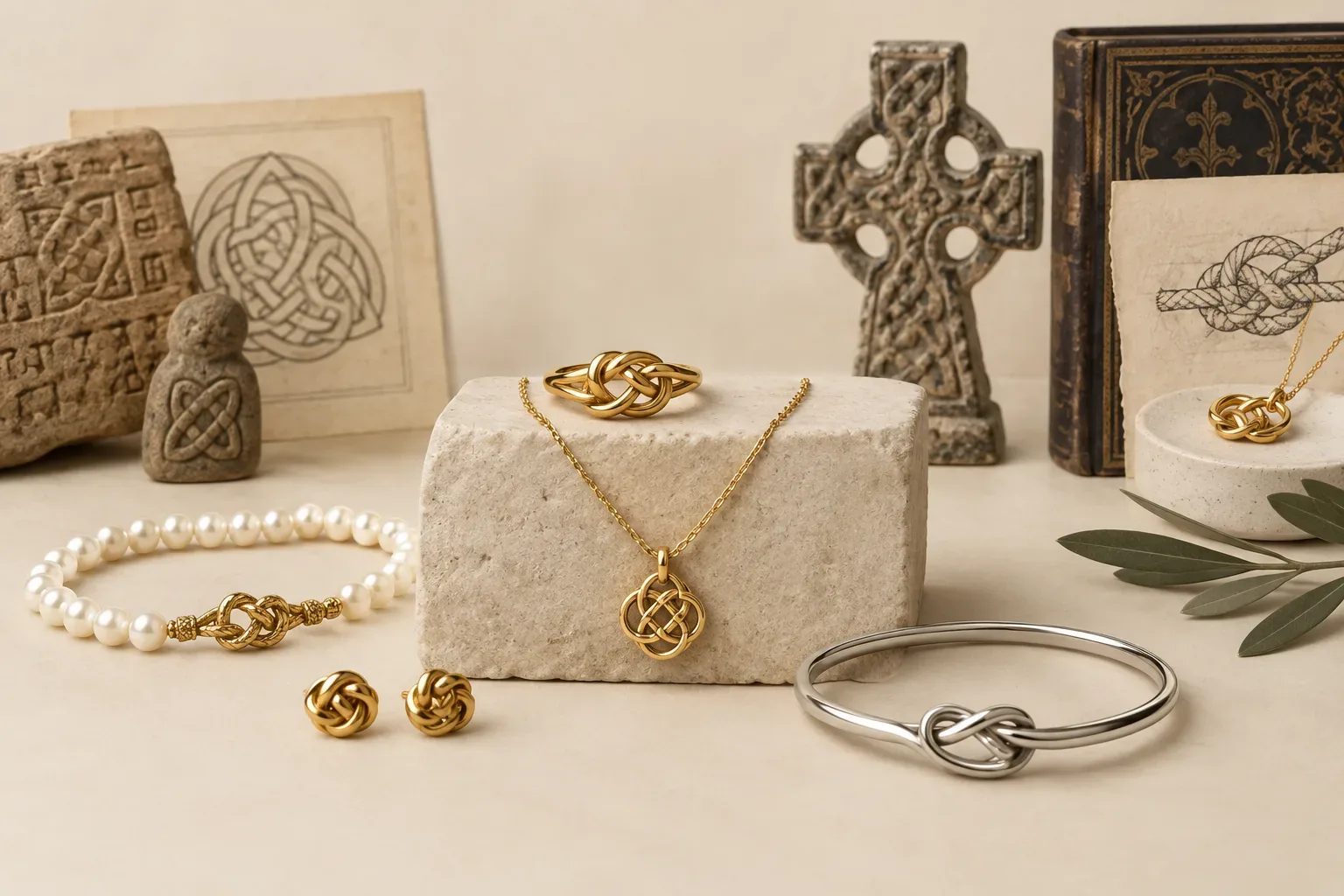
Knot jewelry meaning is historically varied: museums document the knot as a decorative, fastening, and symbolic motif across distinct cultures; modern wearers add personal layers of meaning, so choose pieces with attention to culture, materials, and disclosure.
Short answer
The knot motif in jewelry has multiple, documented uses: as a practical fastening, a decorative motif, and a culturally specific symbol in different places and periods. Museum scholarship summarized by the Victoria and Albert Museum shows knot forms appear in several distinct traditions rather than holding a single universal meaning. In modern practice people often adopt knots to signify continuity, love, protection, or connection, but those contemporary readings are personal or commercial developments rather than a universal historical fact.
Documented history and cultural contexts
Evidence for the use of knots in jewelry and ornamentation appears across many regions and periods as described in museum histories. The Victoria and Albert Museum records knot motifs in objects ranging from ancient jewellery and clasps to medieval metalwork and later decorative arts, indicating that artisans used knot forms for both practical and decorative reasons rather than with one single meaning.
In some cultures knot imagery is integrated with local visual languages or technical traditions. For example, the V&A describes how Celtic-style interlace and continuous knotwork developed as a decorative system in Insular art and later appeared in metalwork and personal ornaments. Separate traditions show knot shapes in East Asian textiles and lacquer, in maritime contexts where sailor’s knots became tokens, and in broader European jewellery where 'love knots' emerged as distinct popular forms in more recent centuries. The V&A’s historical overview emphasizes changing social contexts for ornament rather than a single symbolic interpretation.
Which historical meanings are documented and which are modern interpretations
Documented historical meanings tend to be local and contextual. Museum catalogues and exhibitions described by the Victoria and Albert Museum identify functions—fastening, decoration, display of skill—or associations with local decorative programs, such as interlace in Insular manuscripts and metalwork. Where museums can link a knot motif to a specific social meaning they do so through context: provenance, use, inscriptions, or related texts, not by assuming the symbol carried the same meaning everywhere.
Modern interpretations—ideas you commonly see in marketing, gift guides, or personal narratives—include reading knots as universal signs of eternal love, unbroken friendship, or spiritual continuity. These readings are valid as contemporary personal symbolism, but they should be distinguished from documentary historical claims. In short, a seller or wearer can meaningfully interpret a knot as a symbol of lasting connection today, but that modern meaning is different from the patchwork of historically documented uses described by museum scholarship.
How the knot motif, gemstones, and traditions appear in jewelry
Knot shapes appear across many jewellery types: brooches and clasps that originally mimicked working knots, rings with interlaced bands commonly called love knots, pendants and necklaces incorporating continuous or interwoven lines, and charm-style pieces that imitate sailor’s knots or braided cords. The V&A’s histories note that craftsmen often transformed two-dimensional knot designs from textiles and manuscripts into three-dimensional metalwork and gems.
Gemstones and settings have been combined with knot motifs in various ways. Historical and museum literature summarized by the V&A and its A–Z of gemstones shows that gemstones were used to emphasize focal points of a knot design, to add color contrast, or to lend perceived virtues associated with a stone to a piece. In contemporary jewellery designers set diamonds, sapphires, pearls, and colored stones into knot forms for sparkle and emphasis. When buying gemstones, the Federal Trade Commission recommends asking for clear information about treatments, imitations, and disclosures so you understand whether a stone has been enhanced or is a simulation.
Selecting knot jewelry: materials, meaning, and disclosure
Choose knot jewellery first by considering the wearer’s relationship to the symbol and any specific cultural associations. If the recipient has a family or cultural background in which a particular knot form is meaningful, respect that context and, when appropriate, learn the knot’s traditional associations to avoid accidental appropriation. If the knot is chosen purely as a personal token—connection, resilience, or memory—select a design that visually matches the intent, whether refined (fine metal and gemstones) or casual (cord, rope, or mixed materials).
Material choices affect durability and symbolism. Solid gold and sterling silver are traditional metals for long-term wear; braided leather or silk cord variants suggest casual or bohemian use. If a piece uses gemstones, consult museum resources such as the Victoria and Albert Museum’s A–Z of Gemstones for historical context about stones, and follow the Federal Trade Commission’s guidance to ask sellers about any treatments, coatings, or synthetic materials. Always request written disclosure for treatments or imitations and prefer reputable sellers who provide provenance or laboratory reports when the value justifies it.
Gifting guidance and cultural respect
When gifting knot jewellery be specific about what you intend the piece to mean, especially across cultures. A clear personal note explaining the gift’s intended sentiment can make a modern interpretation explicit and respectful. If the knot design draws on a distinct cultural or religious tradition, research its origins—museum sources like the V&A are good starting points—and consider whether a piece made by artisans from that tradition would be a more authentic and respectful choice.
Avoid imposing a universal symbolic meaning. Instead, present the knot as an offered meaning: a promise, a shared memory, or a wish for continuity. For milestone gifts such as anniversaries, choose materials and workmanship that reflect the occasion. For everyday tokens, consider lower-cost materials or smaller sizes so the piece can be worn daily without concern about loss or damage.
Care, authentication, and practical wear
Care for knot jewellery according to its materials: precious metals benefit from routine polishing and secure storage while cord and leather require different cleaning and drying practices. For jewellery with gemstones, follow the care guidance appropriate to that stone as summarized in museum writing on gemstones and ask the seller about recommended cleaning methods.
If authentication matters, request hallmark or assay information for precious metals and lab reports for valuable gemstones. The Federal Trade Commission’s advice about disclosure should guide your questions: ask about treatments, imitations, and return policies before purchase so you know exactly what you are buying.
Conclusion
The knot motif in jewellery is best understood as a motif with many local histories and many modern meanings. Museum documentation summarized by the Victoria and Albert Museum shows knots used as practical, decorative, and sometimes locally symbolic motifs across different cultures and periods. Today's wearers often layer personal meanings onto those motifs; that practice is legitimate but distinct from the documentary record. Choose and gift knot jewelry with attention to cultural context, material quality, and clear disclosure so the piece can be worn meaningfully and respectfully.
Frequently asked questions
What does knot jewelry generally symbolize?
Historically knots have served many functions—fastening, decoration, or local symbolic roles depending on culture. In modern use people commonly interpret knots as symbols of connection, continuity, or remembrance; these modern meanings are personal or commercial rather than universal historical facts.
Is a Celtic knot the same as an endless knot?
No. 'Celtic knot' refers to styles of interlace in Insular art and related metalwork documented in European collections, while an 'endless knot' is a form found in several traditions including Buddhist decorative arts. Both share visual continuity but come from different cultural contexts, so their histories and connotations differ.
Can knot jewelry be appropriate for an engagement or wedding?
Yes, many people use knot motifs—especially love knots or interlaced rings—to symbolize commitment. If you intend cultural meaning, research the specific knot form and explain the sentiment to your partner. Choose durable materials and secure settings for daily wear.
How can I verify the gemstone or metal in a knot piece?
Ask the seller for written disclosure about metal hallmarks and gemstone treatments. For high-value items request a laboratory report. The Federal Trade Commission recommends asking directly about treatments, imitations, and return policies before purchase.
How do I gift knot jewelry respectfully if it borrows from another culture?
Research the knot’s origins using museum resources, consider buying from artisans of that culture, and include a note that explains your respect for the tradition and your intended meaning. If unsure, choose a neutral design or a contemporary reinterpretation created by an artist engaged with that heritage.
Sources and further reading
- Bedazzled: A History of Jewellery — Victoria and Albert Museum
- An A-Z of Gemstones — Victoria and Albert Museum
- Buying Gemstones, Diamonds, and Pearls — Federal Trade Commission