Meaning at a glance
Documented evidence shows the chain link motif has long combined function and decoration; this article separates historical records (as discussed by the Victoria and Albert Museum) from modern personal meanings and gives practical selection and gifting guidance, including gemstone and disclosure advice from the FTC.
What the historical evidence shows
Scholarly and museum treatments of jewelry emphasize that chains and linked forms appear across many periods because the technique of interlinking metal is both functional and decorative. The Victoria and Albert Museum’s overview of jewelry history notes that styles, materials, and social meanings of jewellery have changed as technologies and fashions evolved, and that metalworking techniques such as linking were central to those developments.
Archaeological and museum collections record linked chains used as neckpieces, belts, fastenings and decorative trims. In some periods the link was primarily a technical solution—for example, creating a flexible, wearable strip of metal—while in others the visual motif of repeated links carried additional social or aesthetic weight. The V&A’s historical framework shows how the same technique could sit in high-status court jewellery in one era and in everyday garlands or practical dress accessories in another.
Because the published museum synthesis treats jewellery across many cultures, it is important to read specific collections and object records for precise attributions. The V&A materials make clear that labels and interpretive captions can distinguish when a chain served a ritual, decorative, or practical role in a given culture or period.
Separate documented historical meanings from modern interpretations
When people today assign symbolic meaning to chain link motifs—connection, bondage, protection, continuity—those are modern, personal or popular interpretations unless a historical source explicitly records the same meaning for a particular culture and object. The V&A’s accounts document changing social contexts rather than a single symbolic dictionary, so claiming that any specific historical people universally saw links as "love" or "unity" would overreach the evidence.
Some historical objects do carry recorded symbolic meanings in their original contexts, but you must consult the object’s provenance and catalogue record to verify that. Otherwise, reasonable modern meanings are valid as contemporary symbolism: many wearers choose chain links to convey relationship, interdependence, or strength, but these are contemporary cultural readings and not automatic historical facts.
How the motif, gemstone, or tradition appears in jewelry
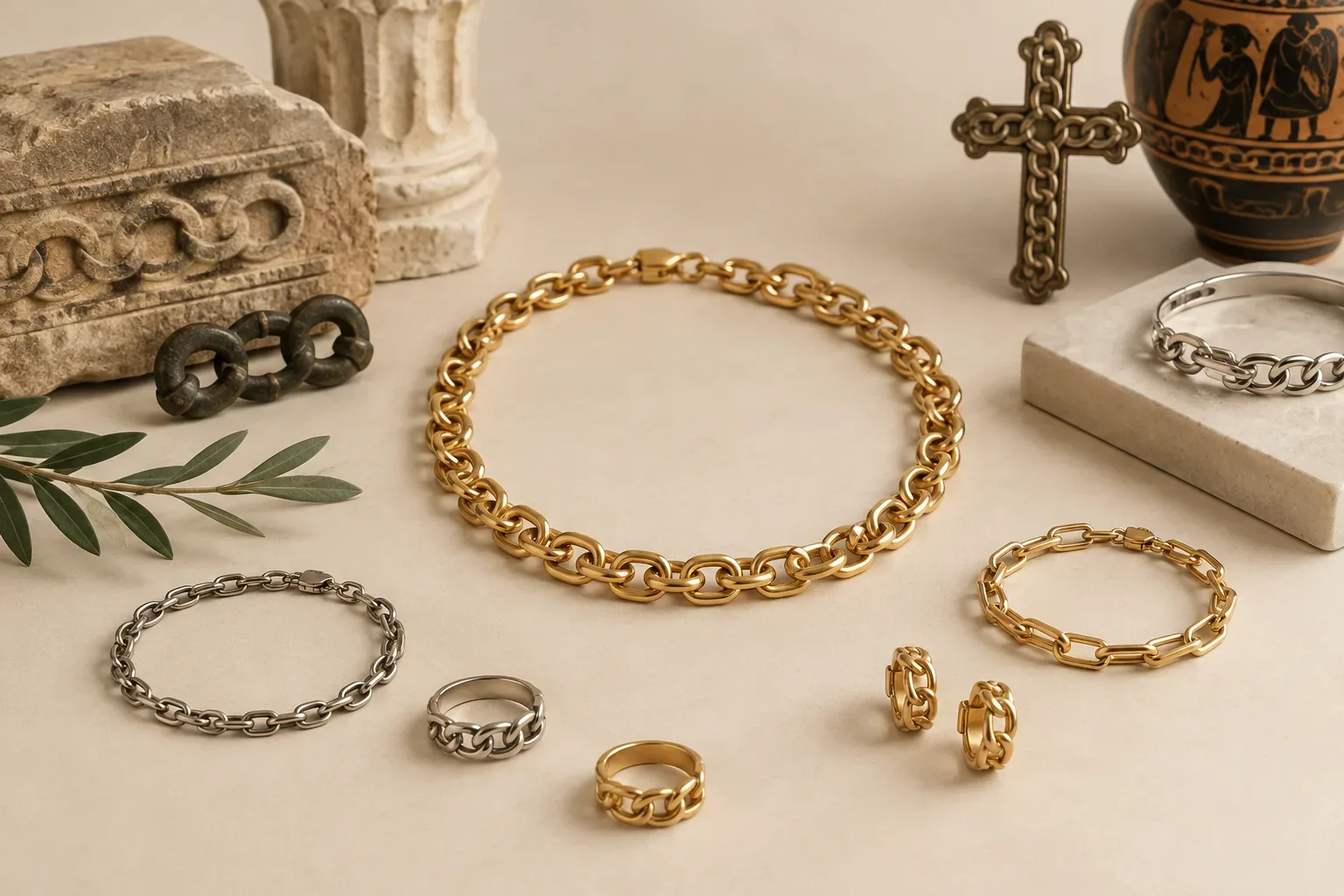
The chain link motif appears in jewellery through many forms: simple cable chains used as the foundation for pendants, bold curb or Cuban links as standalone necklaces, flattened or twisted link shapes for bracelets, and ornamental linkwork incorporated into rings and earrings. The motif can be the primary visual feature or a structural element that supports other decorative components.
Gemstones are often paired with chain links in two main ways. One approach is to set gemstones into link elements so each link carries an inlaid stone or bezel; another is to suspend a gemmed pendant from a linked chain. The Victoria and Albert Museum’s reference on gemstones provides context for how different stones have been used historically and how they can alter the appearance and perceived value of a linked piece.
Designs vary by scale and finish: delicate link chains work with small faceted stones or pearls for a refined look, while chunky links are frequently left unadorned or paired with larger cabochons or signet-style elements. Materials also play a role: gold and silver allow fine, hand-made linking, while contemporary alloys or plated metals produce accessible fashion variations.
Practical and respectful selection and gifting guidance
Decide whether you value historical authenticity or contemporary style. If you want a piece with documented provenance, ask for the maker, date, and provenance; museum sources emphasize the importance of context. If you prefer a modern design that carries a personal meaning for the wearer, choose a style and scale that suits their daily life and wardrobe.
Consider metal and craftsmanship. Solid precious metals (for example gold or sterling silver) differ in price, weight, longevity, and repairability from plated or base metals. The Federal Trade Commission advises buyers to seek clear disclosure about treatments, plating, and imitations for gemstones and metals; ask the seller whether a metal is solid, filled, or plated and whether any gems have been treated or synthesized.
Match the scale and clasp to practical use. A lightweight chain with a spring ring or lobster clasp is discreet and comfortable for everyday wear. Heavier link necklaces benefit from stronger closures and may require reinforced jump rings. Think about the recipient’s lifestyle: a bracelet for someone with active hands should be robust and simple, while a delicate chain is better for occasional wear.
Respect cultural specificity. If a particular linked style is identified with a culture, community, or religious practice, learn its documented meaning before assuming you can repurpose it as a fashion statement. Museum scholarship encourages reading object labels and provenance to avoid appropriating a motif that has a distinct cultural or ceremonial role.
Check gemstone and metal disclosure, and request documentation when appropriate. For valuable purchases, ask for a written description of treatments or laboratory reports for gemstones. The FTC guidance highlights the buyer’s right to clear information about what they are purchasing, including any enhancements or imitations.
Think about engraving or personalization to add a clear, intentional meaning. If you want a chain link to represent relationship or memory, a small engraved tag, a commemorative pendant, or a linked charm can localize that meaning without misrepresenting historical claims.
Final considerations
The phrase chain link jewelry meaning can describe both an object’s long material and technical history and the modern, personal meanings wearers assign today. Use museum resources for documented histories and object-specific meanings, and use contemporary buying guidance when assessing materials and authenticity. A thoughtful choice balances the piece’s craftsmanship, the documented cultural context when relevant, and the personal or relational meaning you intend to convey.
Frequently asked questions
Does a chain link necklace always mean connection or bondage?
No. Meanings such as connection, strength, or bondage are modern interpretations people may apply to chain links. Historical uses were often technical or decorative; the Victoria and Albert Museum notes that jewellery meanings changed across times and cultures. Verify any claimed historical symbolism with object-specific provenance.
How can I tell if a chain or gemstone is authentic?
Ask the seller for clear disclosures about metal content and gemstone treatments. The Federal Trade Commission advises buyers to request documentation and to be informed about whether gems are natural, treated, or synthetic. For high-value pieces, seek a laboratory report or a trusted appraisal.
Are certain chain link styles tied to particular cultures?
Some linked techniques and decorative link styles are associated with specific regions, periods, or workshops, but you should consult museum records or provenance to confirm those attributions. The V&A’s historical material emphasizes the importance of context when identifying culturally specific meanings.
What styles best suit gifting a chain link piece?
Choose scale and durability for the recipient’s lifestyle. A delicate chain and small pendant suit everyday discreet wear, while a sturdier, heavier link is better for bold, regular use. Consider personalization such as engraving to communicate specific meaning.
Can I mix gemstones with chain link designs?
Yes. Designers commonly set gems into link elements or suspend gemmed pendants from chains. The V&A’s A–Z of gemstones explains how different stones have been used historically and how their color, cut, and treatment affect appearance and value.
How should I care for a chain link necklace?
Care depends on materials: solid precious metals may be cleaned and polished by a jeweller, while plated or fragile pieces need gentler treatment. For significant purchases, follow the maker’s care instructions and consult a professional for repairs or deep cleaning.
Sources and further reading
- Bedazzled: A History of Jewellery — Victoria and Albert Museum
- An A-Z of Gemstones — Victoria and Albert Museum
- Buying Gemstones, Diamonds, and Pearls — Federal Trade Commission