Meaning at a glance
This article explains the documented history and changing contexts of the hexagon motif in jewelry, distinguishes verified cultural evidence from later popular interpretations, describes how the form appears in settings and gemstones, and offers practical, respectful guidance for choosing or gifting hexagon pieces.
Quick answer
Documented evidence shows that hexagonal and other geometric motifs have appeared repeatedly in jewellery across many periods and regions; museum scholarship places those uses in practical, decorative, and craft contexts. Modern meanings such as “balance,” “sacred geometry,” or “community” are largely contemporary personal or cultural interpretations layered onto a long decorative history. When buying or gifting hexagon jewellery, combine respect for the recipient’s cultural and personal associations with practical checks on materials and disclosures.
Historical evidence and where it comes from
Museum collections and curatorial scholarship show that geometric shapes, including hexagonal forms, recur in decorative arts and jewellery from antiquity through later periods. The Victoria and Albert Museum (V&A) documents how jewellers used geometric designs as part of changing styles, techniques, and social meanings rather than as a single universal symbol.
Across different historical periods geometric motifs served varied roles: in ancient and classical objects they could reflect local craftsmanship and available tools; in medieval and Islamic decorative arts geometry often shaped overall ornament and pattern; in Renaissance and later European work geometry interacted with portraiture, religious imagery, and heraldry; and in 18th–19th century European and Victorian jewellery geometric forms appear alongside sentimental, naturalistic, and industrial influences. The V&A places these shifts in their social and technological contexts rather than attributing one stable symbolic meaning to the shape.
Archaeological finds and historic pieces in museum collections therefore show repeated use of geometric forms, but the V&A’s curatorial perspective cautions against reading a single, continuous symbolic meaning into the motif across different cultures and centuries.
Separating documented historical meanings from modern interpretations
Documented historical meanings tend to be local and context-dependent and are best reported as such. Museum records commonly link geometric motifs to aesthetics, craftsmanship, status display, patterning, or to fit within broader decorative programs on an object. That is, the evidence supports that hexagonal forms were often chosen for their visual and structural properties and their fit within a design language rather than for a single shared spiritual or moral meaning.
Modern interpretations—for example, that the hexagon universally stands for harmony, balance, or spiritual protection—are largely contemporary readings applied by designers, marketers, and wearers. These readings can be meaningful on a personal level but are not documented as universal historical facts. The V&A’s historical approach, which emphasizes changing social contexts, helps distinguish such modern sentiments from what the object record strictly demonstrates.
How the hexagon motif, gemstones, and traditions appear in jewellery
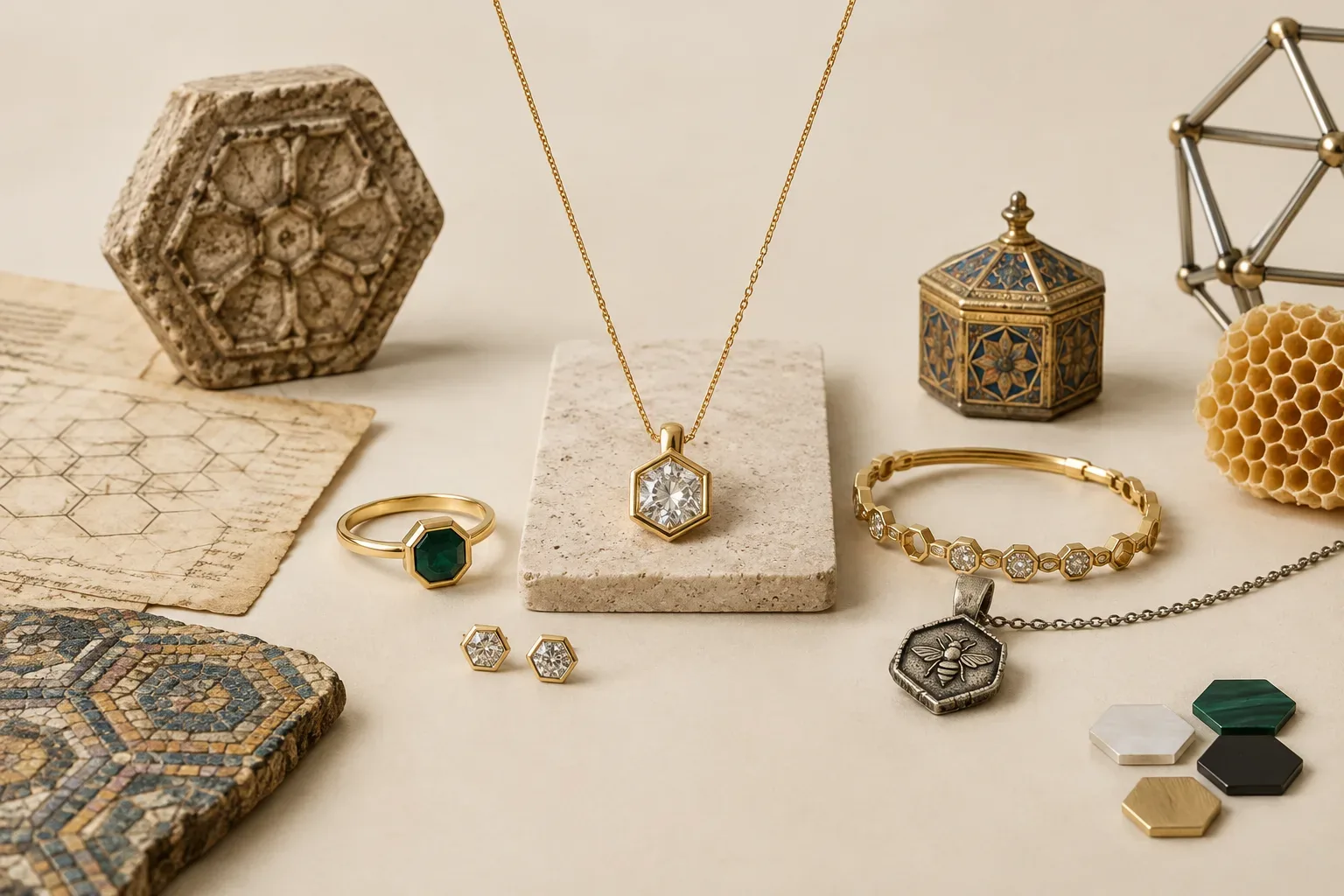
The hexagon appears in jewellery in several practical and decorative ways. Designers use the basic hexagon as a standalone geometric pendant or charm, as a repeating tessellation (a honeycomb or grid), as a framing device for gems, or as part of filigree and inlay work. The motif may also be implied by the layout of a cluster of stones or by the faceting and setting choices a jeweller makes.
Gemstone forms and identification sometimes connect to hexagonal geometry. The Victoria and Albert Museum’s resources on gemstones explain that certain minerals naturally crystallize in hexagonal systems, which affects how they are cut and set. For example, some beryls and other minerals have hexagonal crystal habits; jewellers and gemologists consider crystal form when cutting and orienting stones to best display color and clarity. The V&A’s A–Z of Gemstones provides context on how gem properties influence historical and contemporary jewellery choices.
Cut styles, manufactured components, and metalwork can all emphasize hexagonal lines. Contemporary makers also borrow hexagonal ideas from architecture, tiling, and nature. When buying a piece that features a hexagon-shaped stone or a hexagonal setting, the consumer should be aware that treatments, cutting techniques, and assembled components affect value and appearance; the Federal Trade Commission recommends checking seller disclosures on treatments, enhancements, and whether a stone is natural, lab-grown, or an imitation.
Practical and respectful guidance for selecting or gifting hexagon jewellery
Start by asking or observing: does the recipient prefer geometric styles, or do they favor traditional or figurative motifs? Personal taste matters more than purported universal meanings. If you intend the hexagon to carry a particular message—balance, community, or another sentiment—make that meaning explicit in a card or conversation rather than assuming it will be read the same way by the receiver.
Consider cultural and religious context. Some geometric motifs carry specific meanings in particular traditions; when a piece references a cultural or religious design, respect that context and, if in doubt, ask a knowledgeable person or research the specific design. The V&A’s approach to jewellery history is a reminder that context matters: similar forms can mean very different things in different times and places.
Check materials and disclosures. For gemstones and high-value pieces, request written information on metal purity, gemstone identity, and any treatments or enhancements. The Federal Trade Commission advises buyers to seek clear disclosure about treatments, lab-grown versus natural stones, and imitations, and to obtain a reputable appraisal for significant purchases.
Think about wearability. Hexagonal settings can have corners or edges that catch on fabric; for pieces intended for daily wear, choose rounded edges or protective bezels. If comfort is a priority, select a design scaled to the wearer’s lifestyle—delicate hexagon pendants and signet-style hexagon rings each suit different uses.
When gifting to mark an occasion, pair the piece with information about your intentions and any design provenance you have. If the piece is vintage or has a documented origin, include that provenance as part of the gift; if it is contemporary, include care instructions and any certification from the seller.
Final note
The hexagon in jewellery is best understood through two lenses: the documented, contextual record of design and craft preserved in museum collections and the modern, personal meanings people attach to geometry today. Use museum-backed history to inform respectful choices, and let contemporary interpretation serve as a source of personal meaning rather than a substitute for documented cultural context.
Frequently asked questions
What does hexagon jewelry symbolize?
There is no single documented universal meaning. Museum scholarship shows hexagonal forms have been used for decoration, pattern, and craft across many periods. Modern symbolic readings—such as balance or community—are contemporary interpretations rather than consistent historical facts.
Is hexagon jewellery associated with any religion or culture?
Hexagonal geometry appears in the decorative repertoires of many cultures, but meanings differ by context. The Victoria and Albert Museum emphasizes that geometric motifs acquire significance within their specific cultural and historical settings, so a hexagon in one tradition may not carry the same meaning in another.
Are there gemstones that naturally form hexagonal crystals?
Yes. Some minerals crystallize in hexagonal systems, and that crystal habit influences cutting and setting choices. The V&A’s A–Z of Gemstones explains how natural properties of gems affect their use in jewellery.
Should I be concerned about treatments or imitations when buying hexagon-cut stones?
Buyers should request disclosure about treatments, enhancements, and whether a stone is natural, lab-grown, or an imitation. The Federal Trade Commission advises seeking clear seller disclosures and documentation for significant purchases.
Can I give hexagon jewellery as an engagement or meaningful gift?
Yes—if the design and the message fit the recipient. Because modern symbolic meanings are personal, state your intention clearly when gifting. Consider the recipient’s style, any relevant cultural context, and practical factors such as daily wearability.
How do I care for hexagon settings with pointed corners?
Pieces with angular corners can catch on fabric or be more exposed to knocks. For everyday wear choose protective settings or pieces with softened edges, and follow standard care recommendations for the metal and gemstone used.
Sources and further reading
- Bedazzled: A History of Jewellery — Victoria and Albert Museum
- An A-Z of Gemstones — Victoria and Albert Museum
- Buying Gemstones, Diamonds, and Pearls — Federal Trade Commission