Meaning at a glance
Use a few deliberate jewelry swaps—swap studs for statement earrings, add or lengthen a necklace, layer a cuff or brooch, and change finishing touches—to shift a wedding guest outfit from day to night while respecting cultural meanings and material disclosures.
What the historical evidence shows (and what it does not)
Museum research and curatorial summaries show that jewelry’s social roles and visual language have changed across time and place. The Victoria and Albert Museum’s overview of jewellery history emphasizes that personal ornament has been used to mark status, affiliation, fashion and sentiment in different cultures and periods, and that meanings shifted with changing social contexts. That institutional account is useful because it treats jewellery as a changing social practice rather than a static set of universal symbols.
The V&A’s reference on gemstones documents how particular stones have been valued, traded and fashioned into jewellery in different eras, and how gem use reflects technical and aesthetic developments. These museum resources provide evidence that certain forms and materials recur across time, but they do not justify claiming any single symbolic meaning is universal. What a pearl, a lock of hair in a locket, or a brooch meant in a particular place and period is documented by historical sources; modern wearers may adopt, adapt or discard those meanings for personal reasons.
Separating documented historical meanings from later or personal interpretation
Where museums and historical records identify a documented meaning, state that meaning as associated with a particular culture, period or context. For example, curatorial histories identify mourning jewels and portrait lockets as sentimental responses to death and remembrance in particular social contexts; those practices are documented as Victorian-era and earlier phenomena in European collections, as outlined by museum scholarship. That is different from the modern idea that certain motifs always carry a single, fixed emotional meaning.
Modern interpretations often layer new personal or commercial meanings onto older forms. A pendant model inspired by a Victorian locket can be worn today as a fashion piece, a sentimental object carrying a contemporary memory, or both. The historical record explains what an object meant in its original context; it does not determine how people will use or feel about similar shapes now. Good styling advice recognizes both the historical specificity of older meanings and the legitimacy of contemporary, personal uses.
How motifs, gemstones and traditions appear in wedding guest jewellery
Certain motifs and materials often show up in wedding guest jewellery because of their aesthetic qualities and social associations. Gemstones such as pearls and diamonds appear frequently in formal contexts because of their luster and perceived formality; curatorial resources catalogue how different stones have been used in decorative arts over time. The V&A’s compendium of gemstones explains varieties and historical uses, which helps identify why some stones are chosen for dressy occasions.
Motifs borrowed from historical jewellery—lockets, cameo-style medallions, floral sprays, bows and classic geometric forms—are common in contemporary designs. Some pieces are direct historical revivals; others are modern reinterpretations that reference past styles while using current manufacturing techniques. Convertible pieces designed to change quickly (removable pendants, clip-on to pierced earring adapters, detachable chains) are widely available and are a practical way to echo historical forms while adapting them to day-to-night wear.
Practical day-to-night jewelry styling: simple changes that work
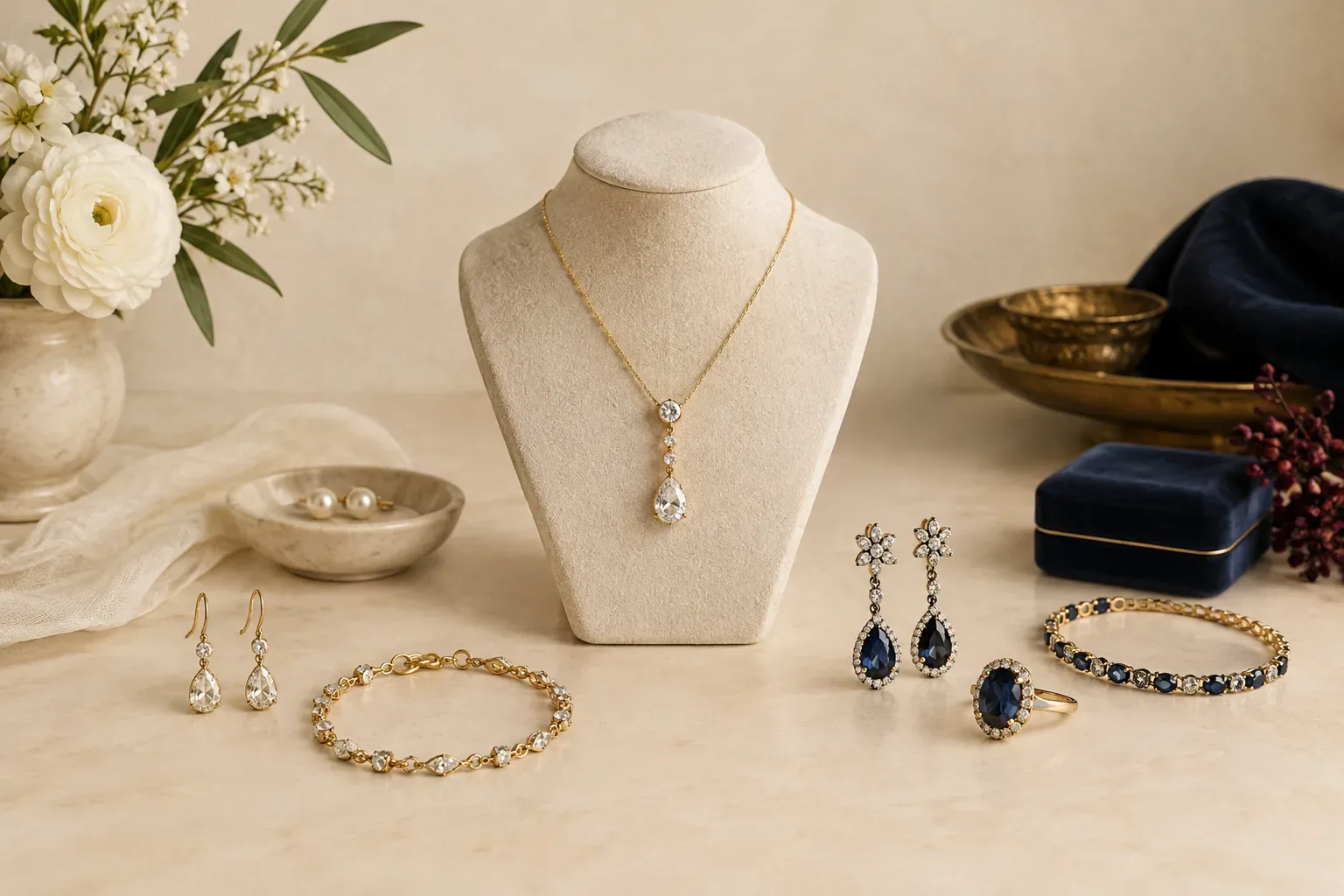
Begin the day with comfortable, secure pieces that won’t snag or distract during a ceremony and daytime socializing. Small studs, a thin chain or short pendant, a slim bracelet and a single ring are sensible daytime choices: they read as polished without being fussy, and they layer well when you add pieces for the evening.
To transition to evening, add or swap for one or two higher-impact elements. The fastest change is to swap studs for statement earrings: clip-on or convertible designs are especially handy for guests who move between activities. A longer, sparkly necklace or a pendant on a longer chain immediately changes a neckline’s emphasis. Add one wider cuff or stack a couple of bracelets to create more visual weight at the wrists for evening photos and dancing.
Brooches and jacket pins are underrated day-to-night tools because they attach quickly and change the focal point of an outfit without interfering with movement. If your daytime look uses a muted palette of metals and matte textures, add a piece with more surface sparkle—rhinestones, cut crystal or faceted gems—to read as evening-appropriate under artificial light.
When possible, use convertible pieces: earrings with removable drops, pendants that attach to different chain lengths, or a bracelet that can be tightened into a choker-style necklace. These choices minimize what you need to carry and reduce the risk of forgetting or losing a separate evening item.
Selection and gifting guidance that is practical and respectful
Research motifs and symbols before you buy or give them as gifts. If a design clearly references a religious symbol or a motif known to a specific culture, confirm that the recipient is comfortable wearing it at a mixed cultural event. When in doubt, choose more neutral, broadly wearable options—classic shapes, simple gemstones and convertible pieces that the recipient can tailor to their own meaning.
Take material and treatment disclosure seriously when purchasing jewellery. The U.S. Federal Trade Commission advises that sellers should disclose gem treatments, synthetics and imitations, and buyers should request that information. If you are buying a gemstone piece to gift, ask the retailer for documentation about treatments (for example, heat treatment of sapphires) and whether the stone is natural, lab-grown or an imitation. Transparent information helps the recipient care for the piece and understand its value.
Consider the event’s formality and the couple’s preferences. Some couples request modest dress or forbid strong displays of religious or cultural symbols; others encourage personal expression. If you are not sure, modest, elegant choices that emphasize quality over ostentation are usually safe. For guests, a guiding principle is to complement rather than outshine the couple—choose pieces that enhance your outfit without drawing all attention away from the wedding party.
Finally, consider practicalities: choose metals compatible with the recipient’s skin (hypoallergenic options if necessary), secure fastenings for active celebrations, and easy-care stones if the wearer will be dancing or outdoors. For a gift, include a short note about any disclosures you received from the seller so the wearer has full information.
Care and purchase notes
Buy with the event and life after the event in mind. If a piece is intended for occasional evening use, prioritize finish and stone security over scratch resistance; for frequent wear choose harder stones and robust settings. The V&A’s resources remind us that jewellery technologies and tastes evolve, so what looks right for a single wedding season may feel dated later; choose lines and proportions you believe the wearer will enjoy over time.
Insist on clear documentation for gemstones and treatments. As the Federal Trade Commission outlines, disclosure about treatments, synthetics and imitations is important for informed purchases. Keep receipts and any gemological reports together with the piece so the buyer or recipient has clear provenance and care instructions.
Final note on cultural respect and personal meaning
Jewellery for weddings carries layered meanings: historical, cultural, social and personal. The documented histories catalogued by museum collections show how specific items functioned in particular times and places. Modern guests and gifters should combine that historical understanding with sensitivity to the couple’s preferences and the wearer’s identity. Doing so allows jewellery to serve both aesthetic and personal goals—enhancing an outfit from day to night while honoring the social and emotional context of the celebration.
Frequently asked questions
What are the easiest jewelry swaps to transition a wedding guest outfit from day to night?
The easiest swaps are changing small studs for statement earrings, adding a longer or sparkly necklace, stacking a cuff or bracelets, and attaching a brooch or pin. Convertible pieces (removable drops, detachable chains) make these swaps quicker and reduce what you need to carry.
Are there motifs I should avoid wearing as a guest because they are culturally or religiously significant?
If a motif clearly references a religion or a specific cultural symbol, research or ask before wearing it at a wedding with diverse guests. When unsure, choose neutral, classic designs. Use the couple’s invitation or guidance about dress code as a reference point.
How should I approach buying a gemstone piece as a wedding gift?
Ask the seller for disclosure about whether the gemstone is natural, treated, lab-grown or an imitation, and for any gem reports. The Federal Trade Commission advises transparency about treatments and imitations so the recipient has accurate information and can care for the piece properly.
Can I wear vintage or heirloom pieces to a wedding?
Yes—vintage and heirloom pieces often add personal meaning, but consider the event’s formality and whether the piece is practical for the day’s activities. Ensure secure fastenings and consider photographing provenance or care notes for insurance or replacement purposes.
Is it rude to wear very sparkly or statement jewelry as a guest?
Not inherently, but moderation is wise. Aim to complement the couple rather than upstage them. If the wedding is very formal, polished sparkle is appropriate; for informal daytime ceremonies, choose more subdued pieces and add sparkle for the evening.
How can I keep jewelry secure during an active reception?
Choose pieces with secure clasps and closed-back settings for stones. Avoid long, dangling elements that can catch while dancing. Consider removing fragile items for active parts of the celebration and replacing them with a sturdier evening piece later.
Sources and further reading
- Bedazzled: A History of Jewellery — Victoria and Albert Museum
- An A-Z of Gemstones — Victoria and Albert Museum
- Buying Gemstones, Diamonds, and Pearls — Federal Trade Commission