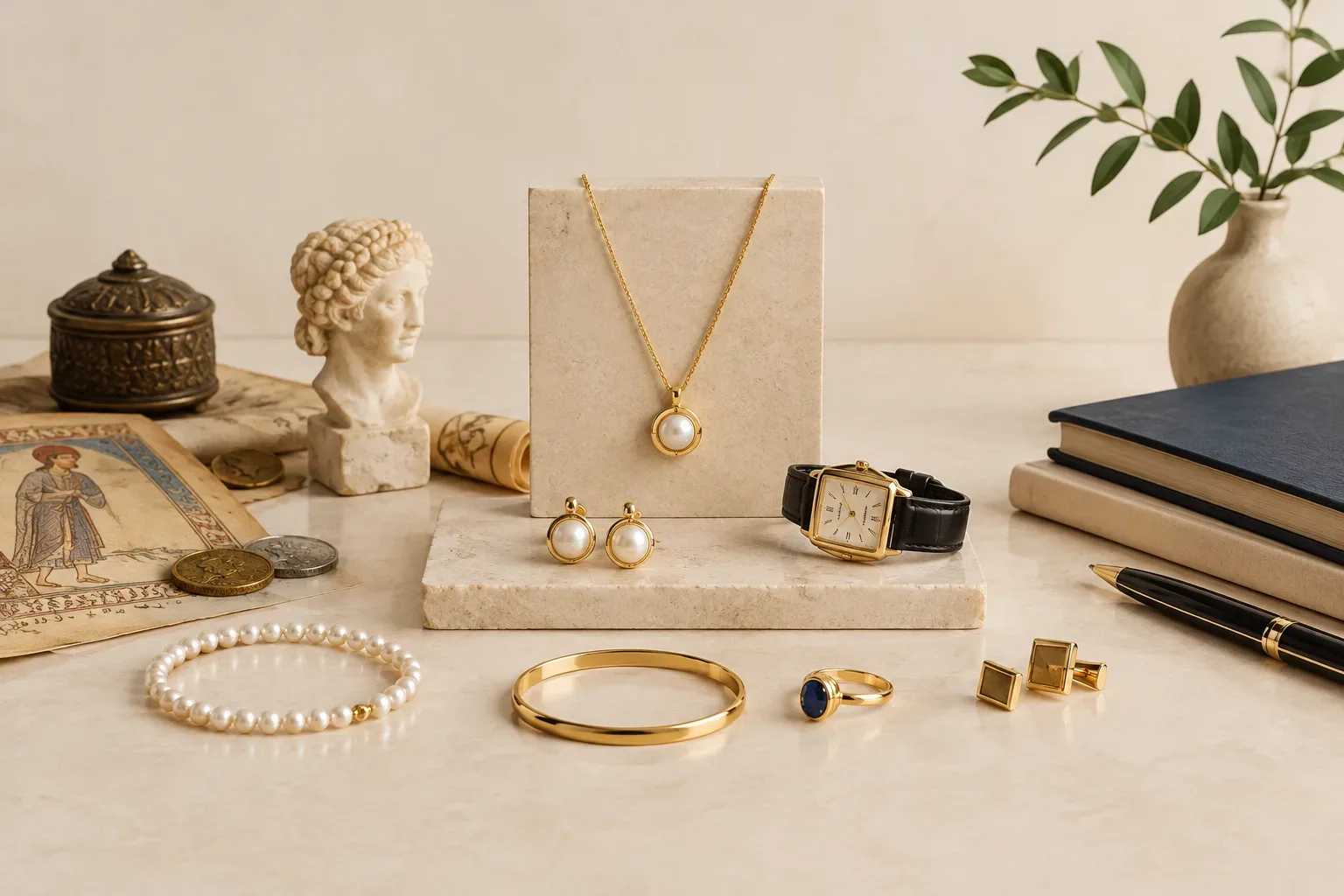
Meaning at a glance
This guide explains documented historical contexts for workplace-appropriate jewelry, separates recorded cultural meanings from later popular interpretations, and gives practical, respectful advice for choosing and gifting pieces that work with office outfits by balancing proportion, color, and focus.
What the historical record shows
Museum scholarship shows that jewelry’s social role and visual language have changed over time and between cultures. The Victoria and Albert Museum describes the long, shifting history of jewellery as a craft and a display of identity, status, and taste across periods and places. Their work emphasizes that materials, techniques, and symbolic uses evolved with technology, trade, and social norms rather than remaining fixed.
Similarly, the Victoria and Albert Museum’s overview of gemstones highlights that different stones have been mined, valued, and used in different societies for reasons including rarity, color, durability, and trade associations. These documentary sources show that historical meanings are context-specific: a practice or meaning associated with one culture or period should not be assumed universal.
Separating documented historical meanings from modern personal interpretations
Documented historical meanings are those that appear in museum records, inventories, treatises, and contemporaneous accounts collected and interpreted by scholars. For example, the V&A’s history identifies that certain forms—such as lockets, signet rings, or mourning pieces—had particular functions or social resonance in some periods. Those documented uses are valuable when you want clothes or jewelry to echo a historical style.
Modern personal interpretations are contemporary layers of meaning people place on motifs or stones today. A heart-shaped pendant worn as a simple fashion choice in an office may carry family or romantic significance for its wearer, but that is a personal association rather than a universal, historically documented meaning. Keep the distinction clear: you can draw inspiration from history without asserting that older meanings automatically apply in modern workplaces.
How motifs, gemstones, and traditions appear in office-appropriate jewelry
Motifs that originated with specific functions—such as lockets for holding portrait miniatures or mourning jewelry that marked bereavement—have reappeared in contemporary design as sentimental or decorative forms. Museum histories show these motifs have been adapted over time, often losing strict functional requirements and becoming stylistic references.
Gemstones appear in modern office jewelry both as color accents and as statements of craft or luxury. An informed buyer can consult gemstone references to learn about hardness, color range, common treatments, and typical settings. The Victoria and Albert Museum’s A–Z of gemstones is a resource for historical context and material identification, while modern concerns about treatments and imitations are addressed in government consumer guidance.
Traditional techniques such as bezel setting, pavé, and cabochon cutting show up in contemporary pieces. What makes a piece office-appropriate is usually its scale, finish, and visual restraint rather than the specific technique used to make it.
Material truth: disclosure, treatments, and durability
When selecting gemstone or metal jewelry for regular wear in an office environment, be aware of material treatments and the implications for durability and value. The Federal Trade Commission provides consumer guidance on buying gemstones, diamonds, and pearls, and emphasizes disclosure obligations around treatments and imitations. For daily office wear, choose durable stones and secure settings, and ask retailers about any enhancements so you understand care needs and long-term appearance.
Practical guidance for choosing jewelry by proportion, color, and focus
Proportion means matching the scale of the piece to your body and to the neckline, collar, or sleeve of the outfit. With tailored jackets and high necklines, choose smaller necklaces or simple studs. With open collars or plain knit tops, a medium-length, single-strand pendant or modest statement necklace can be the focal point. If you wear a bold bracelet or ring, reduce ornamentation at the neck to avoid visual competition.
Color involves coordinating metal tones and gemstone hues with your wardrobe and skin tone without creating a strict rule that excludes experimentation. Observe whether warm metals (like gold tones) or cool metals (like silver tones) sit well with your wardrobe palette. A single accent color—such as a sapphire-blue stud or a lapis pendant—can lift neutral office outfits while remaining discreet if kept to one piece.
Focus means selecting one intentional center of attention for an outfit. Decide whether you want the neck, wrist, or hands to be the focal area. Keep other jewelry minimal so the focal piece reads clearly. For example, choose either a distinctive collar necklace with simple studs or a pair of elegant drop earrings with a neat bracelet, but avoid both simultaneously in most conservative office settings.
Practical guidance for gifting office-appropriate jewelry
When gifting jewelry intended for workplace wear, consider the recipient’s dress code, job role, and personal aesthetic. Conservative roles often favor classic, understated pieces—small stud earrings, a delicate chain, or a simple signet—while creative workplaces may welcome bolder colors and contemporary shapes. If you are unsure, opt for midweight pieces in neutral metals and avoid overtly personal symbols unless you know the recipient’s preferences.
Respect cultural and religious contexts. Some motifs and stones have specific meanings in certain communities; if a piece references a cultural or religious symbol, verify whether it is appropriate for everyday or workplace use. When buying gemstones, ask the seller to disclose any treatments, and include a simple care note with the gift so the recipient knows how to preserve the piece for frequent wear.
Putting it into practice: three example approaches
Minimal classic: For a business-conservative outfit, choose a single pair of small studs and a slim watch or chain. Favor durable metals and hard gemstones if you expect daily wear. Durable, understated pieces photograph well and do not distract in meetings.
Polished accent: For a business-casual wardrobe, select one colorful gemstone pendant or a modest statement ring to serve as the outfit’s focal point. Keep other pieces streamlined so the accent reads as intentional rather than cluttered.
Creative statement: In a creative office, feel free to mix textures and metals while still applying the focus rule: let one piece anchor the look. Historical motifs can be used as conversation starters when appropriate, but treat their historical meanings as background context rather than prescriptions for how they should be worn.
Final notes on respect and personal meaning
Jewelry can convey status, sentiment, and style, but its meanings shift. Use documented historical sources when you want to reference a specific tradition, and treat modern interpretations as individual choices. The most successful office jewelry choices are mindful of workplace norms, durable for frequent wear, and selected with attention to proportion, color, and a clear visual focus.
For further reading on historical motifs and researching their meanings, see our guides on Jewelry Guides, history of lockets, and how to research jewelry symbols.
Frequently asked questions
What jewelry is most appropriate for a conservative office?
In conservative offices choose small, well-made pieces such as stud earrings, a delicate chain, a simple bracelet, or a classic watch. Prioritize modest proportion and a single focal piece rather than multiple competing items.
Can I mix metals for office jewelry?
Mixing metals can work in modern workplaces if done deliberately and sparingly. Aim for a cohesive palette by repeating one metal in larger pieces and introducing another metal as a small accent, keeping overall contrast low for conservative settings.
How do I choose a gemstone that will withstand daily wear?
Refer to gemstone hardness and durability; harder stones resist scratches. Ask the seller about treatments and settings. The Federal Trade Commission advises consumers to request disclosure of treatments and imitations when buying gemstones.
Is it appropriate to wear symbolic or cultural motifs to work?
It depends on the symbol, the workplace, and the wearer’s relationship to the motif. Confirm whether a symbol has specific cultural or religious meanings and consider whether it is appropriate in your professional context. When in doubt, choose neutral or clearly personal pieces.
How should I care for office jewelry to keep it looking professional?
Follow care guidance from the seller, avoid exposure to chemicals and rough surfaces, store pieces separately to prevent scratches, and have rings and settings periodically checked by a jeweller for loose stones or worn prongs.
Sources and further reading
- Bedazzled: A History of Jewellery — Victoria and Albert Museum
- An A-Z of Gemstones — Victoria and Albert Museum
- Buying Gemstones, Diamonds, and Pearls — Federal Trade Commission