Meaning at a glance
Choose earrings and rings that respect the wedding’s cultural context and your comfort while balancing scale and shape with your outfit; understand documented historical meanings from museum research and ask sellers about gemstone treatments and imitations.
What the historical evidence shows
The Victoria and Albert Museum frames jewellery as an object whose form and social meaning change across time and place. The museum’s treatments of jewellery history indicate that people have used personal adornment to mark identity, status, memory, and affiliation in many cultures. Their materials describe how particular shapes, metals, and stones circulated in different regions and periods and how styles shifted with technology and social norms.
For example, the V&A’s overview of gemstones explains how certain stones were prized for material qualities and symbolic associations in distinct contexts. Those associations—such as precious stones signalling wealth in one society or certain motifs being linked to courtly fashion in another—are historically specific. The V&A resources show patterns in which particular forms of jewellery gained prominence in given places and times, rather than universal meanings that apply to every wearer or event.
Separating documented meanings from modern interpretations
Documented meanings are what primary records, museum collections, and curatorial research record about how jewellery was used or understood in a particular culture or period. The V&A documents examples where jewellery functioned as status display, commemorative objects, or practical items (for example, dress fastenings reworked as decorative pins). These are historical observations about how objects were used and perceived in their original contexts.
Modern personal interpretations—how a contemporary wearer may read a motif or gemstone today—are often different from historic meanings. A motif that once signalled allegiance to a family or office may now feel simply decorative or sentimental. Likewise, the cultural significance of a symbol in its original context does not automatically transfer to a modern reception. Respectful choice requires acknowledging the documented context and avoiding assumptions that a meaning is universal or fixed.
How motifs, gemstones, and traditions appear in jewellery
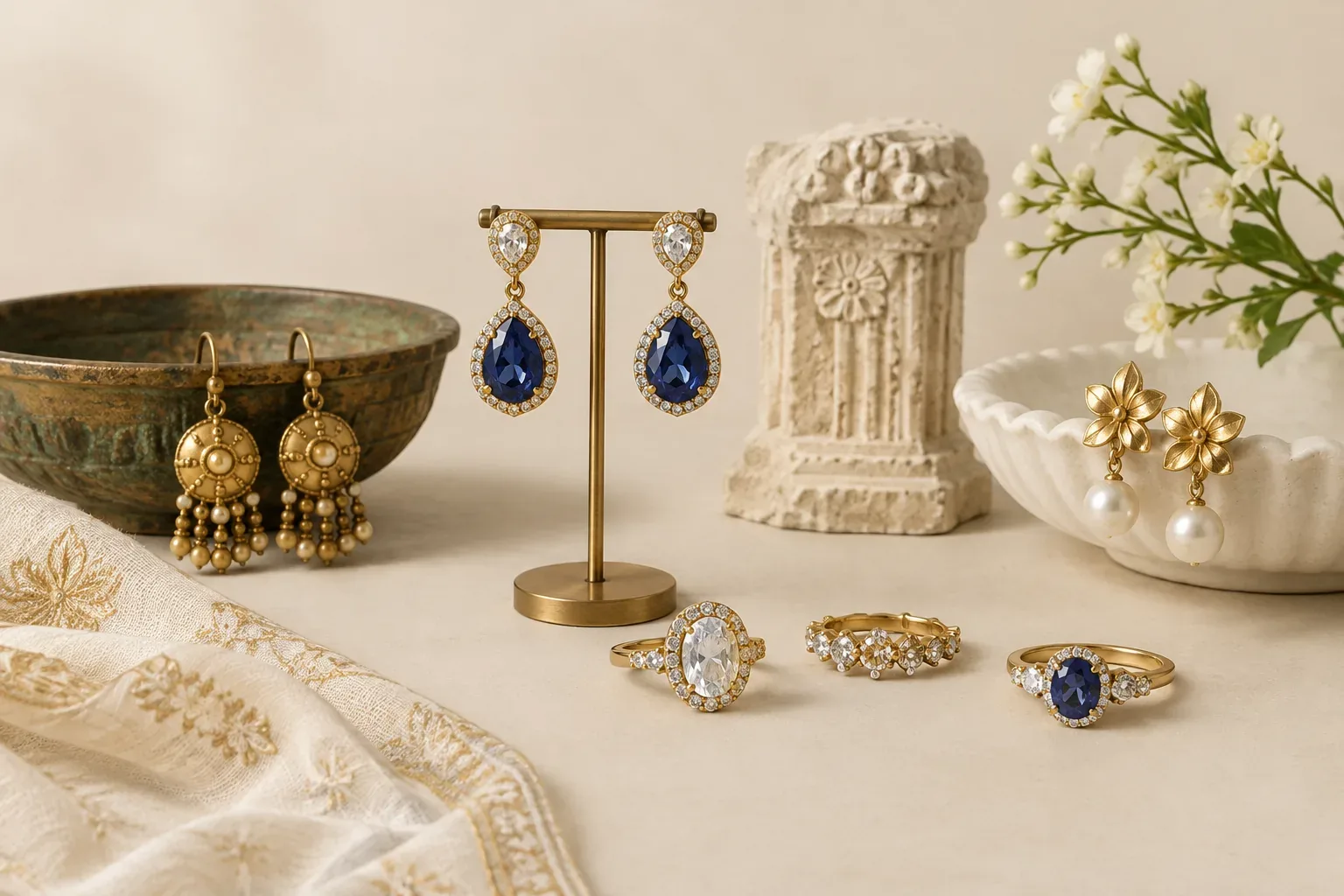
Motifs appear through form, surface decoration, and construction: a floral motif may be engraved or pierced into a metal plate, applied as a cast element on an earring, or suggested by a cluster of stones. The V&A’s surveys of jewellery techniques and styles show how motifs move between jewellery types—pendants, rings, and earrings—adapting to scale and function.
Gemstones appear as cabochons, faceted stones, beads, inlaid chips, or as accents in pavé settings. The V&A’s A–Z of gemstones explains that different cuts and settings were historically chosen for optical effect, durability, and symbolism. Modern pieces may use imitation stones, dyed or heat-treated natural stones, or synthetics; the U.S. Federal Trade Commission requires clear disclosure of many treatments and imitations, so ask sellers about what you are being offered.
Traditions such as wearing a specific stone for a milestone, adopting family heirlooms for weddings, or following local customs about colours and materials show up in the choice and placement of jewellery. Those traditions are culturally specific and sometimes regulated by ritual rules; historical records and museum collections document such practices in particular societies rather than imposing a single set of rules for all guests.
Choosing earrings and rings: scale and shape principles
Balance is the practical principle that governs scale and shape. Consider the neckline, sleeve length, and patterning of your outfit. A high neckline and detailed bodice usually call for smaller earrings and simpler rings so the overall look does not feel crowded. Conversely, a strapless or minimalist dress can take larger earrings or a more sculptural ring because there is visual room to anchor them.
Shape matters for both aesthetics and comfort. Long drop or chandelier earrings create vertical lines that can elongate the neck but are heavier and more likely to tangle with hair or clothing. Huggies and studs sit close to the earlobe and are usually lighter and more secure for long events. Ring shapes with wide bands or prominent settings can be striking but may impede gestures such as holding a glass or dancing; consider low-profile settings if you expect to be active.
Comfort first: materials, weight, and wear time
Comfort affects whether you will actually enjoy wearing a piece for the length of a typical wedding day. Lighter metals and hollow constructs reduce weight in large earrings. Earrings with locking backs or lever-backs are less likely to fall out during dancing. If you are sensitive to alloys, choose known hypoallergenic metals such as titanium or high-karat gold, or confirm the metal content with the seller.
Rings for long wear should fit comfortably and allow natural finger movement. Consider ring profiles and adjust band widths to suit your comfort. If you plan to wear multiple rings, try them together before the event to ensure they do not pinch or spin. For both earrings and rings, test a trial wear of several hours at home to approximate how the pieces will feel during a reception or ceremony.
Styling strategies for coordinating earrings and rings
When styling earrings and rings together, aim for cohesion without exact matching. Choose one focal feature—either your earrings or a statement ring—and keep the other pieces quieter. Coordinate metal tones across pieces for a unified look, but small mixed-metal accents can feel contemporary when deliberately balanced.
Think in terms of negative space: if your earrings are long or intricate, select rings with slimmer profiles or simpler stones so the hands do not compete with the face for attention. Conversely, sculptural cocktail rings pair best with understated studs or small hoops. For multiple rings, stagger widths and textures so the combination reads as curated rather than cluttered.
Respectful selection and gifting guidance
When selecting or gifting jewellery connected to a wedding, be mindful of cultural or religious symbols and of personal meanings attached to heirlooms. If a symbol has a clearly documented religious function in a particular community, respect local protocols: ask the hosts or do a little targeted research before wearing or gifting such a motif. The V&A’s historical perspective underlines that objects can have very specific cultural roles in their original contexts.
If you plan to gift jewellery to the couple or to a host, choose something neutral or clearly celebratory rather than a symbol reserved for liturgical use. A piece that acknowledges the couple’s taste or matches their wedding palette tends to be received well. When purchasing gemstones, ask the seller about treatments, origin, and whether a stone is natural, synthetic, or imitation; the Federal Trade Commission guidance requires transparency on many such points and helps you make an informed purchase.
Practical checklist before the wedding
Try your complete jewellery set with your outfit, shoes, and hairstyle at least once before the event, and wear it for a few hours to check comfort. Confirm that earring backs are secure and that rings are sized for possible swelling from heat or salt (for outdoor events). If you plan to dance a lot, prioritize locking earring backs and low-profile ring settings, and consider leaving very valuable or easily snagged pieces at home.
When in doubt about a symbol or motif, err on the side of asking a knowledgeable friend or the hosts. Respect for the ceremony and for culturally specific meanings is better than assuming a motif is purely decorative.
Frequently asked questions
Can wedding guests wear statement earrings?
Yes—statement earrings can be appropriate if they balance with your outfit and are comfortable for several hours. Choose secure backs and consider hair and neckline so the earrings do not snag. If you plan to dance or move a lot, prefer lighter designs or pick a single statement piece and keep other jewellery minimal.
Are there jewellery symbols guests should avoid?
Avoid wearing symbols known to have a specific religious or ritual significance in the ceremony’s culture unless you are certain of the appropriateness. The V&A’s research highlights that symbols often have historically specific meanings, so when in doubt ask the hosts or choose neutral motifs.
How do I balance rings and earrings together?
Pick one focal area—either the face (earrings) or the hands (rings). If your earrings are large or intricate, opt for simpler rings. If you want sculptural rings, pair them with small studs or hoops. Coordinate metal tones or use a deliberate mixed-metal palette for cohesion.
What should I ask a seller about gemstones?
Ask whether the stone is natural, synthetic, or an imitation and whether it has been treated (for example, heat-treated or dyed). The U.S. Federal Trade Commission provides guidance on disclosure, so sellers should be able to explain treatments and origins.
How can I ensure my earrings won’t fall out during the event?
Choose earrings with secure fittings such as locking backs, screw-backs, or lever-backs. Test them with a trial wear and consider using clear silicone stoppers for extra security with push-backs.
Is it okay to wear family heirlooms as a guest?
Wearing family heirlooms is acceptable, but be mindful if an heirloom is itself associated with that wedding family or ritual. If the piece has particular cultural or ceremonial meaning for the hosts, consult a member of the family first to avoid offense.
Sources and further reading
- Bedazzled: A History of Jewellery — Victoria and Albert Museum
- An A-Z of Gemstones — Victoria and Albert Museum
- Buying Gemstones, Diamonds, and Pearls — Federal Trade Commission