Meaning at a glance
This guide explains the documented history and shifting social contexts of wearing jewelry with tailored jackets, distinguishes historically recorded meanings from later or personal interpretations, describes how motifs and gemstones appear in pieces intended for blazers, and offers practical, respectful selection and gifting guidance focused on proportion, color harmony, and visual focus.
What the historical record actually shows
Museums and scholarship show that decorative objects and jewellery have long been used to signal status, identity and taste, and that those uses change over time and by society. The Victoria and Albert Museum’s overview of jewellery history emphasizes that jewellery’s social functions and forms shift across periods and classes, from functional fasteners and status markers to sentimental and fashion items (Victoria and Albert Museum).
Historically, many of the motifs and settings we see on modern jacket jewellery—floral sprays, enamelled animals, heraldic emblems and gemstone accents—have precedents in the V&A’s collections and exhibitions, which document how techniques, materials and display contexts evolved. The V&A’s A–Z of Gemstones provides the museum’s guidance on how particular stones were used and valued across different periods and cultures, and how identification and meanings can vary with context (Victoria and Albert Museum).
Those museum reports make two important points relevant to blazers today: first, jewellery forms and meanings are not fixed but respond to social change; second, the same object can mean different things depending on who wore it, when, and why. Treat historical evidence as descriptive—what people actually did or valued—rather than as a universal prescription for meaning.
Documented historical meanings versus modern interpretations
Documented historical meanings tend to be specific: a mourning locket in Victorian Europe held a portrait or lock of hair and was associated with bereavement and remembrance; civic or heraldic badges denoted allegiance or office. The V&A materials document these functions as part of broader social and technological histories (Victoria and Albert Museum).
Modern interpretations—such as reading a floral lapel pin automatically as a sign of romantic intent, or assuming a particular gemstone always guarantees a specific personality trait—are often personal or culturally local rather than historically documented. Contemporary wearers and designers freely repurpose motifs for fashion, personal symbolism, or brand identity. When choosing or gifting, distinguish what a symbol meant historically (museum documentation) from what it might mean to an individual today; ask or explain rather than assume.
How motifs, gemstones and traditions appear on blazer jewellery
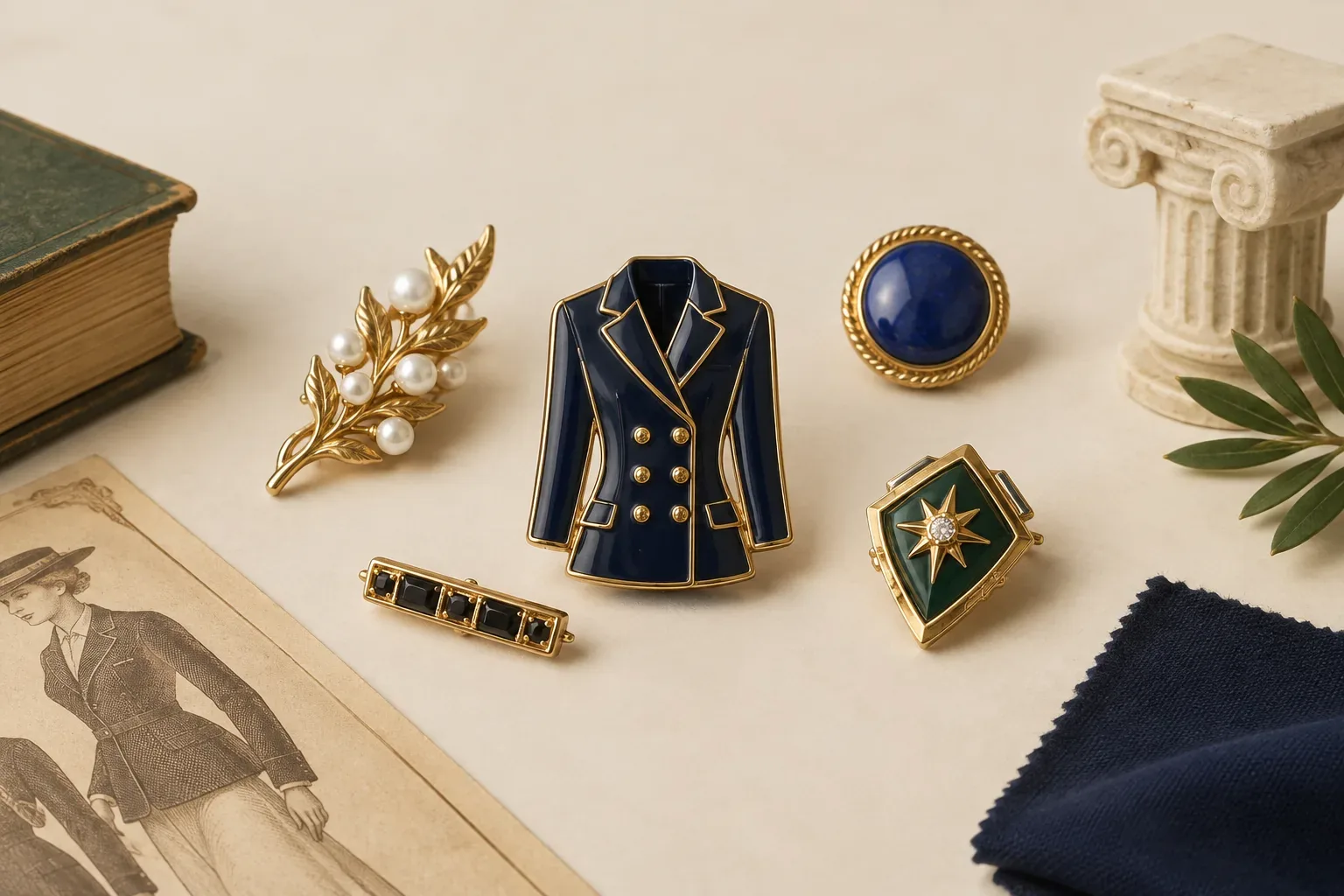
Motifs and gemstones appear on blazers primarily as lapel pins, brooches, cufflinks, collar chains and small pendant necklaces worn inside an open blazer. Lapel pins and brooches can be enamelled, set with cabochon or faceted stones, or cast in metal. Historical techniques such as enamelling and gemstone setting persist in modern pieces, and the V&A’s resources show these methods have long histories (Victoria and Albert Museum).
Gemstones commonly used with tailored jackets range from small accent diamonds or zircons to colored stones such as sapphires, garnets and pearls. The V&A’s A–Z of Gemstones offers context on how particular stones have been used historically and how their color and cut affect appearance in dress jewellery (Victoria and Albert Museum). For buyers, the Federal Trade Commission’s consumer guidance on gemstones, diamonds and pearls remains essential: it explains that treatments, synthetics and imitations exist and that sellers should disclose material treatments and origins (Federal Trade Commission).
Traditions such as wearing a symbolic pin for membership, remembrance, or support are modern continuations of older badge practices. But the social meaning of such badges depends on temporal and cultural context: what signified membership in one era or place may mean something different today.
Proportion: size and placement
Proportion is the first practical rule. Small, discreet pins work with narrow lapels and slim, minimalist blazers; larger brooches or multi-stone pieces suit wider, structured lapels and heavier fabrics. A piece should neither overwhelm the line of the jacket nor vanish against it. Visually test proportion by holding the piece to the lapel before purchasing or try a clip-on mock-up to see how it sits when the jacket is buttoned and unbuttoned.
Consider placement. A traditional placement is on the left lapel near the buttonhole or slightly below the collar point. For contemporary looks, try a slightly higher or lower position to align jewellery with the neckline of the top beneath. For necklaces, ensure the pendant length complements the blazer opening: short chains read as an accent against a V-neck or open collar, while longer pendants work with unbuttoned jackets and wraps.
Color: metal tones and gemstone harmony
Match metal tone to the outfit and to the wearer’s usual choices. Warm metals (yellow gold, rose gold, brass tones) pair naturally with warm fabrics and autumnal palettes; cool metals (white gold, platinum, sterling silver) pair with cool or neutral palettes. Mixing metals can work if you keep to a deliberate balance, for example a single warm metal accent against predominantly cool tones.
Choose gemstone color to harmonize or intentionally contrast. A single colored stone can echo a blazer’s lining, a shirt hue, or the wearer’s eyes; contrasting stones can create a focal pop. Remember that small stones read differently from large ones: a pavé of tiny stones can add texture without adding color dominance, while a single colored cabochon will draw the eye.
Focus: single statement versus coordinated accents
Decide whether jewellery is the outfit’s focal point. A bold brooch or an unusual lapel pin can be the single statement that defines a look, in which case keep other jewellery minimal. Alternatively, use small coordinated accents—matching cufflinks, a subtle lapel pin, and a fine chain—to create a cohesive but understated effect.
Consider the occasion. Formal or ceremonial events often suit a single, clearly placed piece. Everyday professional settings typically favour moderation and pieces that complement rather than compete with tailoring. For evening wear or creative settings, bolder combinations and unexpected placements can be appropriate.
Respectful selection and gifting guidance
When selecting or gifting jewelry for a blazer, research whether a motif has cultural, religious, or organizational meaning for the recipient. If a symbol may carry special significance—such as religious icons, insignia, or political emblems—ask discreetly or choose neutral designs unless you are certain the recipient welcomes the symbolism.
Practical gifting considerations include the recipient’s metal allergies, typical wardrobe palette, and the blazer’s style. Provide provenance or receipts for higher-value pieces and ask the seller about gemstone treatments and any certification; the Federal Trade Commission recommends consumers seek disclosure of treatments, enhancements, and whether a stone is synthetic or natural (Federal Trade Commission). For sentimental gifts, consider engraving or a note that explains your intention, but avoid asserting historical meanings as facts when they are contemporary or personal interpretations.
For ethical concerns, ask the retailer about sourcing and treatment disclosures and prefer sellers who are transparent. If unsure about size or style, opt for adjustable pieces, modest sizes, or gift receipts to allow an exchange.
Care, buying, and verification
Care for blazer jewellery according to its materials: enamel and delicate stones need protection from knocks; plated metals may wear with frequent rubbing against fabric. Store pins with their clasps closed to avoid snagging and remove jewellery before dry cleaning or heavy laundering.
When buying, use museum and consumer guidance to inform questions. The V&A resources help with historical context and gemstone identification, while the FTC advises consumers to ask about treatments and disclosure (Victoria and Albert Museum; Federal Trade Commission). For notable purchases, request written information on materials, treatments, and return policies.
Final thought
Jewellery for blazers is a conversation between personal style, historical forms, and social context. Use proportion, color harmony, and a clear decision about whether the piece should command attention or subtly complement your outfit. Respect documented histories and the meanings they carried, but recognize that modern wearers often create new, personal meanings when they choose and wear jewellery.
Frequently asked questions
What size brooch should I wear on a blazer?
Choose a size proportionate to the lapel: small, discreet pins for narrow lapels; larger brooches for wider, structured lapels. Test a piece against the lapel before buying to ensure it neither overwhelms the jacket’s line nor disappears against the fabric.
How do I match gemstone color to a blazer?
Harmonize by echoing a lining or shirt color for a subtle effect, or use a contrasting stone as a deliberate focal pop. Consider stone size and setting: small stones add texture, a single colored cabochon draws the eye.
Can I mix metals when wearing jewelry with a blazer?
Yes, if you do so deliberately. Keep the mix balanced—for example, a single warm metal accent within an otherwise cool palette—or coordinate by repeating one metal across multiple small pieces to create cohesion.
Is it appropriate to wear religious or political symbols on a blazer?
Exercise caution. If a symbol has potential cultural, religious or political significance, ask the recipient before gifting or be certain the wearer welcomes that meaning. When unsure, choose neutral designs that avoid unintended messages.
How should I care for enamelled pins and stones on blazer jewellery?
Protect delicate surfaces from knocks and snagging. Store pins with clasps closed, remove jewellery before dry cleaning or heavy laundering, and follow any care advice provided by the seller for specific materials.
How can I verify a gemstone’s authenticity and treatments?
Ask sellers for written information on whether a stone is natural, synthetic, or treated. The Federal Trade Commission recommends requesting disclosure of treatments and any certifications for notable purchases (Federal Trade Commission).
What should I consider when gifting blazer jewellery?
Consider the recipient’s usual wardrobe, metal allergies, and any cultural meanings attached to motifs. Prefer adjustable or modest pieces if you are unsure of size, and include a gift receipt or provenance information for higher-value items.
Sources and further reading
- Bedazzled: A History of Jewellery — Victoria and Albert Museum
- An A-Z of Gemstones — Victoria and Albert Museum
- Buying Gemstones, Diamonds, and Pearls — Federal Trade Commission