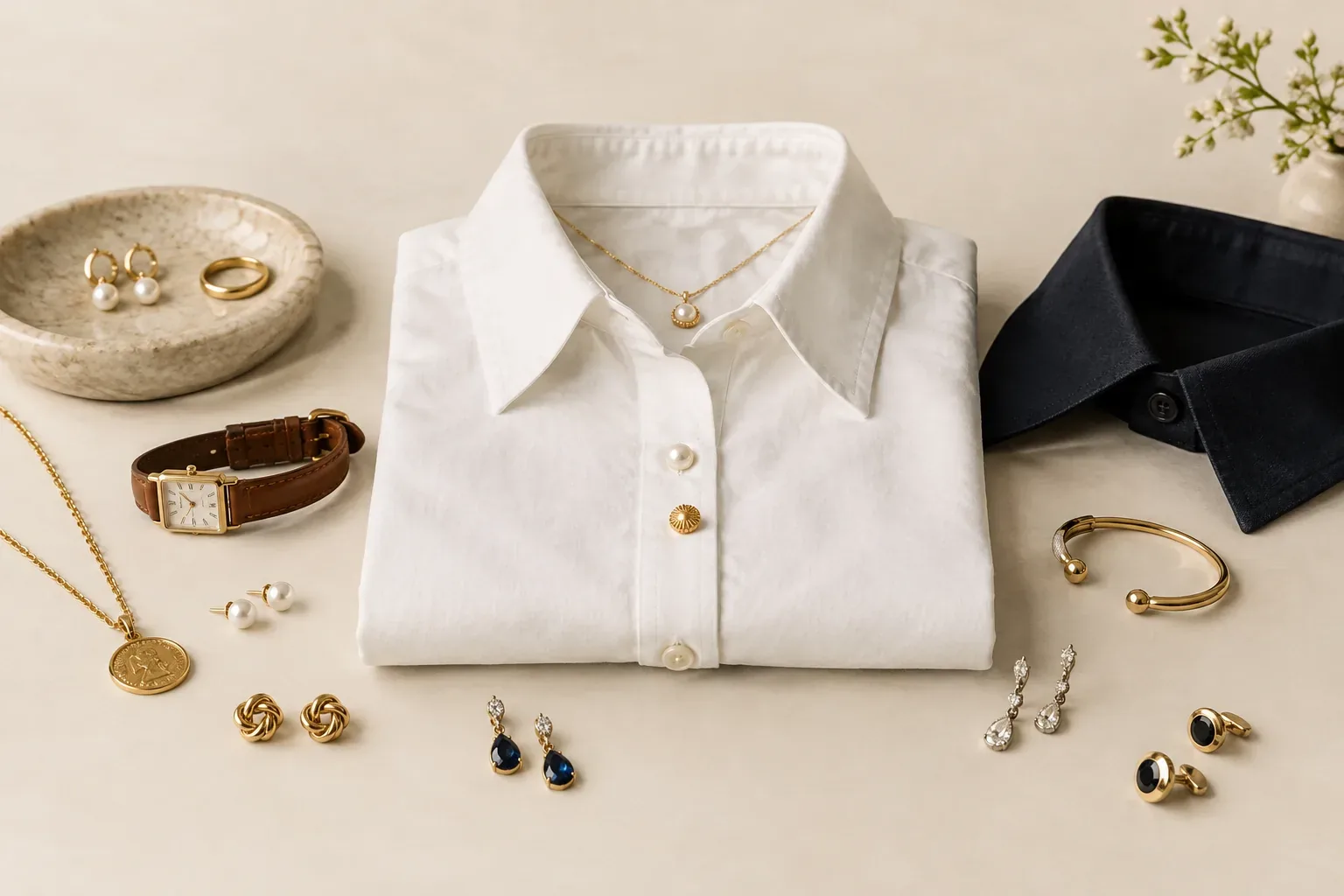
Meaning at a glance
Use small, secure daytime pieces placed close to the collar or placket, and switch one or two elements—a pendant, brooch, or earrings—to elevate the same button-down for evening; the V&A documents the functional origins and evolving contexts of many fasteners and personal gems, while modern styling is personal and culturally varied.
Quick answer
Keep daytime jewelry simple and close to the body—studs, short chains, and slim collar clips—and then change one or two focal pieces for evening, such as swapping a short chain for a slightly longer pendant, adding a single statement brooch at the collar, or replacing understated studs with drop earrings. This approach respects the documented functional origins of many shirt fasteners and ornaments while allowing contemporary personal expression.
Documented history and cultural contexts
Jewellery has long combined practical function with personal meaning. The Victoria and Albert Museum's surveys of jewellery history describe how many objects that now read as purely decorative began as functional fasteners, status markers, or personal emblems. The V&A places these types of objects within changing social contexts rather than attributing a single, enduring symbolic meaning.
For example, fastenings and pins used to hold garments together or secure cloaks were often decorated, and over time similar objects became wearable statements of wealth, craft, or affiliation. The V&A's exhibition and articles make clear that such functional origins are a recurring theme across different periods and places, and that the significance of a given ornament changed with technology, fashion, and social norms.
When discussing gemstones, the V&A's A–Z of Gemstones highlights that particular stones were prized for their colour, rarity, or perceived properties, and that those preferences shifted by period and culture. The V&A presents these preferences as historical facts about taste and use rather than universal symbolic claims.
Documented meanings versus modern personal interpretations
Documented historical meanings are best described as context-specific: objects served practical purposes, indicated social rank, or acted as portable forms of identity. The V&A's work shows that an ornament could simultaneously be a fastener, a status symbol, and a sentimental token depending on time and place.
Modern interpretations—what someone today feels a piece 'means' when worn with a button-down shirt—are personal and influenced by fashion, media, and individual history. Those contemporary readings are valid as personal expression but should not be mistaken for historical universality. Where scholarship records a practice or stated meaning, I attribute that to the museum sources; where I offer styling or gifting advice, that is contemporary practical guidance.
How motifs, gemstones, and traditions appear on button-down shirts
Motifs and gems that historically appeared as clasps, brooches, or pendants are adapted to button-down shirts in several common ways. Collar clips and small pins echo the earlier functional fasteners: they sit across or at the collar point to add a decorative accent while leaving the shirt’s buttons visible. Brooches can be anchored to the shirt front or the collar stand to create a single focal point.
Necklaces and pendants are the most direct translation of historical pendants. Short chains that fall just below the collarbone work well with a slightly open top button; longer chains can be worn under an open placket for a layered effect. Gemstones historically valued for colour and light—pearls, garnets, sapphires, and others described in the V&A's A–Z—are commonly set in small studs, short pendants, or low-profile collar pins so they read as refined rather than overpowering on a shirt.
For shirts with French cuffs, cufflinks continue a long history of functional ornamentation. Tie pins and studs also echo historical utilitarian objects that gradually became decorative. In all cases, the practical origin—fastening, securing, or marking clothing—remains visible in the way these elements sit against the shirt.
Day-to-night strategies: simple changes that work
Plan your day-to-night switch with minimal changes that have maximal visual impact. During the day, choose small, secure pieces: stud earrings, a short chain or collar clip, and a conservative brooch if you want one. For evening, replace one of those elements with a bolder piece: swap studs for shoulder-grazing drops, replace a short chain with a pendant on a longer chain, or move a small brooch to the collar point and pin it more visibly.
If you wear a button-down with the top two buttons open during the day, you can layer a short chain over a shirt and add a longer pendant for evening, letting the pendant sit on the placket for drama. Alternatively, keep a thin necklace on during the day and clip on a removable statement locket or charm before heading out. For a quieter switch, change only the earrings: a single swap from studs to drops shifts the outfit without disturbing hair or makeup.
Brooches and collar pins are especially effective because they read differently depending on placement. A small brooch close to the collarbone reads understated; moving it to the collar point or higher on the placket makes it more central and evening-appropriate. For men and women who wear ties, a tie pin or a decorative tie bar can substitute for a necklace and creates a comparable day-to-night transition by swapping an understated bar for a jeweled pin.
Selection and gifting guidance: practical and respectful
Choose pieces that suit the shirt's collar and fabric. Stiff collars and heavier fabrics support heavier pins and brooches; lightweight cottons and silks do better with small studs, short chains, or collar clips designed not to strain the fabric. Consider the scale of the jewelry relative to the collar and placket so the piece complements rather than competes with the shirt.
When selecting gemstones or materials, consult established guidance about treatments and disclosures. The U.S. Federal Trade Commission's consumer advice on buying gemstones, diamonds, and pearls stresses that treatments, synthetics, and simulants should be clearly disclosed by a seller. If you value a particular stone for its material authenticity—natural, untreated, or lab-grown—ask the seller for documentation and disclosure before purchasing.
For gifts, consider function and personal meaning separately. A brooch or collar clip can be a thoughtful present that aligns with the recipient's wardrobe habits, while a pendant with an engraved date or motif can carry explicit sentimental meaning. Avoid assuming a single symbol has the same cultural or religious meaning for everyone; when gifting symbols with known cultural or religious resonance, do some discreet research or ask the recipient if they appreciate that tradition.
Care, disclosure and respectful use
Treat vintage or heirloom pieces with care. Pins and brooches made for stiff historical fabrics may snag modern lightweight shirts. If you plan to wear vintage jewellery on delicate button-downs, have a tailor reinforce a small area of fabric or choose to anchor the piece to an underlayer rather than directly through the shirt.
Respect cultural and religious symbols. The V&A documents how motifs and objects have specific historical meanings in their original contexts, and those meanings may carry contemporary significance. If a piece includes a clearly identifiable cultural or religious emblem, use it with awareness of its origins and, when in doubt, ask about the appropriateness of wearing or gifting it.
Always request or retain documentation about gemstones and treatments. As the FTC notes, sellers should disclose enhancements and imitations, so ask for such details especially when buying higher-value pieces. Proper disclosure protects both buyer and seller and helps preserve trust in the gift or investment.
Frequently asked questions
What necklace length works best with a button-down shirt for day-to-night styling?
A short chain that sits at the collarbone is most versatile for daytime and can be layered with a longer pendant for evening. Choose a length that falls comfortably above or on the placket when the top button is open so it reads clearly against the shirt.
Can men use the same day-to-night jewelry strategies with button-down shirts?
Yes. Swap an understated tie bar or cufflinks for a decorative tie pin, add a pendant beneath an open collar, or change studs to small drop earrings if comfortable. The key is to alter one element to transform the look without over-accessorizing.
Are vintage brooches safe to wear on modern shirts?
Vintage brooches can be heavier or have pin mechanisms that snag lighter fabrics. Anchor them to a sturdier underlayer or have a tailor reinforce the shirt fabric. Inspect the pin mechanism and, if needed, have it repaired by a jeweller to avoid damaging the shirt.
How do I know if a gemstone has been treated or is a simulant?
Ask the seller for written disclosure about treatments, enhancements, or whether the stone is synthetic or a simulant. The Federal Trade Commission advises that such information should be provided. If in doubt, request a certificate from a recognised lab for higher-value purchases.
Is it appropriate to wear jewellery with religious or cultural motifs on a button-down shirt?
It can be appropriate if you understand the symbol's meaning and context. The Victoria and Albert Museum documents many motifs with cultural significance; if a symbol is clearly religious or culturally specific, research its contemporary meaning and consider asking the wearer or recipient about their preferences.
How can I avoid damaging my shirt when attaching pins or clips?
Choose lightweight pins designed for garments, avoid repeatedly placing heavy pins through the same spot, reinforce the area with a small patch or underlayer if necessary, and remove brooches before laundering to protect both the jewellery and the fabric.
Sources and further reading
- Bedazzled: A History of Jewellery — Victoria and Albert Museum
- An A-Z of Gemstones — Victoria and Albert Museum
- Buying Gemstones, Diamonds, and Pearls — Federal Trade Commission