Meaning at a glance
Jasper is an opaque microcrystalline quartz material sold in many patterned varieties; trade labels require scrutiny and modern meanings are not medical facts.
What jasper is (minerals and varieties)
Jasper is part of the broader quartz family and is recognized primarily by its opacity, color, and patterning. The Smithsonian National Museum of Natural History describes quartz in its many occurrences and varieties and places patterned opaque forms such as jasper within that broader mineral context. Pattern, color banding, and the presence of inclusions or iron staining produce the many trade names and visual varieties you will see in the marketplace.
Historical evidence and how cultures are documented
Authoritative mineral and museum sources emphasize jasper's material identity rather than a single, consistent symbolic history. The Smithsonian's resources on quartz document its long presence in natural history collections and its many varietal names, which in turn shows that jasper has been recognized as a distinct visual type of quartz over time. Individual cultures used opaque silicates for ornament and functional objects, but the Smithsonian resource does not consolidate a single, universal symbolic meaning for jasper across periods or peoples.
The Gemological Institute of America (GIA) highlights how trade names can be applied to patterned quartz materials; their article on “Dalmatian Jasper” is an example of a trade label that helps sellers and buyers talk about appearance but does not alter the stone's mineral classification. Where archaeological or cultural studies record specific symbolic roles for particular stones in named societies, those are specialized findings in archaeology, history, or folklore and are not summarized in the GIA or Smithsonian pages cited here.
Documented historical meanings versus modern interpretations
Documented historical meanings: Mineralogical and museum sources focus on identification, occurrence, and use. The Smithsonian documents quartz varieties and their roles as materials in collections, which supports the fact that jasper was used as an ornamental material but does not provide a unified symbolic meaning assigned across cultures. The GIA demonstrates how market names such as Dalmatian jasper function as trade labels, not as authoritative cultural interpretations.
Modern interpretations: In contemporary markets and personal practice, jasper is frequently associated with notions such as grounding, nurturing, or connection to the earth. These associations are modern, are promoted by metaphysical sellers and individual practitioners, and vary widely by community and person. Such interpretations are personal or cultural beliefs and should not be treated as medical facts or universal truths.
How jasper appears in jewelry
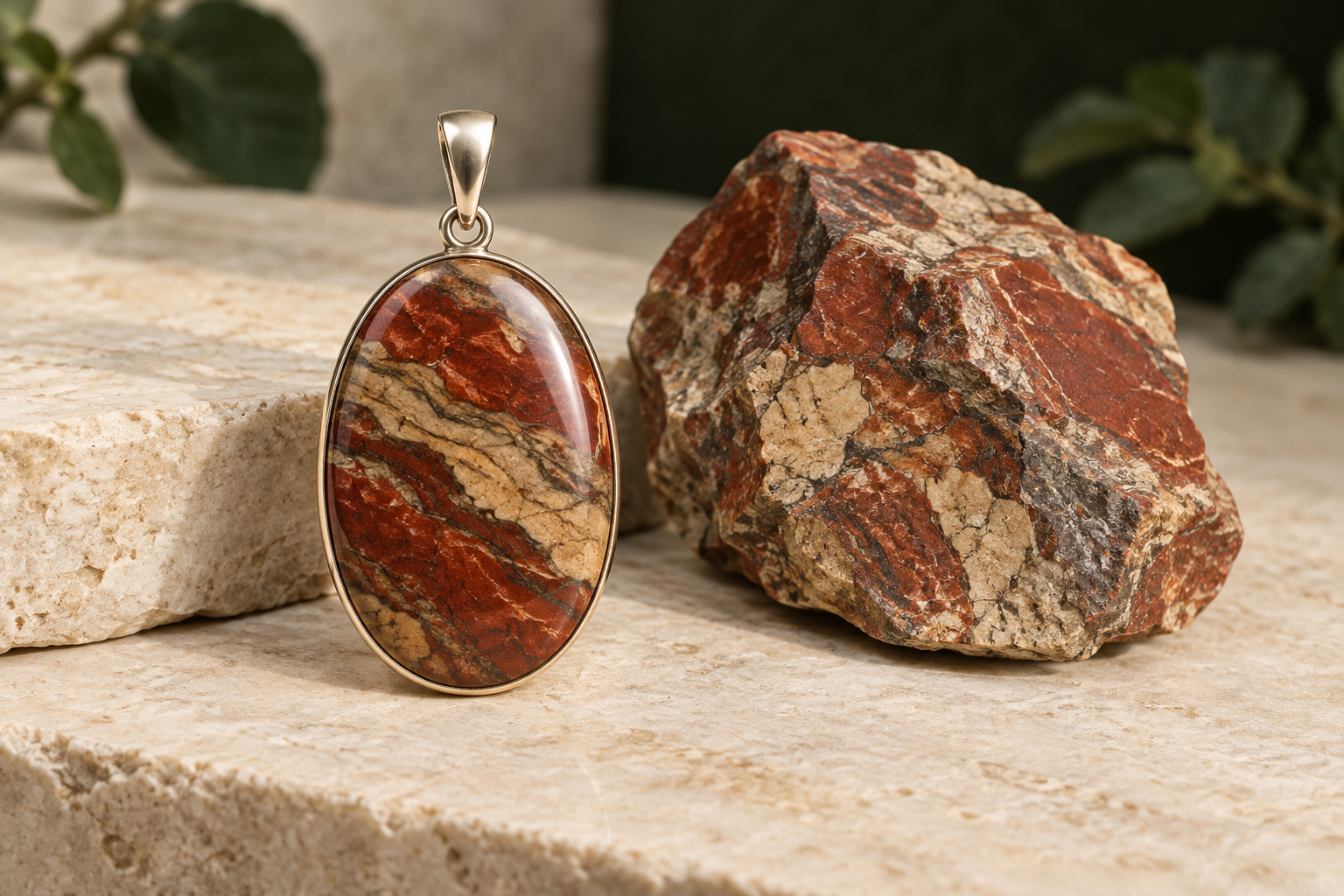
Jasper's appeal to jewelers and buyers comes from its variety of surface patterns and colors. In jewelry you will commonly encounter jasper set as polished cabochons, carved into beads and pendants, and used for inlay or sculpted elements where the stone's pattern is the focal point. Because jasper is opaque, it is rarely faceted like transparent gemstones; lapidaries capitalize on surface patterns by shaping and polishing to showcase a stone’s markings.
Trade labels are common in jewelry descriptions. For example, the GIA article on Dalmatian jasper shows how a distinct spotted appearance is marketed under a recognizable name. That label helps consumers identify the look they want and helps sellers describe pieces, but it does not change the basic mineralogy: the material is a form of microcrystalline quartz.
Buying: what to ask and how to judge quality
Begin by asking clear questions about identity and treatment. Request the seller’s description of the stone, whether they are using a trade name, and whether the piece has any dyes, stabilizers, or surface coatings. Trade names such as “Dalmatian jasper” are common and helpful for describing appearance, but they are not scientific classifications on their own; the GIA uses such examples to illustrate how trade names work in the marketplace.
Assess pattern, color saturation, and how those characteristics align with the wearer’s taste. Because jasper is valued for its surface character, clarity is not the same factor as for transparent gems; instead look for pleasing pattern, consistent polish, and sound settings. Consider mounting choices: bezel settings protect thick, opaque stones better than exposed prong settings, while understated mounts can let a patterned jasper be the visual focus.
Gifting guidance: respectful and practical choices
When gifting jasper, consider the recipient’s style and cultural context. Some buyers choose jasper for its earthy colors and strong surface patterns; others select it for personal or metaphysical reasons. If a stone’s symbolic meaning matters to the recipient, check whether they prefer historically documented associations from a particular culture or more recent personal meanings.
Be transparent about what you know. If you are purchasing under a trade name, tell the recipient that the name describes appearance rather than a cultural or medical claim. If you buy from a commercial listing that uses a trade name, keep any original documentation or the seller’s description to accompany the gift.
Care and maintenance
Caring for jasper is similar to caring for many polished, opaque stones. Clean gently with mild soap and water and a soft cloth, rinse and dry thoroughly, and avoid prolonged exposure to harsh chemicals or abrasive cleaners. Because jasper is prized for surface polish, avoid ultrasonic cleaners and steam treatments unless you know the piece has no dyes, coatings, or fragile inlays.
Store jasper jewelry separately from harder, faceted stones to avoid surface scratches. For mounted pieces, consider protective settings when the wearer plans frequent use, and inspect settings periodically to ensure beads or cabochons remain secure.
Putting it together
Jasper jewelry meaning depends on two clear facts: first, jasper is an opaque, patterned form of microcrystalline quartz recognized across mineralogical resources; second, many of the symbolic meanings popularly attached to jasper are modern and personal rather than universally documented. Use authoritative descriptions to confirm identity, treat trade labels as appearance descriptors, and choose or gift jasper with attention to pattern, mounting, and the recipient’s beliefs.
Frequently asked questions
What exactly is jasper?
Jasper is an opaque variety of microcrystalline quartz valued for its colors and surface patterns; museum resources on quartz describe it as one of several visually distinct forms within the quartz family.
Is Dalmatian jasper a different mineral?
No. As the Gemological Institute of America explains, names like 'Dalmatian jasper' are trade labels used to describe a particular spotted appearance of a patterned quartz material, not a separate mineral species.
Do historical sources give jasper a single symbolic meaning?
Authoritative mineralogical and museum sources document jasper as a material used in ornament and collections but do not record a single, universal symbolic meaning across cultures; specific symbolic uses must be sourced to the cultural or historical scholarship that studies that context.
Are the meanings I see online medical facts?
No. Modern metaphysical or wellness claims tied to gemstones are personal or commercial interpretations and are not medical facts. Treat them as beliefs rather than scientific statements.
How should I clean and store jasper jewelry?
Clean gently with mild soap and a soft cloth, rinse and dry thoroughly, avoid harsh chemicals and abrasive cleaners, and store pieces separately to prevent scratching.
What should I ask the seller when buying jasper?
Ask about the stone's identity, whether a trade name is used, and whether the material has been dyed, stabilized, or treated; request clear photos or documentation if provenance matters to you or the recipient.
Sources and further reading
- Dalmatian Jasper — Gemological Institute of America
- All Sorts of Quartz — Smithsonian National Museum of Natural History