Meaning at a glance
Iolite is gem-quality cordierite prized for strong pleochroism; optical and durability facts are well documented by gemologists while compass or navigator legends belong to modern interpretation rather than established historical record.
What iolite is: mineral identity and optical behavior
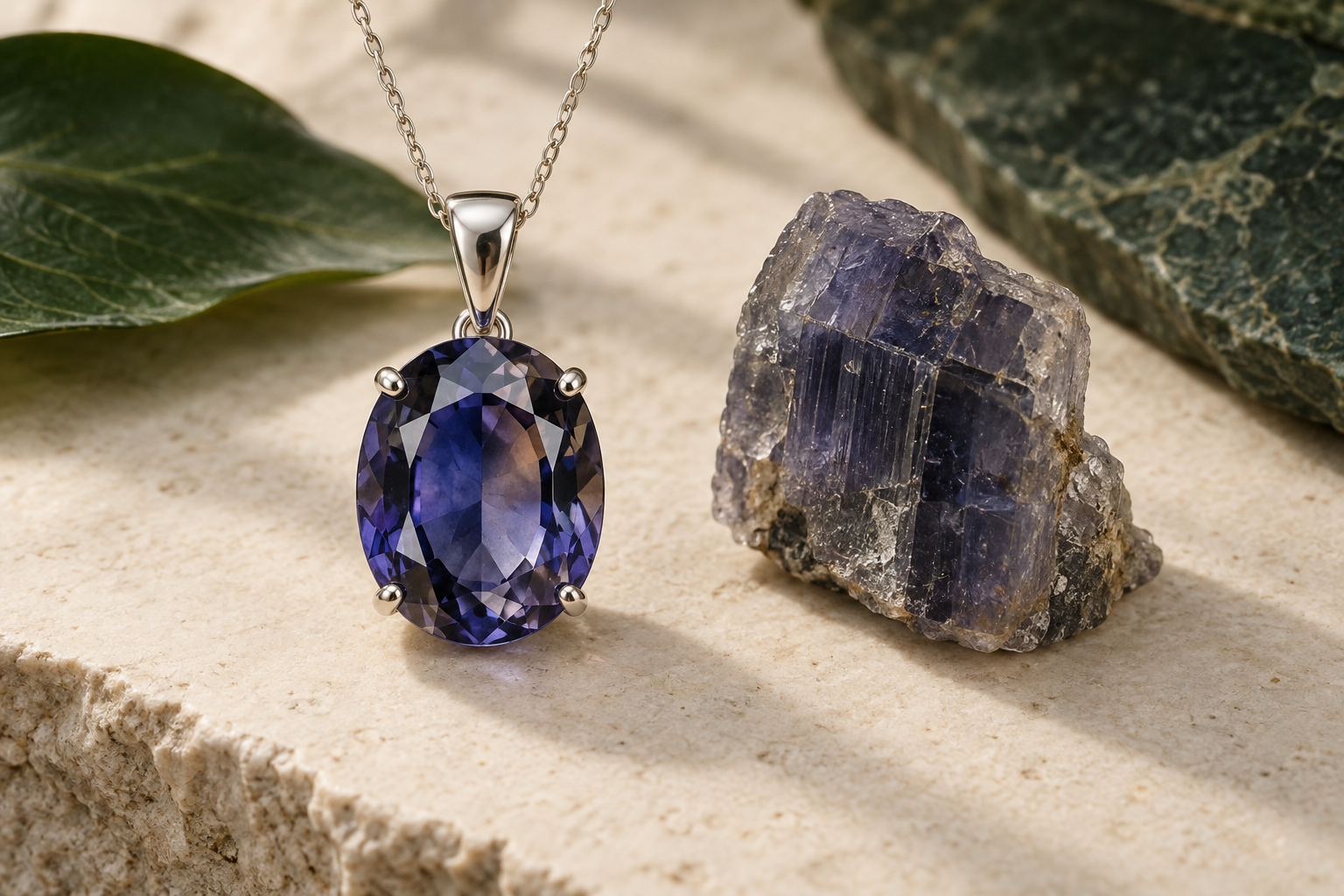
Iolite is the gem variety of the mineral cordierite. Gemological authorities identify it by its chemical composition and crystal structure and emphasize its characteristic optical feature: strong pleochroism. Pleochroism means the stone can show distinctly different colors when viewed from different directions; experienced gemologists and cutters orient iolite to present the most desirable color face-up in finished gems. The Gemological Institute of America (GIA) describes iolite’s pleochroism and color behavior as central to its identification and handling.
Documented history and cultural references — what the records show
Gemological and museum literature places iolite within the broader context of gem materials used in jewelry rather than as a stone with a long, well-documented symbolic tradition in a single ancient culture. The Smithsonian National Museum of Natural History discusses iolite in the context of gems and minerals and situates it among other materials that have been cut and set for ornamentation.
Formal historical documentation emphasizes iolite’s material and optical properties rather than a continuous symbolic role. Where popular narratives associate iolite with seafaring or navigation, those associations are not the same as primary historical evidence recorded by contemporary sources. For historical facts about iolite as a mineral and gemstone, the Gemological Institute of America provides the standard gemological descriptions and notes on durability and care.
Separating documented meanings from modern interpretation
Documented facts about iolite are primarily mineralogical and gemological: its identity as cordierite, its strong pleochroism, and its physical properties that affect cutting and care. Those are the statements supported by scientific examination and gemological literature.
By contrast, symbolism such as calling iolite a "navigator’s stone" or assigning it a universal meaning for travel, guidance, or spiritual direction is a modern interpretation that appears in popular jewelry writing and personal belief. Such symbolic attributions may be meaningful to individuals or buyers, but they are not the same as documented historical beliefs tied to a specific culture or period. If you value historically attested symbolism, treat these contemporary meanings as personal or modern cultural layers placed on the gem rather than as verified ancient lore.
How iolite appears in jewelry
Iolite is used cut as faceted stones and occasionally as cabochons. Because pleochroism can show different hues from different angles, cutters orient the rough to maximize the most desirable color face-up, so two finished gems from the same rough can look different depending on how they were cut. Typical jewelry uses include rings, earrings, pendants, and bracelets. In settings intended for daily wear, jewelers commonly select protective designs such as bezel or partial-bezel settings for larger or more exposed stones.
Color ranges in iolite pieces tend toward violet-blue, bluish-gray, and yellow-brown tones depending on crystal orientation and lighting. Jewelers often set iolite in contrasting metal tones—yellow gold, rose gold, and silver-tone metals—to bring out different color aspects of the gem. Because light direction and viewing angle affect appearance, many retailers suggest inspecting iolite in several lighting conditions before purchase.
Practical buying guidance
When selecting iolite jewelry, prioritize seeing the stone in person or asking for multiple photos in different lighting. Because pleochroism can dramatically change the apparent color, view the gem face-up and at an angle so you can judge how it will look when worn. Evaluate cut quality, which controls how the stone displays color and brilliance, and check clarity; surface-reaching fractures or significant inclusions will affect durability and appearance.
Ask the seller about any treatments and request clear disclosure. For durability, iolite is moderately hard and suitable for many settings, but it is not as hard as sapphires or diamonds, so choose protective settings for rings or bracelets that will experience frequent impact. Consider the wearer’s lifestyle when choosing a setting: bezel or halo designs reduce exposure, while open prongs may be more vulnerable. Buy from reputable dealers who offer return policies and verification of the gem’s identity.
Practical gifting guidance and respectful considerations
If you plan to gift iolite, ask whether the recipient prefers a vivid blue or a more muted gray-violet and whether they need an everyday-wear or occasional-wear piece. Explain pleochroism as part of the gift story: some recipients appreciate stones that reveal color shifts depending on light and angle, while others prefer a very consistent face-up color.
Be mindful when assigning symbolic meaning. If you want to present iolite as a stone for "guidance" or "journey," frame that as a contemporary or personal sentiment rather than an ancient universal fact. That approach honors both the wearer’s experience and the distinction between verifiable gem properties and modern symbolic layers.
Care and maintenance
Gemological guidance for iolite emphasizes gentle care. Iolite’s moderate hardness means it will tolerate everyday wear in many settings but can chip if subjected to sharp impacts or abrasions. Clean iolite safely with warm, soapy water and a soft brush, and rinse and dry thoroughly. Avoid harsh chemicals, prolonged exposure to high heat, and sudden temperature changes.
If a stone is heavily included or has fractures, avoid steam or ultrasonic cleaners unless a qualified jeweler examines and advises that such cleaning is safe. For routine maintenance, have prongs and settings checked periodically, particularly for rings and bracelets, to reduce risk of stone loss or damage.
Buying summary and final thoughts
Iolite makes an attractive alternative to more familiar blue gems. Its meaning splits cleanly into two domains: the objectively documented — mineral identity, pleochroism, and care recommendations provided by gemological authorities — and the subjective — contemporary symbolic uses such as journey or guidance associations. If you value both aspects, choose a piece that displays the color and quality you want and present any symbolic label as a personal sentiment rather than as an undisputed historical fact.
For more reading on gem types and care, see the Gemstones category on this site and related articles exploring color change stones and birthstone traditions.
Frequently asked questions
Is iolite the same as cordierite?
Iolite is the gem-quality form of the mineral cordierite. Cordierite is the mineral name used in scientific and mineralogical contexts; gemological sources refer to the gem variety as iolite.
Why does iolite appear to change color?
Iolite displays strong pleochroism, meaning it can show different colors when viewed from different directions. This is an inherent optical property of the crystal and is the reason cutters orient rough material carefully to maximize the most desirable face-up color.
Is iolite durable enough for everyday jewelry like engagement rings?
Iolite is moderately hard and suitable for many types of jewelry, but it is not as hard as sapphires or diamonds. If you choose iolite for a ring intended for daily wear, consider protective settings such as bezels and have the setting checked regularly to reduce the risk of damage.
How should I clean and care for iolite jewelry?
Clean iolite with warm, soapy water and a soft brush, rinse well, and dry. Avoid harsh chemicals, extreme heat, and sudden temperature changes. If a stone has visible fractures or heavy inclusions, avoid steam or ultrasonic cleaning unless advised safe by a professional jeweler.
Does iolite carry specific historical symbolism I should mention when gifting?
Historical documentation for iolite focuses on its material and optical properties rather than a single, widely attested symbolic meaning. Modern associations—such as links to navigation or personal guidance—are contemporary interpretations and should be described as personal or popular symbolism rather than definitive historical fact.
Sources and further reading
- Iolite — Gemological Institute of America
- Iolite Description — Gemological Institute of America
- Gems and Minerals: Beauties and Building Blocks — Smithsonian National Museum of Natural History