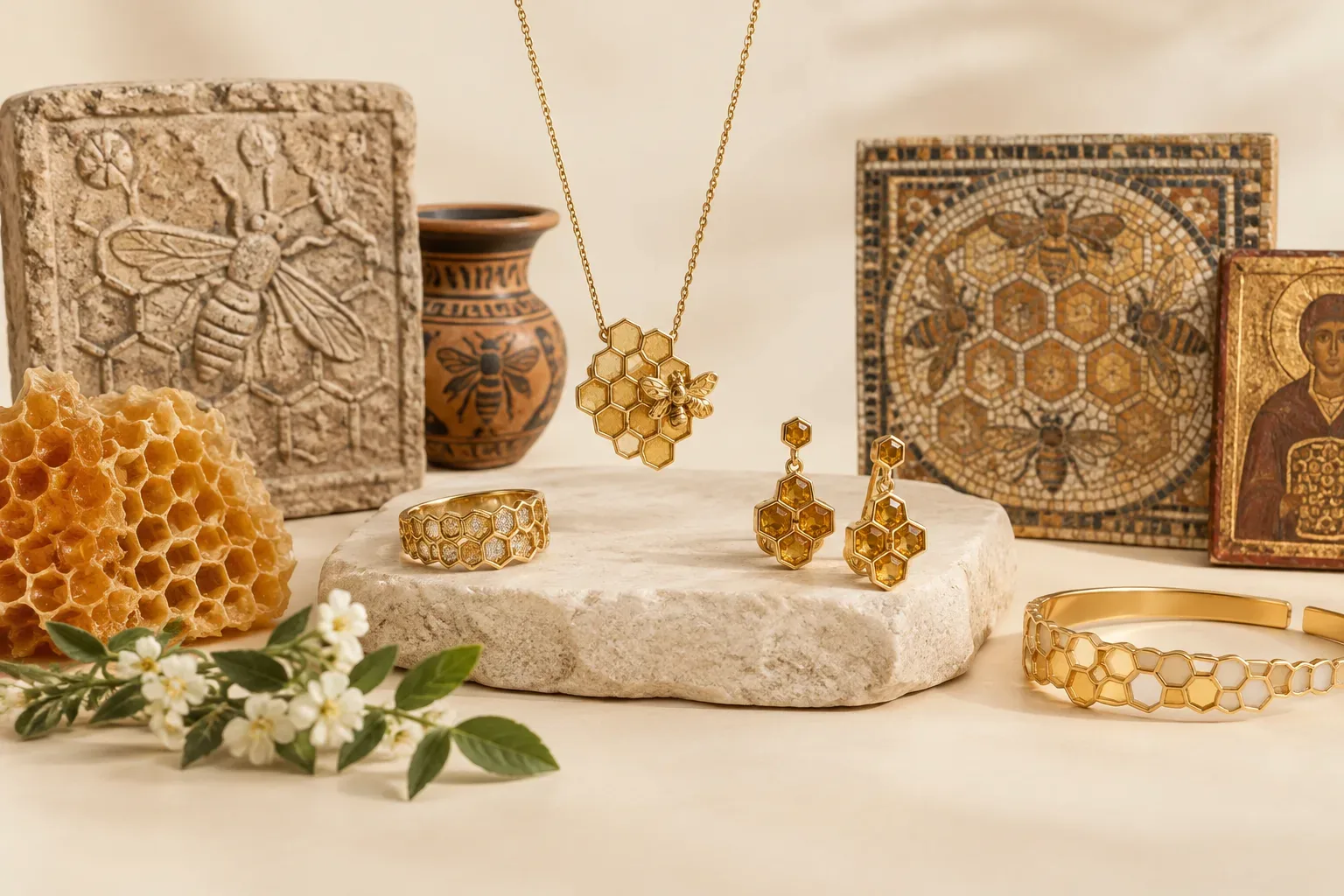
Meaning at a glance
Honeycomb jewelry meaning combines documented decorative and practical uses of the hexagonal motif across craft traditions with later personal and popular symbolic readings; this article separates museum-documented history from contemporary interpretations and offers practical guidance for choosing and gifting honeycomb-themed jewelry.
Documented historical evidence and the motif in context
The use of geometric repeating patterns, including hexagons resembling honeycomb cells, appears across many cultures as an ornamental vocabulary rather than a single symbolic system. Museum scholarship frames these patterns as part of changing decorative tastes, craft techniques and material availability rather than proof of one fixed meaning. The Victoria and Albert Museum, for example, presents jewelry history as an evolving record of social context, materials and craftsmanship rather than as a catalogue of fixed symbolic meanings; their surveys emphasize how motifs are adopted, adapted and reinterpreted over time (Victoria and Albert Museum).
Surviving objects and museum displays demonstrate that jewelers have borrowed natural forms, including beehive and honeycomb shapes, for their visual appeal and structural practicality. In many historical contexts the motif is a design choice that complements other signs—such as heraldry, religious emblems or portraiture—rather than a standalone doctrinal symbol. The V&A’s broader studies of jewelry make clear that interpretation depends on documented provenance, maker marks and contemporary texts rather than on motif alone (Victoria and Albert Museum).
When gemstones or specific materials accompany the honeycomb motif, their historical meanings generally reflect the familiar histories of those materials. For example, gemstone identifications and historical contexts are well described in museum resources such as the Victoria and Albert Museum’s A–Z of Gemstones, which outlines how particular stones were valued and used in different periods rather than tying a single gem to a single symbolic reading (Victoria and Albert Museum).
Separating documented historical meanings from modern personal interpretations
Documented meanings: Where historians can identify an explicit meaning for a motif, it tends to come from contemporary documentation—inscriptions, makers’ notes, receipts, or written texts from the period—rather than the geometric shape itself. Museum curators caution against ascribing a single, universal symbolic meaning to geometric motifs like the honeycomb without supporting evidence in the object’s provenance or context (Victoria and Albert Museum).
Modern and personal interpretations: In contemporary jewelry markets and popular culture, the honeycomb is widely read as a symbol of industry, teamwork, community, sweet reward, home and ecological concern. These readings are modern and often personal or commercial rather than grounded in consistent historical sources. It is correct to describe these as valid contemporary meanings for individual wearers, but they should not be presented as historical certainties.
How the honeycomb motif, gemstones, and traditions appear in jewelry
Design vocabulary: Jewelers use the honeycomb motif in multiple ways: as pierced or openwork lattice, as engraved or stamped surface pattern, as a repeated geometric inlay, or as three-dimensional sculptural elements echoing a beehive. The motif is attractive to designers because the hexagon tessellates cleanly, creating a visually satisfying repeat that works at many scales from delicate rings to large statement necklaces.
Gemstones and textures: Designers commonly combine the honeycomb motif with particular gem cuts, pavé settings or druzy stones to suggest the sparkle of honey or nectar. Museum guides on gemstones describe how different stones and surface treatments carry their own material histories; choosing amethyst, citrine, or other stones changes the visual tone and can add layers of contemporary meaning for the wearer (Victoria and Albert Museum).
Associated traditions: In modern handcrafted and commercial jewelry, bee and honeycomb imagery often appear together to create a coherent thematic set—bee motifs for the animal and honeycomb for the environment it inhabits. While the combined imagery carries modern symbolic weight, museums emphasize treating such pairings as design ensembles rather than proof of an ancient symbolic doctrine (Victoria and Albert Museum).
Practical guidance for choosing honeycomb jewelry
Consider context and intention: Decide whether you want a piece primarily for its aesthetic qualities, for a contemporary symbolic meaning (for example, teamwork or environmental concern), or because of an identified historical association with a particular object. If you are seeking a historical connection, ask for provenance, maker information and any documentation that links the piece to a named period or maker, because museums rely on such evidence to make historical claims (Victoria and Albert Museum).
Material and gemstone choices: Think about the materials and gemstone treatments used. Natural stones, treated stones, simulants and synthetic materials can all be attractive and meaningful, but they carry different values and care needs. For reliable purchasing guidance about disclosure of treatments, imitations and trade practices, consult the Federal Trade Commission’s consumer guidance on buying gemstones, diamonds and pearls to understand what sellers should disclose (Federal Trade Commission).
Scale and wearability: Honeycomb patterns work well as small accents and as larger architectural statements. For everyday wear, look for well-finished edges in openwork designs to avoid snagging and for secure settings if stones are used within cell shapes.
Respectful choices when gifting honeycomb jewelry
Match symbolism to the recipient: If you plan to give honeycomb jewelry with an intended meaning—such as celebrating collaboration or home—make that intention clear to the recipient so the gesture is understood in context. Because modern symbolic readings are personal rather than historically fixed, explain why you chose the motif to avoid misunderstanding.
Cultural sensitivity and provenance: If a piece claims a specific cultural or historical origin, ask for documentation. Museums stress that accurate labels and provenance are essential when assigning historical or cultural meaning; without such evidence, treat claims of ancient or sacred symbolism with caution (Victoria and Albert Museum).
Budget and sustainability: If environmental concerns motivate the choice—for example, choosing bee imagery to show ecological support—consider materials and sourcing. Ask sellers about metal sourcing and gemstone treatments and consult consumer guidance on transparent disclosure from the Federal Trade Commission to make informed purchases (Federal Trade Commission).
Care, disclosure and buying tips
Care and construction: Honeycomb openwork can trap dirt and require gentle cleaning. Ask about finishing, soldering of joins and whether stones are flush-set or bezel-set for security. Well-constructed pieces will document metal type, hallmarking and, where applicable, gemstone treatment.
Seller disclosure: For gemstones, the Federal Trade Commission recommends that consumers seek clear disclosure about treatments, imitations and origin; reputable sellers will provide written information on any enhancements and on the metal content of a piece (Federal Trade Commission).
When to consult experts: If you encounter claims that a honeycomb motif carries a particular historic or religious meaning tied to a named culture, ask for provenance or a trusted specialist opinion. Museum research methods rely on documentary evidence and conservator reports to establish firm historical claims (Victoria and Albert Museum).
Conclusion
The honeycomb motif in jewelry is a flexible and visually appealing design element with a long history as a decorative pattern and a growing set of contemporary symbolic associations. Museum scholarship cautions that geometric motifs are best read in context with provenance and documentation when seeking historical meaning, while modern wearers are free to adopt personal or communal meanings. Use informed questions about materials, maker provenance and gemstone disclosure when buying or gifting, and be explicit about your intended meaning when giving a piece to someone else.
Frequently asked questions
What does honeycomb jewelry symbolize?
Historically the honeycomb is best understood as a decorative geometric motif unless contemporaneous documentation links it to a specific meaning; in modern usage people commonly assign it symbolic meanings such as community, industry, home or ecological concern, but these are contemporary interpretations rather than universal historical facts.
Is honeycomb jewelry a religious symbol?
There is no single documented religious meaning for the honeycomb motif across cultures; museum scholarship advises relying on provenance or written sources associated with an object if a religious interpretation is claimed (Victoria and Albert Museum).
Are there historical cultures that used honeycomb designs in jewelry?
Geometric repeating patterns including hexagonal shapes appear in many craft traditions. Museums present such patterns as part of wider decorative vocabularies and stress that specific cultural meanings require documentary evidence such as provenance or contemporary texts (Victoria and Albert Museum).
Which gemstones work well with honeycomb motifs?
Gemstone choice depends on desired color, sparkle and durability; designers often pair honeycomb patterns with pavé stones, druzy textures or colored gems to evoke nectar and warmth. For historical context on gemstones and their uses, consult museum resources such as the Victoria and Albert Museum’s A–Z of Gemstones.
How can I be sure a honeycomb piece is honestly described?
Ask the seller for written disclosure about metal content, hallmarks and any gemstone treatments or imitations. The Federal Trade Commission provides consumer guidance on required disclosures for gemstones, diamonds and pearls to help buyers verify claims.
What should I consider when gifting honeycomb jewelry?
Be explicit about your intended meaning so the recipient understands the sentiment, verify any cultural or historical claims with documentation if that matters to the gift, and consider sustainability or sourcing questions if ecological symbolism is important to the recipient.
Sources and further reading
- Bedazzled: A History of Jewellery — Victoria and Albert Museum
- An A-Z of Gemstones — Victoria and Albert Museum
- Buying Gemstones, Diamonds, and Pearls — Federal Trade Commission