Meaning at a glance
This article traces museum-documented uses of the bamboo motif in decorative arts, separates historically recorded contexts from later or personal symbolism, explains how the motif is made and combined with gemstones, and gives practical guidance for respectful selection and gifting.
Quick answer
Explain the documented history and changing contexts of the bamboo motif, separate cultural or religious evidence from later popular interpretations, and give practical guidance for choosing and wearing the motif in modern jewelry.
What the historical evidence shows
Museum collections and curatorial writing show that plant motifs have been a recurring source of decoration in jewelry across many regions and periods, and that meanings and uses change over time. The Victoria and Albert Museum (V&A) documents how jewellery’s forms and subjects are adapted as tastes, trade and social roles change, and it treats botanical ornament as part of that larger narrative of shifting context rather than as a single fixed message.
Within those broad patterns, examples of bamboo-inspired forms and treatments most commonly appear in East and Southeast Asian decorative arts held in museum collections and catalogues, and in European jewellery that referenced Asian plants during periods of fascination with 'Oriental' design. The V&A’s coverage of jewellery history highlights both the long presence of botanical ornament in Asian and European material culture and the 18th–19th century European fashion for motifs drawn from Asian arts, which helped introduce and rework plant motifs in new decorative vocabularies.
When gemstones are part of the design, interpretation and materials are best understood through standard gemological and curatorial practices. The V&A’s A–Z of Gemstones describes how particular stones have been chosen for colour, durability or symbolic association in different contexts. Combining museum research with gemological information helps trace which stones and techniques were used historically and why.
Separating documented cultural meanings from later or personal interpretations
Scholarly and museum records rarely treat a motif as carrying a single, universal meaning across time and place. The V&A emphasises that jewellery’s meanings are socially produced and can change when objects travel, when fashions shift, or when makers and wearers repurpose imagery. As a result, attributions such as "bamboo means resilience" or "bamboo represents longevity" are common in modern popular writing but should not be assumed to be universally historically documented for every culture or period.
Where a particular culture has an established symbolic vocabulary linked to bamboo, that is best confirmed through primary cultural sources or specialist studies rather than general jewellery surveys. In the absence of such a targeted source in the museum literature cited here, it is safest to treat many of the popularly repeated symbolic claims as modern or community-specific interpretations rather than as universal historical facts. Museums such as the V&A record objects and contexts that show how motifs were used and reinterpreted; those records help distinguish original uses from subsequent symbolic layers added by later makers, dealers, and wearers.
How the bamboo motif and related gemstones appear in jewellery
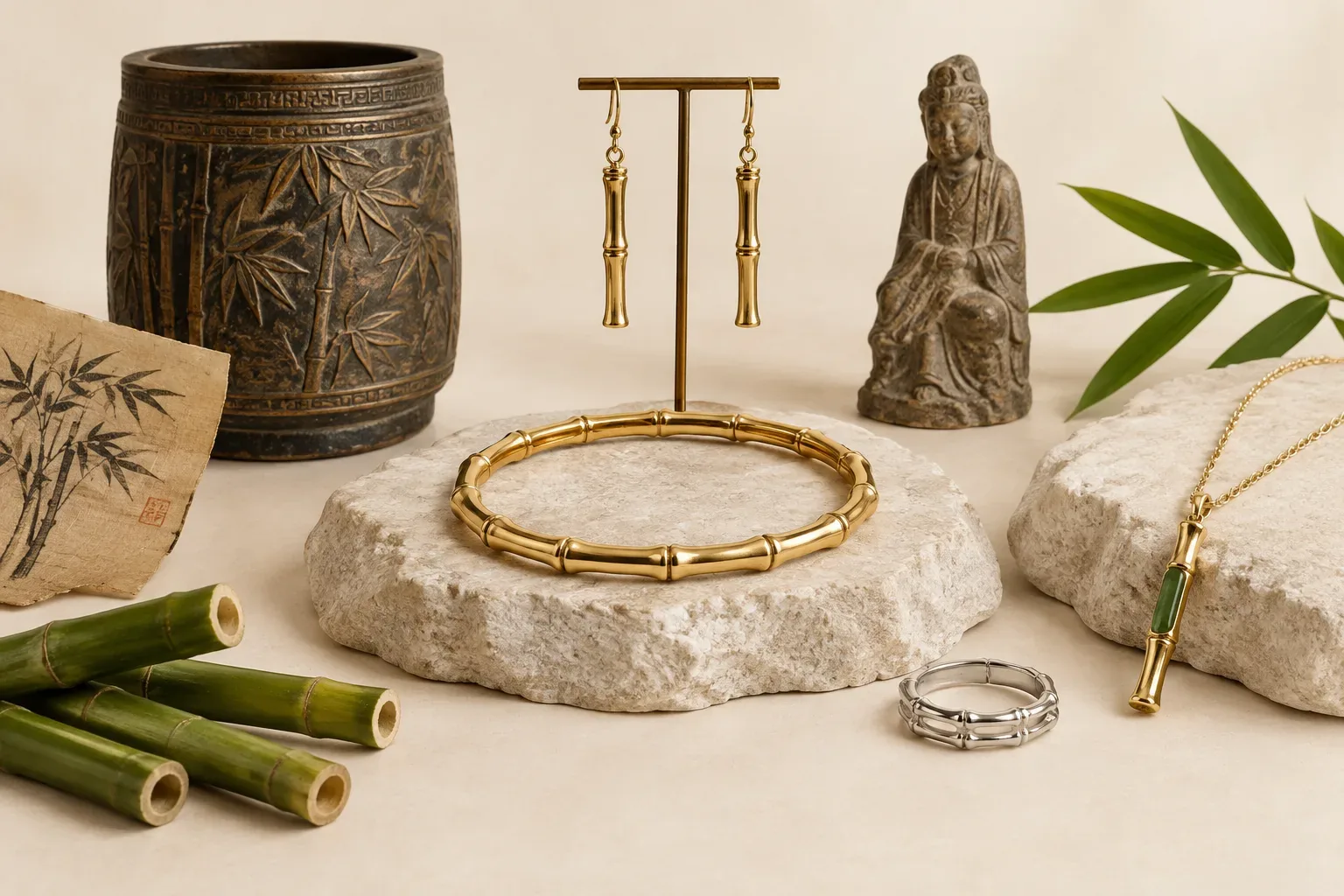
In jewelry design the bamboo motif appears in three main ways: as a literal representation (carved, inlaid or cast to resemble bamboo stalks and nodes), as a stylised motif inspired by bamboo geometry (repeating cylindrical sections, jointed bands or latticework), and as a colour or texture cue brought in through gemstones and finishes. The motif may be executed in metalwork, carving (in wood, bone or hardstone), enamel, and inlays.
Makers often choose materials that echo bamboo’s look or colour. Green stones such as jade, green tourmaline, chrysoprase or peridot can be used to suggest bamboo’s greenness; opaque or carved jade pieces may be carved into bamboo-like sections or combined with metal fittings. The V&A’s A–Z of Gemstones provides context on how curators identify and explain the historical choice of particular stones for colour and wearability in decorative objects.
Techniques include carved jade or hardstone beads configured as segmented bangles, gold or silver bands cast or chased to show bamboo nodes, and enamel or painted motifs on lockets and brooches. In later European jewellery influenced by East Asian art, the bamboo form might be reinterpreted in more stylised ways—for example, as repetitive cylindrical links or as a decorative motif on a clasp or setting—reflecting the period’s aesthetic rather than a single symbolic claim.
Choosing and gifting bamboo jewellery: respectful, practical advice
Start by clarifying what you or the recipient value: material authenticity, cultural resonance, everyday wearability, or a particular artist’s expression. If you want a piece with documented historical or cultural meaning, seek items with clear provenance and curatorial description. Museum entries and specialist dealers will often state an object’s date, place of origin and documented use; the V&A’s approach to jewellery history is a useful model for how context can be explained and verified.
Ask the maker or seller for written information about materials, treatments and any restoration. U.S. consumer guidance from the Federal Trade Commission (FTC) highlights the importance of accurate disclosure for gemstones, diamonds and pearls, including treatments and imitations; apply the same standard when buying bamboo-themed jewellery. If a green stone is marketed as jade, for example, request testing or certification because various green stones can be sold under misleading names or after enhancement.
Be mindful of cultural context when gifting. A piece that evokes another culture’s motifs can be a meaningful gift for someone with a direct connection, but it can feel insensitive if the design appropriates sacred symbols or if the recipient has no relation to the culture from which the motif originates. If in doubt, ask the recipient about their comfort with culturally specific symbolism or choose a contemporary design by a maker from the culture being represented.
Consider practical wear factors. If you want everyday wear, choose durable metals and hard-wearing stones and check settings for secure construction. If the piece uses carved materials such as jade or wood, ask about care recommendations; such materials can be more vulnerable to knocks or chemicals than solid metal. Finally, include a short note about why you chose the motif—personal meaning given by the giver can be an important and respectful layer of interpretation.
Concluding note
The bamboo motif in jewellery is a good example of how decorative forms move between cultures and eras, acquiring new associations as they travel. Museums such as the Victoria and Albert Museum help us see the documentary record of those movements and caution against assuming a single historical meaning. When you choose or gift bamboo-themed jewellery today, combining awareness of provenance with clear questions about materials and respectful consideration of cultural context will make the piece both beautiful and thoughtful.
Frequently asked questions
Does bamboo always mean resilience or longevity in jewellery?
No. While modern popular writing often attributes meanings such as resilience or longevity to bamboo, museum records and curatorial practice treat meanings as context-dependent. The Victoria and Albert Museum emphasises that motifs acquire different associations in different places and periods, so you should not assume a single universal meaning without specific cultural evidence.
How can I tell if a green stone in bamboo-themed jewellery is real jade?
Ask the seller for test results or certification and for written disclosure of any treatments. The V&A’s gemogy guidance explains why certain stones have been chosen historically, and the Federal Trade Commission recommends that buyers request accurate information on gemstones, treatments and imitations to avoid misrepresentation.
Is it culturally insensitive to wear or gift bamboo jewellery from another culture?
Not necessarily, but sensitivity matters. If the motif has religious or strongly local cultural significance, it’s respectful to learn about that context and, when possible, buy from makers or communities associated with the motif. If you are unsure, ask the recipient about their preferences or choose a contemporary design by a creator from the relevant culture.
What kinds of jewelry commonly feature bamboo motifs?
Bamboo motifs appear in bracelets and bangles, rings, pendants, brooches and clasps. Designers may use metalwork that mimics bamboo nodes, carved hardstone sections, enamelled surfaces or green gemstones to suggest bamboo’s colour and texture.
How should I care for carved or mixed-material bamboo jewellery?
Care depends on materials. Hardstones such as jade are relatively durable but can chip; carved wood and some inlays need protection from moisture and chemicals. For all pieces, avoid harsh cleaners, store items separately to prevent knocks, and ask the maker for material-specific care instructions.
Where can I find reliable historical information about a bamboo-themed antique?
Look for reputable museum catalogues, specialist dealers with documented provenance, and curatorial descriptions. The Victoria and Albert Museum’s work on jewellery history is an example of how objects and contexts are recorded; combine museum information with provenance and specialist reports for the best picture.
Sources and further reading
- Bedazzled: A History of Jewellery — Victoria and Albert Museum
- An A-Z of Gemstones — Victoria and Albert Museum
- Buying Gemstones, Diamonds, and Pearls — Federal Trade Commission