Meaning at a glance
Explain the documented history and changing contexts of the strawberry motif, separate cultural or religious evidence from later popular interpretations, and give practical guidance for choosing and wearing the motif in modern jewelry.
Quick answer
Historically, museums and curators record the strawberry as one of many botanical motifs used in jewelry to signal naturalism, seasonality, or personal sentiment rather than a single fixed religious or cultural meaning; modern wearers and designers have layered additional personal and popular associations—such as sweetness, love, or youth—onto that older visual language. This article explains the documentary evidence for botanical motifs in jewelry, separates those historical findings from contemporary interpretations, describes how the motif appears in pieces and materials, and offers respectful, practical guidance for selecting or gifting strawberry jewelry.
What the historical record actually shows
Museum scholarship emphasizes that jewelry styles and their social meanings change over time. The Victoria and Albert Museum’s exhibition materials and interpretive work on jewelry history make clear that natural and botanical motifs recur across periods because they reflect changing tastes, technologies, and social ideals rather than a single universal symbolism. Curators at the V&A place floral and fruit imagery within broader narratives of ornament, material availability, and sentimental fashion rather than ascribing one constant meaning to any one plant motif.
In practice, that means items with fruits or flower decoration appear in different contexts: as secular status objects, as personal or sentimental gifts, or as components of dress associated with particular seasons or fashions. The V&A’s overview of gemstones and historical practices also documents how jewellers used particular materials and techniques—such as enamelling, stone carving, and metalwork—to render natural forms convincingly. Those technical choices influenced which motifs were popular at which times because some materials and techniques make certain shapes and colours easier or more effective to depict.
Where scholarship is cautious: religious or fixed meanings
Scholarly and museum sources do not present a single, documented religious or magical meaning for the strawberry motif that held across cultures. Instead, curators and historians note that botanical motifs were polyvalent: their significance depended on the wearer, the patron, the place, and the moment. The V&A’s writings on jewelry history underscore that objects should be read in their social and material context rather than reduced to one universal symbol.
Because museums emphasize provenance and context, they separate the artifact from later popular narratives. When a later era or modern maker attaches a specific romantic or erotic meaning to a motif, that interpretation belongs to that newer context and should be treated as a contemporary layer rather than a direct continuation of earlier beliefs.
Documented historical meanings versus modern personal interpretations
Documented historical meanings depend on the object’s provenance, intended audience, and the fashions of its period. For example, botanical motifs in the Renaissance and later periods often celebrated nature, seasonal abundance, or the technical skill of the maker; during the 18th and 19th centuries, naturalistic brooches and pendants could also signal sentimentality and domestic virtues. These interpretations reflect the kinds of evidence and contextual narratives museums like the V&A compile for their collections rather than a single symbolic dictionary entry for strawberries.
Modern personal interpretations are common and varied. Contemporary wearers and designers frequently associate strawberry imagery with sweetness, youthful charm, summer, romantic affection, or fertility, and sometimes use the motif playfully or as a fashion statement. These are legitimate personal or cultural meanings, but they are modern layers and not the only possible readings. It is important not to treat recent popular meanings as historically universal.
How the strawberry motif and related materials appear in jewelry
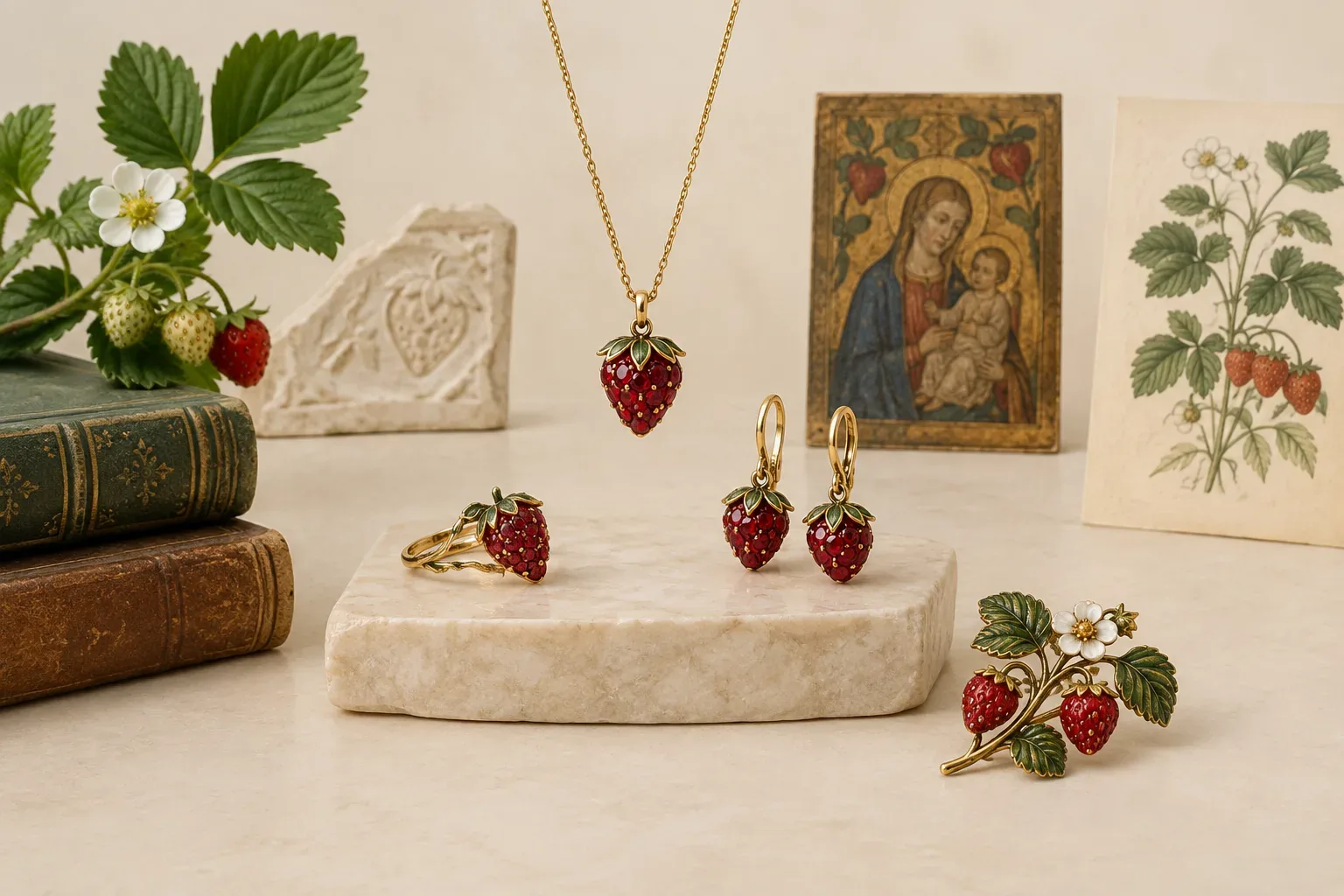
Jewellers render strawberry shapes and colours through several longstanding techniques. Enamelling is a classic route to achieve glossy red surfaces and subtle highlights; metalworkers can suggest seeds by texturing or using tiny gold or silver granulation. Carved stones and cameos can produce small, detailed fruit forms, while in contemporary costume or artisanal jewellery coloured gemstones and dyed agates may be chosen for their stable red or pink tones. The Victoria and Albert Museum’s materials on gemstones and jewellery techniques describe how choices of stone, enamel, and metalwork help convey forms drawn from nature, and how those technical options shaped popular motifs over time.
In terms of object types, the strawberry motif appears on brooches, pendants, charms, rings, and in children’s or novelty jewellery. It may be literal, a small three-dimensional charm, or stylized—reduced to a graphic red teardrop with seed-like dots. Designers also combine the motif with other botanical elements such as leaves, or place it within sentimental formats like lockets and charm bracelets where personal meaning is likely to be emphasized.
Practical and respectful advice for choosing or gifting strawberry jewelry
Start by asking about the recipient’s tastes and any cultural or personal associations they may have. Some people embrace the playful, affectionate associations of a strawberry; others prefer more neutral motifs. If you are giving a piece for a ritual occasion or in a cultural context you do not share, brief respectful research or a polite conversation can prevent misunderstandings.
Check materials and disclosure. The Federal Trade Commission advises buyers to ask sellers about treatments, imitations, and the nature of gemstones and metals before purchase. Request written information about any gemstone treatments, dyed materials, plating, or assembled construction so you understand long-term care and value. If the piece involves valuable stones or metals, ask for appropriate documentation or a jeweller’s report.
Consider durability and care: enamel and surface plating can be delicate, and dyed or treated stones may require special handling. Choose settings and metals that match the recipient’s lifestyle; a daily-wearer benefits from solid settings and harder stones, while occasional or seasonal pieces can prioritise visual effect. Personalisation—inscribing a date, adding a meaningful charm, or choosing a gemstone colour tied to a birth month—can convey thoughtful intent without asserting an assumed symbolic meaning.
Finally, contextualise your gift. If you plan to explain a symbolic reason for choosing a strawberry—such as celebrating a ‘sweet’ memory—frame it as your personal sentiment rather than ascribing an ancient or universal meaning. For readers who want to explore broader symbolic options or presentation, see our guide on How to Choose Meaningful Jewelry: A Practical Gift Guide and our Symbols category for related motifs and histories.
Where to look next
If you want to research a specific antique piece, provenance and maker’s marks, where available, will be the most informative evidence of intended meaning. The V&A’s historical treatments of jewellery are a useful model because they combine object-level description with social and technical context. For modern purchases, consult sellers’ material disclosures and, when in doubt about authenticity or treatment, ask for specialist verification as recommended by the FTC.
A contemporary example of the motif in handmade gemstone jewellery can illustrate how modern makers combine historical visual language with current materials and personal meanings. For a commercially available example that demonstrates this approach, see Pink Agate Strawberry Necklace.
Frequently asked questions
What does strawberry jewelry symbolize?
Historically, museum records show the strawberry appears as one of many botanical motifs rather than carrying a single fixed meaning; modern wearers commonly read it as a sign of sweetness, affection, youth, or summer, but such readings are contemporary and personal rather than universally documented.
Is strawberry-themed jewellery appropriate for formal occasions?
It can be appropriate depending on design and materials: a finely made strawberry motif in gold, enamel, or carved stone can suit formal wear, while playful or novelty versions suit casual contexts; consider the piece’s execution and the wearer’s style when deciding.
How can I verify the materials in a strawberry pendant?
Ask the seller for material and treatment disclosures and any certificates; the Federal Trade Commission recommends asking about gemstone treatments, dyed stones, plated metals, and assembled components and seeking professional appraisal if uncertain.
Are there cultural sensitivities I should consider when gifting strawberry jewelry?
Because meanings vary by individual and community, check whether the recipient has particular cultural or personal associations with fruit imagery and present your gift as a personal sentiment rather than claiming an ancient or universal symbolism.
How should I care for enamel or plated strawberry pieces?
Treat enamel and plated surfaces gently: avoid prolonged water exposure, chemicals, and rough contact; store pieces separately to avoid abrasion and follow the maker’s care instructions to preserve colour and surface finish.
Sources and further reading
- Bedazzled: A History of Jewellery — Victoria and Albert Museum
- An A-Z of Gemstones — Victoria and Albert Museum
- Buying Gemstones, Diamonds, and Pearls — Federal Trade Commission