Meaning at a glance
Documented evidence shows the square motif has served practical, decorative, and stylistic roles in jewelry across many periods; modern symbolic readings (stability, balance, grounding) are personal interpretations rather than universal truths, and practical choice or gifting should consider craftsmanship, provenance, and disclosure of treatments.
Quick answer
Historically the square motif in jewelry has been used for functional framing, decorative geometry, and stylistic emphasis; modern symbolic meanings such as stability or balance are largely personal interpretations rather than universal facts. This article explains the documented history, separates cultural evidence from later readings, shows how the motif appears in pieces, and offers practical selection and gifting guidance in light of museum and consumer-protection guidance.
What people mean by the square motif
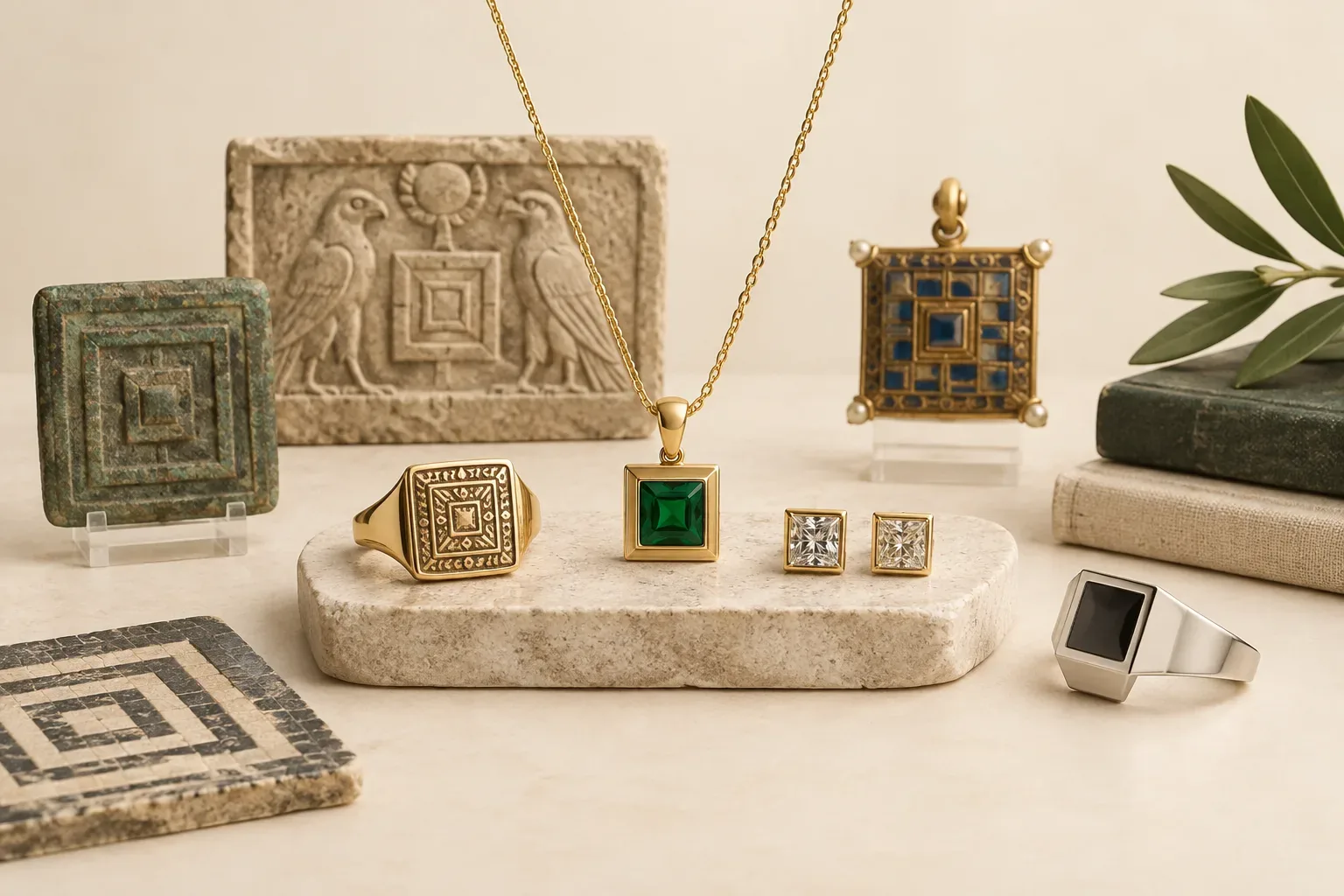
When people talk about square jewelry meaning they may mean one of three things: the geometric motif (a four‑sided form used in ornament and structure), a square or rectangular gemstone cut or setting, or a cultural or period tradition that favoured angular geometry. These uses overlap: a square bezel can both frame a stone and echo contemporary architectural styles, while a square pendant might carry a stamped image or inscription.
Documented historical evidence and cultural contexts
Museum collections and exhibitions show that geometric shapes, including squares and rectangles, recur throughout jewelry history as design elements and practical forms. The Victoria and Albert Museum describes how jewellery across periods has reflected broader artistic tastes, technologies, and social contexts rather than a single symbolic language. Geometric framing, neat planar surfaces, and rectangular or square plaques are visible in examples from many eras and regions as catalogued and interpreted by the V&A.
In later historic periods—particularly in movements that embraced geometry as a principle, such as the Art Deco era—square and rectangular motifs became stylistically prominent as part of a deliberate aesthetic. The V&A links such developments to changing tastes, industrial techniques, and the influence of architecture and graphic design on jewellery. These are documented curatorial observations about style and context rather than claims that a motif carried one fixed meaning everywhere.
Archaeological and museum records often emphasize function and social context. For example, flat square or rectangular surfaces work well for engraved seals or signets, and rigid geometric settings can protect a stone and make it sit neatly against clothing. The V&A’s accounts focus on how and why jewellers used particular shapes as practical solutions and as fashionable forms in their time.
Separating documented historical meanings from modern interpretations
Documented historical meanings are those that can be supported by contemporary sources, inscriptions, provenance records, or museum interpretation. The V&A’s research typically frames the square motif in terms of design choice, technical practice, and cultural style—for example, as a framing device for gems, a shape suited to engraved surfaces, or an element of an era’s aesthetic preferences.
Modern symbolic interpretations—stability, balance, order, earthiness, or pragmatism—are common in contemporary popular writing and personal practice but are not universal or historically constant. People today may choose a square motif because those words resonate with them personally, because of current fashion, or because of the piece’s provenance. It is important to treat those modern meanings as individual or contextual readings rather than as inherited, universal symbolism.
How the square motif, gemstones, and traditions appear in jewelry
Squares and rectangles appear in jewellery in several distinct ways: as the overall silhouette of a pendant or brooch, as a bezel or frame around a gemstone, as the cut or facet arrangement of a stone, as engraved or inlaid plaques, and as repeated geometric patterns in metalwork or enamelling. Each form carries different practical and visual implications.
Signet rings and engraved plaques: Flat, square or rectangular surfaces are historically useful for engraving motifs, initials, or seals. Museum collections described by the V&A show that flat planes make clear fields for incised or chased decoration and for transferring an image when used as a seal.
Settings and silhouettes: Square bezels protect edges and give a strong graphic outline to a gem or enamel panel. In periods where crisp geometry was fashionable—illustrated in V&A holdings—jewellers used square and rectangular outlines to align with broader design trends.
Gemstones and cuts: Stones can be fashioned into square or rectangular shapes; historically and today, cutters and jewellers choose shapes for optical performance and wearability. The V&A’s reference material on gemstones contextualises how different cuts and shapes have been used and adapted over time in jewellery practice. When buying gemstones, also follow contemporary consumer guidance about disclosure of treatments and imitations: the U.S. Federal Trade Commission’s guidance advises sellers to disclose treatments, enhancements, and imitations so buyers can make informed choices.
Pattern and repetition: Small square motifs may be repeated as tessellations, inlaid mosaics, or as part of filigree and granulation patterns. These uses are often decorative but also reflect technical skills and the visual language of a given period or workshop, as documented by museum curators.
Practical guidance for selecting or gifting square‑motif jewelry
Consider what you want the piece to say and whom you are gifting. If you want to convey a modern idea such as stability or balance, say so in a gift note; the recipient’s personal associations matter more than assumed historical meanings. If you are choosing a piece for its historical or cultural significance, look for clear provenance and curatorial notes and research the maker or period using museum resources such as those at the Victoria and Albert Museum.
Think about wearability and scale. Square bezels and hard‑edged silhouettes can feel more architectural and less organic than rounded designs; they sit and catch light differently and may be better suited to structured outfits. For everyday rings or bracelets, inspect how the corners are finished: sharp corners can catch or wear faster than rounded or protected edges.
Assess craftsmanship and materials. Examine settings, joins, and finish. For gemstones, ask whether the stone has been treated or is an imitation; follow the Federal Trade Commission’s guidance to request disclosure about treatments, synthetics, or dyeing so you understand what you are buying. If provenance or ethical sourcing is important, request documentation from the seller.
Respect cultural contexts. A square motif may have specific meanings in particular communities or be associated with ritual items. If the piece is explicitly cultural or sacred, learn about its use and ask permission or advice from knowledgeable sources before wearing it in contexts where it might be inappropriate.
For engraved or signet-style pieces, consider personalization. A square field is ideal for initials, a short motto, or a simple emblem. Commission the engraving from a reputable maker and keep a written record of any custom work for future care and valuation.
Care, authentication, and further research
Care for square‑edged settings by keeping corners clean and avoiding knocks that can stress angles. For gemstones, follow standard care instructions for the specific stone; the V&A’s materials on gemstones provides contextual information about stone types and historical uses that can inform care choices.
When authenticity matters, ask for documentation and independent appraisals. The FTC highlights the importance of clear disclosure on treatment and imitation; reputable sellers will provide transparent information about any enhancements.
If you want to learn more about symbolism and how to research a jewellery motif, use museum catalogues and specialist guides and follow practical research steps such as checking provenance, maker’s marks, and exhibition records. Our related articles on symbols, gift guidance, and researching jewellery can help you put a square motif into the right historical and personal context.
Final thoughts
The square motif in jewellery is best understood as a persistent formal choice with many practical and stylistic uses across history. Museum research highlights functionality, design trends, and cultural context rather than a single universal meaning. If you are drawn to a square piece today, treat any symbolic reading as personal and intentional, check materials and provenance, and choose a style and scale that fit the wearer’s life and values.
Frequently asked questions
Does a square always symbolize stability or earth?
No. While many modern readers associate the square with stability or grounding, such meanings are contemporary interpretations. Historical museum research typically describes the square as a design choice or functional form rather than a single symbolic statement.
Are square settings more likely to chip a gemstone?
Square or sharp-cornered settings can expose stone corners to impact; look for protective bezels or rounded corner treatments and ask the maker about durability when selecting an everyday piece.
How can I verify whether a square-cut gemstone has been treated?
Ask the seller for full disclosure and any laboratory reports. The Federal Trade Commission advises buyers to request information on treatments, enhancements, and synthetic or imitation materials so you can make an informed purchase.
Is it appropriate to wear culturally specific square motifs as fashion?
Appropriateness depends on context. If a piece is explicitly cultural or ritual in origin, research its use and, where relevant, consult knowledgeable sources before wearing it in settings where it might be sensitive or sacred.
What should I consider when gifting a square piece?
Consider the recipient’s style and any personal associations they may have with the shape, check materials and provenance, and include a note explaining why you chose the motif if you intend a symbolic message.
Sources and further reading
- Bedazzled: A History of Jewellery — Victoria and Albert Museum
- An A-Z of Gemstones — Victoria and Albert Museum
- Buying Gemstones, Diamonds, and Pearls — Federal Trade Commission