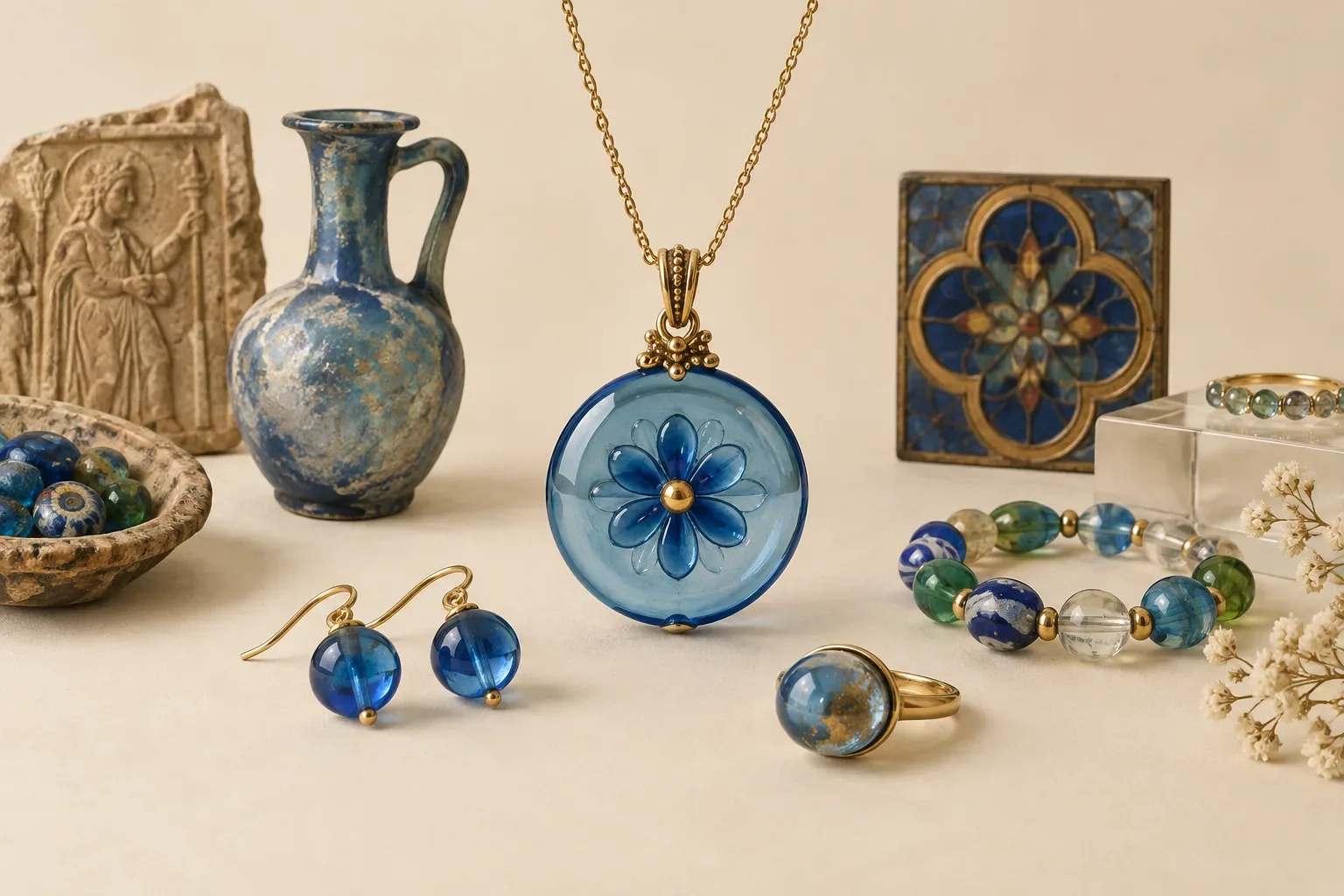
Meaning at a glance
This article explains the documented history and changing contexts of glass jewelry, distinguishes museum‑recorded uses from modern personal or commercial meanings, and gives practical guidance on composition, hallmarks, disclosure, selection, and gifting.
Direct answer: what “glass jewelry explained” means
Glass jewelry explained, in one sentence: museum records show glass has been shaped and used as decorative beads, inlays, and gem simulants across multiple cultures and centuries, and contemporary concerns about composition, hallmarks, and truthful disclosure are best managed by combining historical knowledge with clear questions to sellers. This piece follows that evidence: it presents documented history and changing contexts, separates recorded cultural meanings from later or personal interpretations, and offers practical choices for selecting and gifting glass jewelry.
Documented historical evidence, by culture and period
The Victoria and Albert Museum (V&A) traces jewelry as a changing social practice rather than a single fixed meaning, noting that different materials—including glass—appear in multiple periods and places as decorative or status objects. The V&A collections and interpretive material note glass beads and inlays in ancient and classical contexts, written and object evidence of skill in glassmaking in medieval and Renaissance Europe, and the later European development of paste and decorative glass to imitate gemstones or produce new aesthetic effects.
To be precise rather than sweeping: archaeological and museum records described by the V&A document glass beads and inlaid glass objects in ancient and classical contexts, glassmaking traditions that developed in medieval and Renaissance Europe (including the distinctive Venetian glass industry), and the 18th–19th century European practice of producing cut and moulded glass to stand in for gems in fashion jewelry. The V&A emphasizes how these practices shifted with technology, trade, and social uses rather than implying a single symbolic meaning across time and place.
What the historical record actually says about meaning, versus later interpretations
The V&A’s narrative of jewelry history shows that functions recorded in the object record tend to be pragmatic: markers of wealth or trade goods, personal ornament, or fashionable dress. When a museum catalogue records a piece’s use or context, that statement is based on provenance, fashion history, or associated documents rather than a universal symbolic claim.
Modern symbolic claims—such as attributing spiritual, healing, or quasi‑traditional protective powers to specific glass motifs—are typically contemporary personal or commercial interpretations unless a clear historical source links them to a named culture. Always treat modern claims about ancient symbolic uses with caution: museums encourage interpreting objects within documented contexts and warn against projecting later beliefs onto earlier makers or wearers.
Composition and how glass appears in jewelry
Museum descriptions emphasize glass as a manufactured decorative material that makers have shaped into beads, inlaid elements, simulated gems (often called 'paste' in historical sources), and sculptural forms. Historically and today, glass appears as standalone beads strung into necklaces and bracelets, as mounted stones set into metalwork to mimic cut gemstones, and as decorative accents or enamel‑like surfaces on metal objects.
Historically attested techniques recorded by the V&A include moulded and faceted paste used in costume jewelry, millefiori and cane‑work associated with Venetian production, and lamp‑worked beads used in later folk and fashion contexts. Contemporary makers also use kiln‑formed and fused glass, torch‑work, and laminated dichroic sheets; these modern techniques are stylistic and technical continuations of the long museum record of glass as a versatile decorative medium.
Hallmarks and marking practices: what to expect
Glass itself is not subject to the same hallmarking systems that govern precious metals. Museums and trade guides make a clear distinction: a glass stone or bead will not carry a metal hallmark, but the metal mount or setting that holds a glass element may be hallmarked according to national regulations for silver, gold, or platinum.
In practice this means that if you are evaluating a piece for its metal content, look for recognized metal hallmarks on the setting. If your interest is in whether a mounted stone is a natural gem, treated gem, or a glass simulant, the maker’s documentation and seller disclosure are crucial because hallmarks on metal do not confirm the nature of non‑metal components.
Disclosure and buyer protection: what the FTC advises
In the United States, the Federal Trade Commission (FTC) provides consumer guidance about buying gemstones, diamonds, and pearls and about seller disclosure of treatments and imitations. The FTC’s consumer guidance emphasizes that sellers should not misrepresent materials and should disclose when a material is an imitation or has been treated to alter its appearance.
For glass jewelry, the FTC guidance means sellers should clearly state when a stone is glass, a glass simulant (often historically called 'paste'), or a treated gem. For buyers, the practical step is to request written confirmation of composition, any available testing documentation, and a clear return policy if disclosure is incomplete.
Choosing and gifting glass jewelry: practical, respectful guidance
Start with context. If you are buying from an antiques dealer or museum shop, consult provenance statements and catalogue notes—museums such as the V&A present their objects with contextual information that helps explain how a piece was used historically. If the piece is contemporary, ask the maker about technique, origin, and care.
Ask explicitly about composition and disclosure. Use the FTC’s guidance as a checklist: ask whether stones are natural, treated, synthetic, or glass simulants; request written confirmation for significant purchases; and confirm the metal content of settings through hallmarks or assay reports if that matters to you.
Consider wear and care. Glass can be attractive and durable but is not scratch‑resistant in the same way as sapphire or diamond, and some decorative glass may be brittle. Choose settings and designs that protect exposed glass elements for everyday wear, and follow maker care instructions for cleaning and storage.
Respect cultural origins. When a design references a named cultural style or technique—Venetian millefiori, for example—acknowledge the geographical and historical origins in how you present or gift the piece. If a seller claims a symbolic or religious meaning for a motif, ask for evidence or provenance before treating that meaning as historically documented.
How to research a specific piece
Begin with published object records. The V&A and similar museum catalogues are valuable starting points because they combine object description, documented provenance where available, and scholarly interpretation. Use those records to identify whether similar objects were domestic fashion, trade goods, or used in other functions.
Next, verify technical claims with the seller and, for higher‑value items, with an independent gemstone tester or certified appraiser. The FTC guidance recommends clear disclosure; when you do not receive it, treat the absence of written information as a red flag and consider an independent assessment before purchase.
Closing: balancing history, meaning, and present‑day use
Glass has been an important and adaptable material in jewelry for centuries, used for decorative, practical, and fashionable ends. The best approach to ‘glass jewelry explained’ is evidence‑based: rely on museum documentation for historical context, treat modern symbolic claims as personal or commercial unless corroborated by reliable sources, and follow FTC‑recommended disclosure practices when buying or gifting.
If you want to explore related reading or practical gift advice on this site, see our Jewelry Guides section or the article How to Choose Meaningful Jewelry: A Practical Gift Guide. For deep historical examples, the V&A’s resources remain a central and well‑documented place to begin.
Frequently asked questions
How can I tell if a stone is glass or a natural gemstone?
Ask the seller for written disclosure and any available test reports. The Federal Trade Commission recommends that sellers state whether a stone is natural, treated, synthetic, or an imitation; if you still have doubts, seek an independent appraiser or gemologist for testing rather than relying on visual inspection alone.
Does glass jewelry carry hallmarks?
Glass components themselves are not hallmarked. Hallmarks typically apply to precious metals in settings. If metal assay or purity is important to you, look for recognized metal hallmarks on the setting and ask the seller for assay or hallmark details.
Are there historical symbolic meanings attached to glass jewelry?
Museum records, such as those at the Victoria and Albert Museum, document how glass was used as ornament, status display, and in fashion, but meanings vary by culture and period. Modern symbolic claims—healing properties or spiritual powers—are usually contemporary interpretations unless specific historical evidence links a motif to a named culture.
Is glass jewelry a good choice for everyday wear?
Glass can be attractive and suitable for regular use, but its durability varies with technique and design. Some decorative or finely modelled glass is more fragile than harder gemstones, so choose protective settings and follow care instructions provided by the maker or seller.
How should I care for antique glass jewelry?
Refer to the object’s provenance and any care notes from the seller or conservator. Museums like the V&A preserve glass objects under controlled conditions; for wearable antiques, avoid harsh chemicals, sudden temperature changes, and impact. When in doubt, consult a conservator before cleaning.
What should I ask a seller before buying glass jewelry as a gift?
Request written confirmation of the materials, disclosure of any treatments or imitative status, information about the metal setting and hallmarks if relevant, the piece’s origin or maker, care instructions, and the return policy if the item does not meet your expectations.
Sources and further reading
- Bedazzled: A History of Jewellery — Victoria and Albert Museum
- An A-Z of Gemstones — Victoria and Albert Museum
- Buying Gemstones, Diamonds, and Pearls — Federal Trade Commission