Meaning at a glance
This article explains the documented history and changing contexts of glass in jewelry, separates historical evidence from later popular interpretations, and offers practical guidance for selecting, wearing, and caring for glass pieces while respecting cultural meanings.
What the historical record shows
Museum research and exhibitions document glass as a long-standing jewellery material with many different social meanings. The Victoria and Albert Museum (V&A) treats jewellery as an object class whose materials and motifs change with fashion, technology, and social context, and notes how glass has been incorporated into those changes over centuries. The V&A's collections and interpretive materials show glass appearing in European and Mediterranean contexts both as imitation gemstones and as decorative beads used in trade and personal adornment.
Because museums like the V&A catalogue and interpret objects from many places and periods, the archaeological and curatorial record can show specific uses in particular cultures—for example, glass paste used to imitate precious stones in periods and markets where gemstones were expensive, or glass beads included in trade assemblages. Where the V&A attributes a use or meaning to a piece, that interpretation is based on the object's provenance, context, and contemporaneous documentary sources rather than on later popular narratives.
Separating documented historical meanings from modern interpretations
Documented historical meanings come from the object record and curatorial interpretation. The V&A emphasizes that jewellery meanings shift: an item that functioned as a status sign in one period might later be used as costume jewellery or as a sentimental token. When the museum assigns a historical meaning to glass items—such as glass paste functioning as an economical substitute for gemstones in a particular period—that claim is grounded in material evidence and context.
Modern personal and popular interpretations of glass jewelry often layer additional meanings that are not documented in the historical record. Contemporary wearers may ascribe spiritual, environmental, or personal symbolism to glass beads or to the idea of ‘durability’ itself. Those modern meanings are valid as personal or cultural statements, but they should be distinguished from claims about how particular pieces were used or understood in the past. In short, follow the V&A for museum-backed historical interpretations, and treat modern symbolic readings as contemporary meanings that individuals or groups attach to glass jewellery.
How glass motifs and techniques appear in jewellery
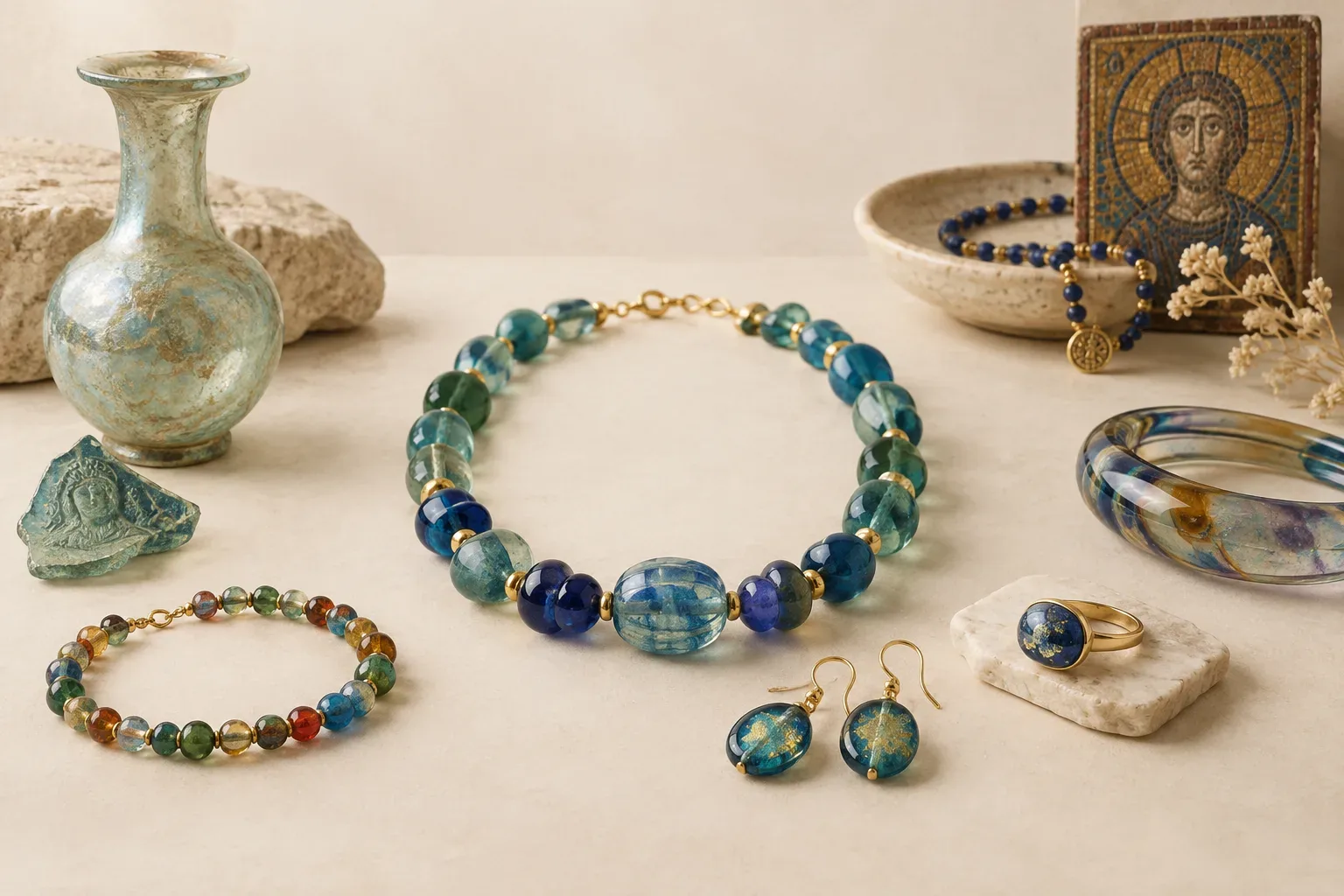
Glass shows up in jewellery in several recurring ways: as imitation gemstones (often called paste or glass stones), as faceted or polished beads, and as worked decorative elements such as millefiori or lampwork beads. The V&A’s materials on gems and jewellery note that such glass techniques were widely used alongside genuine gemstones and precious metals, and that the choice of glass versus natural gem carried social and economic implications in different periods.
In practice, glass elements may be set into precious metal mountings, strung as beads on thread or wire, or used as inlays. The visual similarity of glass paste to cut gemstones is part of what made it popular historically, while more recent studio glassmakers and beadmakers have emphasized color, transparency, and surface texture as aesthetic features in their own right.
Tarnish, wear, and the concept of 'durability' for glass jewellery
Tarnish is a term usually applied to metal surfaces that chemically darken or change color over time. When discussing glass jewellery durability it helps to consider the whole object: a glass element is paired with settings, stringing materials, and fastenings that may tarnish, wear, or fail. Because museum documentation treats materials and construction together, the V&A’s approach reminds us that durability is not only a property of the glass but a property of the finished object within its use environment.
Wear shows up in different ways depending on construction and use. The long-term appearance of a piece depends on surface abrasion, impact, environmental exposure, and how the piece is stored. Historical examples in museum collections are often preserved because they were not worn continuously; their condition informs curators about how people used jewellery but should not be taken as a complete guide to everyday wearing life in any era.
Practical care and buying guidance
Ask sellers for clear information about what you are buying. The Federal Trade Commission (FTC) specifically advises consumers to seek disclosure about treatments, imitations, and the distinction between natural gemstones and substitutes. For glass jewellery that imitates gemstones or uses treated components, ask whether the item is hand‑made, mass‑produced, whether glass elements are sealed or coated, and whether any adhesives or coatings require special care.
For everyday handling and storage, adopt practices that minimize knocks and abrasion. Store glass pieces separately from harder gemstones and metal chains to reduce the risk of surface scratches. If a piece has a metal setting, remember that the setting and clasp are often the first components to show wear; inspect threads, crimps, soldered joins and clasps periodically and have a professional jeweller repair or reinforce them when needed.
Cleaning should be conservative. For many glass-adorned objects, gentle cleaning with a soft cloth and mild soap, followed by thorough drying, is a safe starting point. Avoid aggressive household cleaners, ultrasonic baths, or steam cleaners unless the maker or a trusted jeweller confirms those methods are safe for the specific piece. When in doubt, consult a professional conservator or jeweller with experience in both glass and the metals or organic materials used in the setting.
Consider how you will use a piece when choosing it or offering it as a gift. If the intended wearer expects long-term, everyday wear from a piece, favour designs with robust mounts, quality clasps, and materials known to stand up to the intended activity. If the piece is intended as a decorative, occasional‑wear or ceremonial object, that intent should be clear to the buyer and recipient so expectations about longevity match the object’s construction.
Cultural respect and gifting guidance
Recognize that glass jewellery can carry culturally specific meanings that have changed over time. Museum interpretation underscores that materials and motifs may have signified trade relationships, social rank, or local craft traditions in their original contexts. When selecting or gifting glass jewellery that references a specific culture or historical style, do so with respect: learn what the motif or technique signified in its original context according to reliable sources, and avoid presenting a historical object’s style as a generalized or exoticized symbol.
If a piece was made by a living cultural community or by a craftsperson using a recognizable traditional technique, consider sourcing it directly from the maker or from sellers who provide clear provenance and support fair compensation. For gifts, explain what you know about the piece’s origin and encourage the recipient to treat any culturally specific meanings with curiosity and respect rather than assuming a universal significance.
When to consult a professional
Consult a professional jeweller or conservator for significant repairs, for assessment of a valuable or antique piece, or when cleaning methods could affect fragile settings or applied finishes. For market transactions, follow the FTC’s guidance and insist on written confirmation of material, treatments, and origin when these factors affect value. Museums like the V&A can offer contextual information about styles and historic uses, but condition and durability assessments for a particular object are best handled by a trained conservator or an experienced jeweller.
Summary
Glass has been a versatile and socially meaningful jewellery material across periods and places; museum scholarship such as that of the Victoria and Albert Museum documents those changing contexts. For modern owners and givers, the practical task is to distinguish historically grounded meanings from contemporary symbolic readings, to seek clear seller disclosure about materials and treatments as recommended by the Federal Trade Commission, and to choose construction and care practices that match the intended use of the piece.
Frequently asked questions
Does glass jewelry tarnish like silver or other metals?
Tarnish is commonly used to describe chemical darkening of metals. Glass elements do not tarnish in the same way as metal, but the overall piece can show wear via scratched surfaces, degraded coatings, or tarnish of metal settings. Inspect the full construction and ask the seller about the setting and any coatings.
How do I tell if a glass stone is an imitation or a genuine gem?
The Federal Trade Commission recommends that sellers disclose when an item is an imitation or has been treated. Ask for written confirmation of material and treatment, and consult a qualified appraiser or jeweller if the identification affects value or intended use.
Can I clean glass jewellery with ultrasonic cleaners?
Some glass items and many settings tolerate ultrasonic cleaning, but others—especially those with glued settings, fragile coatings, or organic stringing materials—can be damaged. When in doubt, use gentle cleaning with a soft cloth and mild soap and consult a professional for high-value or delicate pieces.
How should I store glass beads and glass-adorned necklaces?
Store glass jewellery separately from harder gemstones and metal chains to reduce scratches and abrasion. Use soft pouches or lined compartments and avoid piling multiple pieces together when possible.
Is it respectful to wear or gift glass jewellery inspired by another culture?
Yes, if you approach the choice thoughtfully. Learn about the motif’s origin from reliable sources, respect living traditions and makers by seeking proper provenance, and be transparent with the recipient about what you know and what you do not know.
Sources and further reading
- Bedazzled: A History of Jewellery — Victoria and Albert Museum
- An A-Z of Gemstones — Victoria and Albert Museum
- Buying Gemstones, Diamonds, and Pearls — Federal Trade Commission