Meaning at a glance
Glass jewelry has documented uses across many periods and social contexts; when buying, assess material identification, workmanship, and seller disclosure, and choose pieces for the occasion and wearer rather than assuming a single symbolic meaning.
Quick, direct answer
Glass jewelry buying guide — concise answer: Glass has been used in jewelry for centuries in many roles, from decorative beads and paste imitations to modern art glass; when buying, treat material identification and disclosure as the primary quality concerns, evaluate workmanship and condition, and match the piece to the intended use or recipient rather than assuming a universal symbolic meaning. The Victoria and Albert Museum documents how jewelry materials and social contexts change over time, and the Federal Trade Commission recommends that sellers disclose treatments and imitations, so prioritize provenance and clear seller statements when valuing glass jewelry.
Historical evidence and where it’s documented
Museum scholarship shows that jewellery materials and meanings shift across periods and cultures rather than remaining constant. The Victoria and Albert Museum records a broad sweep of jewellery history and notes that materials once viewed as expendable or imitative can rise or fall in social value depending on fashion, technology, and context.
For buying decisions it is useful to separate the broad historical periods addressed in museum collections. The Victoria and Albert Museum’s materials cover antiquity (ancient markets and trade in decorative materials), the medieval period (use of glass and non-precious inlays alongside metalwork), the early modern and Georgian eras (growing use of paste stones and decorative glass in costume pieces), the nineteenth century (industrial production and the expansion of costume jewellery), and the twentieth century onward (mass-market costume jewellery and studio glass movements). These period labels reflect how curators and historians organize material change rather than a single continuous story for the material.
Specific cultural meanings or production techniques are best cited from museum catalogues or primary scholarship for each region. The V&A provides general documentation of jewellery history and changing social context but does not make universal claims about symbolic meaning for all communities at all times.
Documented historical meanings versus modern personal interpretations
Documented historical meanings are those supported by museum records, inventories, estate documentation, or contemporary accounts. The Victoria and Albert Museum emphasizes that the social significance of jewellery—what a material signified—varied by period, class, and location. For example, in some contexts non-precious materials were used intentionally to imitate more costly gems; in others they were prized for color and craftsmanship in their own right.
Modern interpretations are individual or community readings applied today. Contemporary wearers may attach personal symbolism to a glass bead, sea glass pendant, or lampwork bead that differs from any historic meaning. These personal meanings are valid for the wearer but are not the same as documented historical uses. Treat modern symbolic claims as contemporary cultural practice rather than universal historical fact.
How glass motifs, gemstones, and traditions appear in jewellery
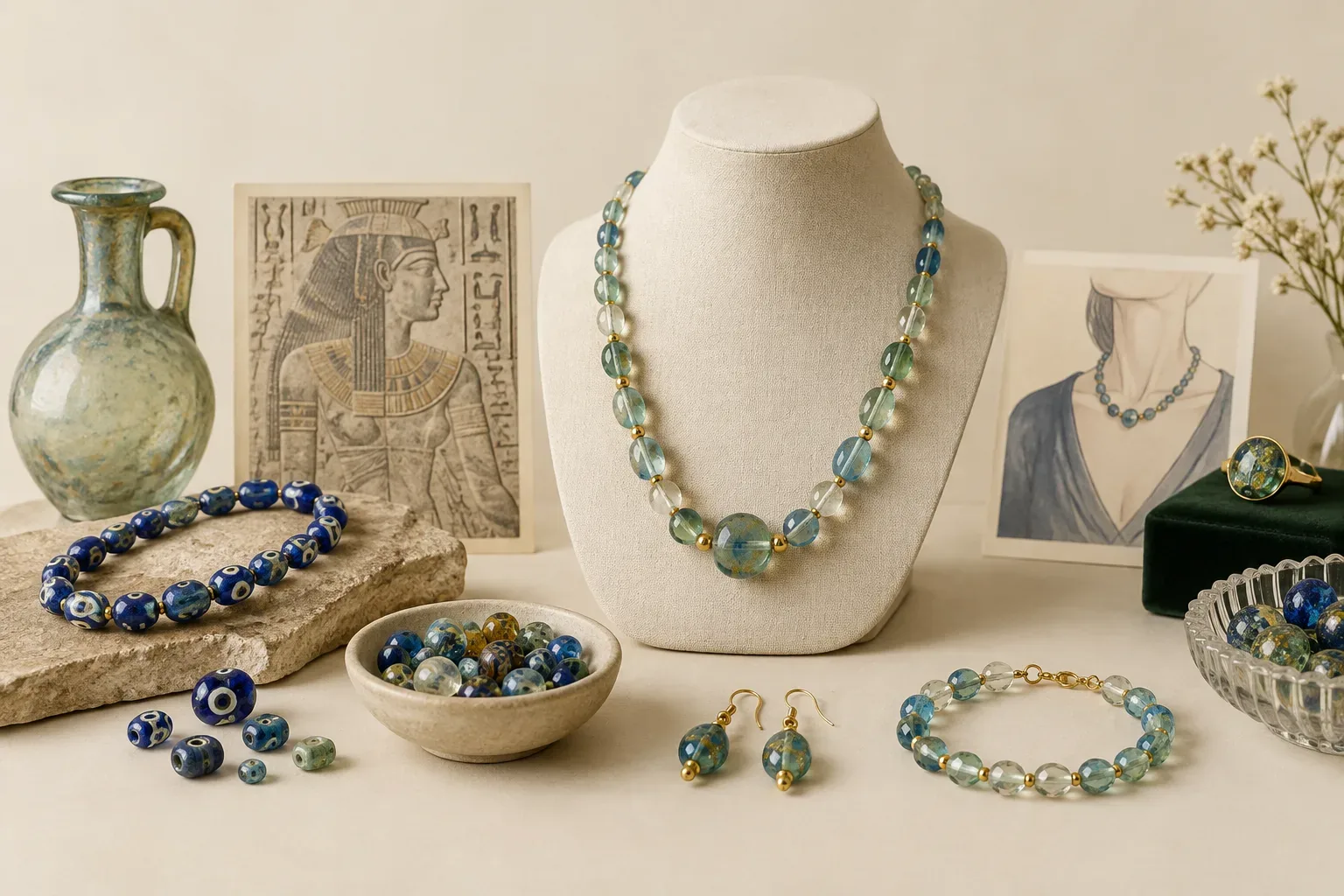
In wearable objects, glass appears in multiple technical and stylistic roles. Glass is used as formed beads strung in necklaces and bracelets, as set inlays or ‘paste’ stones that imitate cut gems, as fused or lampworked focal beads, and in contemporary studio pieces where glass is the primary sculptural material. Museum descriptions and gemstone guides note that materials historically served both imitative and decorative functions.
From a design standpoint, glass shows up as a motif (for example, a repeated bead type or colored glass cabochon), as a simulated gemstone (paste glass cut and faceted to catch light), and as unique artisanal focal pieces (blown, fused, or kiln-formed elements). How the material is used affects its visual impact, durability, and price.
Quality: what to inspect and why it matters
Material identification and maker’s evidence are primary quality indicators. Look for clear information from the seller about whether a piece is glass, crystal, or a treated/assembled object. The Federal Trade Commission advises consumers that sellers must not mislead buyers about material treatments or whether an item is an imitation of a precious gemstone. Request written confirmation when buying online.
Examine workmanship: consistent color, smooth surfaces, uniform hole finishing in beads, neat settings, and secure closures indicate quality. In older or studio pieces, fine tool marks and careful joins are signs of handcraftsmanship. Condition matters for value: chips, clouding, or hairline cracks reduce both beauty and structural integrity.
If a piece is described as a simulated gemstone (for example, paste), recognize the difference in material value versus the skill and design value of the piece. Provenance and maker will influence price independently of whether the core material is glass.
Price factors and valuation
Price reflects multiple elements: the raw material, technique, maker or brand, age, rarity, condition, and provenance. A mass-produced glass bead bracelet will price differently from a signed studio glass pendant or an antique set of cut glass paste stones in an historic setting. Museum collections demonstrate how context—designer, patron, and historical moment—can raise the value of non-precious materials.
Market norms vary. Expect lower intrinsic material value for plain glass compared with precious gems and metals, but be prepared to pay more for exceptional artistry, historical importance, or a reputable maker. When in doubt, ask the seller for comparables and documentation of maker’s marks or exhibition history.
Best uses: when glass jewelry is a great choice
Glass jewellery is well suited to everyday fashion, because it can deliver bold color at moderate cost and is easily replaceable if lost or damaged. Costume and statement pieces made from glass allow for seasonal trends without heavy investment.
For formal wear or heritage settings, glass can be an excellent choice if the piece’s design, cut, and setting carry the required gravitas—particularly when the work is by a recognized maker or part of a curated vintage design. For sentimental gifts, the personal meaning you attach matters more than the material itself; a well-chosen glass piece can be meaningful and wearable.
Conservational uses differ: fragile, cut, or historically important glass may be best reserved for occasional wear or kept within a collection where environmental control reduces risk of damage.
Practical selection and gifting guidance
Be explicit about expectations when buying as a gift. Ask whether the recipient prefers durable daily wear or occasional statement pieces, whether they have metal allergies that affect settings, and whether they value designer attribution or artisan uniqueness. Choose weight, scale, and clasp type to suit the wearer’s habits.
Ask the seller for clear disclosures: material identification, any treatments or adhesives used, and return or repair policies. The Federal Trade Commission recommends that sellers avoid misleading descriptions of imitations and disclose treatments; use that standard in your conversations. When purchasing vintage glass, request condition reports and provenance if available.
Respect cultural meanings. If a glass motif is associated with a specific cultural or religious tradition, research its significance and, where relevant, consult primary cultural sources or museum documentation before giving the piece. If you are unsure about a motif’s cultural sensitivity, choose an alternative design or ask a knowledgeable source.
Care, conservation, and aftercare notes
Treat glass like other delicate materials: avoid hard knocks, store pieces separately to prevent abrasion, and keep them away from extreme heat or rapid temperature changes. Clean glass with mild soap and water and a soft cloth; avoid harsh chemicals that can attack glue or decorative coatings.
For antique or museum-quality glass, seek professional conservation advice before attempting repairs. A conservator can also advise on display and storage if the piece is collectible rather than wearable.
Frequently asked questions
Is glass jewelry considered 'real' jewellery?
Glass is a legitimate jewellery material with both decorative and historical uses; its market value differs from precious gemstones, but craftsmanship, age, and provenance can make glass jewellery collectible. Museum documentation shows materials and their social meaning change over time, so evaluate pieces by their maker and context rather than by material alone.
How can I tell if a gemstone is glass or a real gem?
Request material identification from the seller and look for clear disclosure of treatments or imitation claims. The Victoria and Albert Museum’s gemstone guidance stresses the importance of identification, and the Federal Trade Commission advises sellers not to mislabel imitations. When uncertain, have the piece assessed by a qualified gemmologist.
What should I ask the seller before buying glass jewellery online?
Ask for explicit material identification, any treatments or adhesives used, the maker or brand, condition photos from multiple angles, and the return policy. The FTC recommends that sellers disclose imitations and material treatments, so written confirmation will protect you if the item differs from the description.
Is vintage glass jewellery worth restoring?
It depends on the piece’s historical or maker significance and condition. For museum-quality or valuable vintage items, seek professional conservation advice; for inexpensive costume pieces, repairs may be more practical but rarely restore full market value. Consider sentimental value and intended use when deciding.
How should I care for glass jewellery to make it last?
Store individually to prevent abrasion, avoid thermal shock and hard knocks, clean with mild soap and water, and avoid harsh chemicals that may attack coatings or adhesives. Reserve fragile or historically significant pieces for occasional wear.
Sources and further reading
- Bedazzled: A History of Jewellery — Victoria and Albert Museum
- An A-Z of Gemstones — Victoria and Albert Museum
- Buying Gemstones, Diamonds, and Pearls — Federal Trade Commission