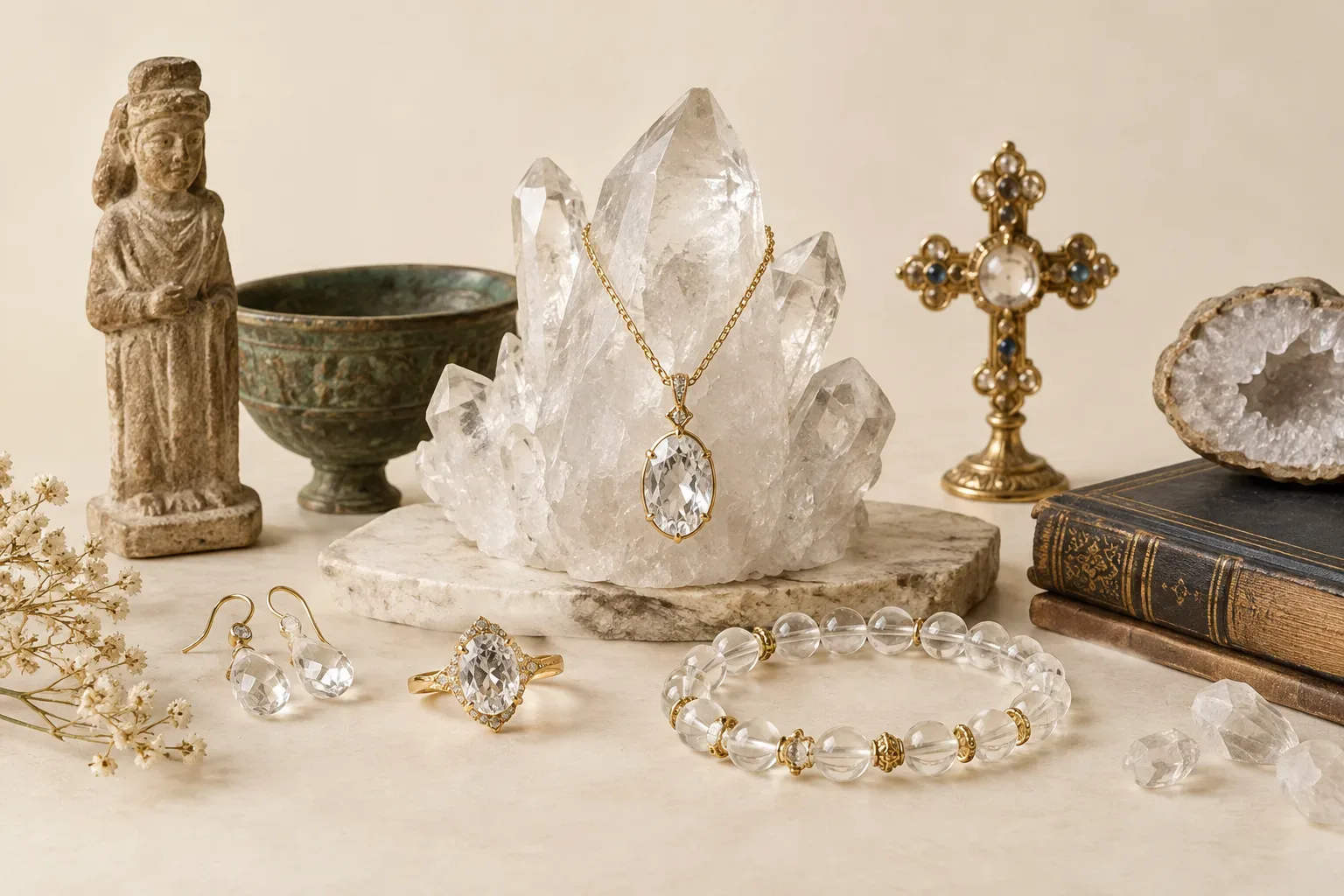
Meaning at a glance
This article explains the documented history and changing contexts of crystal jewelry, distinguishes historically attested meanings from modern personal readings, describes how crystals and metal hallmarks appear in jewelry, and gives practical guidance on buying, gifting, and disclosure.
Quick answer
Crystal jewelry explained in one line: museums and consumer agencies treat 'crystal' as a term that can refer to natural transparent gemstones such as rock crystal or to man-made glass cut to imitate gems, and the documented social meanings of crystal and other gemstones have shifted across cultures and periods; accordingly, buyers should look for clear disclosure about material treatments and metal hallmarks, and choose or gift pieces with attention to provenance, context, and the recipient’s values. This summary follows the thesis of explaining documented history, separating cultural evidence from later popular interpretation, and offering practical selection guidance.
What historians and museums say about crystal in jewelry
The Victoria and Albert Museum (V&A) places gemstones and glass within a long, changing social history of jewellery, showing how techniques, materials and meanings shift as fashion, technology and social structures change. The V&A’s materials note that gemstones and rock crystal appear repeatedly from ancient to modern times, repurposed in different settings and for different audiences rather than carrying a single, unchanging meaning.
Across cultures and eras, jewelers chose transparent stones and glass for a variety of purposes: to show technical skill through cutting and carving, to imitate more expensive gems, to hold personal imagery or relics, or to signify social rank when set in costly metalwork. The V&A’s accounts of gem and jewellery history emphasize context — for example that the same material might be prized for spiritual use in one period and for fashionable display in another.
Historical evidence by culture and period
Ancient Egypt and classical antiquity: Museum collections and scholarship trace long-standing uses of transparent stones such as rock crystal for carved amulets, beads and inlays in the ancient Mediterranean and Near East. These uses are documented in museum collections and archaeological reports and are presented in museum overviews of jewellery history as part of a material chronology.
Medieval and Renaissance Europe: In medieval and Renaissance contexts, transparent stones and rock crystal were used for reliquaries, devotional objects and portrait miniatures set into rings and lockets. The V&A presents these roles as tied to religious practice and elite display rather than a single symbolic formula.
Early modern and Victorian Britain: The V&A documents how advances in cutting and setting, combined with changing social norms around display and mourning, produced new forms such as memorial jewellery and mass-produced glass imitations. In Victorian Britain, both sentimentality and advances in market production shaped how clear stones were worn and understood.
20th century to contemporary: Museum histories chart a further expansion of meanings as costume jewellery and new glassmaking techniques made crystal-like materials accessible to broader publics. The significance of crystal-like gems continues to depend on context, fashion and individual choice.
Documented historical meanings versus modern personal interpretations
Documented meanings: Where museums and curators can point to documentary evidence — inscriptions, inventories, religious texts, workshop records or archaeological contexts — they attribute specific uses and meanings to jewellery. For example, a crystal carved and placed in a reliquary has a documented religious role within that artifact’s context. The V&A emphasizes relying on such documentary or material evidence when assigning historical meanings.
Modern personal interpretations: Many contemporary meanings attached to crystals — for example, that a particular type of crystal will bring health, luck or spiritual energy — are personal or cultural interpretations that gained popularity much later than the historical objects themselves. These modern beliefs are valid as personal or cultural practices for those who hold them, but they are not the same as documented historical use and so should be presented as contemporary interpretations rather than historical fact.
What 'crystal' means in composition and in jewelry making
In jewellery contexts, the word 'crystal' can denote different materials and should not be assumed to mean a single mineral. Museums’ gemstone guides, like the V&A’s A–Z of Gemstones, treat natural transparent minerals such as rock crystal (a clear variety of quartz) as distinct from glass or other man-made materials that are cut and finished to resemble gemstones. Knowing which material you are looking at requires identification that may include visual inspection, documentation from the seller, and sometimes specialist testing.
Hallmarks refer to marks struck on the metal parts of jewellery to indicate metal content, maker, or assay authority. While hallmarks apply to metal components and not to stones themselves, they are crucial for dating and authenticating a piece, and museums use hallmarks and maker’s marks to help establish provenance and period. When evaluating crystal jewellery, consider both the stone material and the metal hallmarks together because the metal can tell you about date, origin and legal standards around metal content.
Disclosure: what should sellers tell you
In many jurisdictions consumer protection agencies require clear disclosure when gems or other materials are treated, synthesized or imitated. The U.S. Federal Trade Commission (FTC) advises buyers to expect sellers to disclose whether stones are natural, synthetic, treated, or imitations, and to describe the nature of any treatments that affect value or durability.
Practical implications of disclosure: ask whether a crystal is natural rock crystal, cut glass, or a man-made optical glass; whether a stone is dyed, coated or otherwise treated to enhance color or clarity; and whether the metal is hallmarked for precious metal content. For pieces sold as antique or vintage, request any provenance documentation and inquire about restoration work or replacements, since replacement stones and repairs affect both historic integrity and value.
How crystal motifs and traditions appear in jewellery forms
Cut and carved stones: Historically, transparent stones were carved into intaglios, cameos and religious miniatures; museum collections show these forms set into rings, pendants and reliquaries. The combination of a clear stone and fine carving was a way to display both material and technical skill.
Set stones and glass imitations: Transparent stones and glass are commonly set in rings, necklaces and brooches. In some periods jewellers used leaded glass or paste to imitate more costly gems; museums document this technique as part of the history of costume jewellery and market responses to changing demand. The setting style, metalwork and any accompanying hallmarks help place a piece in its proper historic or market context.
Choosing or gifting crystal jewellery thoughtfully
Start with intent and research: consider what you want the piece to signify for the wearer. If your intention is historical interest, look for provenance and hallmarks and consult museum resources or reputable dealers. If your intention is aesthetic or personal, focus on craftsmanship, wearability and the recipient’s preferences rather than claiming a historical meaning the object does not have.
Respect cultural and religious contexts: some items derive meaning from specific cultural or religious practices. If a piece appears to be an artifact tied to a living religious tradition or a particular cultural practice, buying or wearing it requires sensitivity and, where appropriate, consultation with members of that community. Museums and reputable dealers can often advise on context and provenance.
Ask for clear disclosures and documentation: request written information about materials, treatments and metal hallmarks. For higher-value purchases, seek independent appraisals or certificates from recognized gemological labs. Use the FTC consumer guidance as a checklist for what should be disclosed when you buy gemstones, diamonds or pearls.
Care, upkeep and ethical considerations
Care: treatment of the stone or metal affects cleaning and repair methods. Treated or fragile stones may not tolerate the same cleaning as hard, untreated gems. If the seller cannot provide information about treatments, treat a piece conservatively and consult a qualified jeweler before cleaning or repair.
Ethics and provenance: for historically significant pieces, documentation of origin and lawful export is important. When in doubt about provenance or cultural sensitivity, consult museum resources, specialists or the seller’s records. Museums like the V&A collect and display jewellery with attention to provenance and context, and their curatorial notes can be useful as starting points for research.
Concluding guidance
Crystal jewelry explained requires two parallel approaches: use documentary and material evidence to understand historical uses and meanings, and respectfully treat contemporary beliefs and personal meanings as separate but valid. Rely on museum documentation for historical context and on consumer protection guidance for buying and disclosure. When you choose or gift a crystal piece, aim for clear information about materials and treatments, sensitivity to cultural context, and alignment with the wearer’s tastes and values.
Frequently asked questions
What exactly does 'crystal' mean when used by a seller?
Sellers may use 'crystal' to mean natural transparent gemstones like rock crystal or to describe cut glass made to resemble gems. Ask the seller for written disclosure about whether the piece is natural, synthetic or glass and whether any treatments were applied; the FTC advises that such material disclosures should be clear to consumers.
How can I tell if a crystal stone is natural or glass?
Visual inspection alone is often inconclusive. For reliable identification, request documentation from the seller, consult the V&A’s gemstone guides for contextual clues, and for higher-value items seek an independent gemological test or certificate.
Do hallmarks tell me about the stone?
Hallmarks apply to metal parts and can indicate metal content, maker, or assay origin; they help date and authenticate the setting but do not identify the stone itself. Use hallmarks together with stone disclosure and provenance for a full picture.
Are sellers required to disclose treatments or synthetics?
In many jurisdictions, including guidance from the U.S. Federal Trade Commission, sellers should disclose whether gemstones are natural, synthetic, treated, or imitations and describe treatments that affect appearance or value. Ask for written details before purchase.
Is it inappropriate to wear or gift historical crystal pieces from other cultures?
It depends on context. Items tied to sacred use or living cultural traditions require sensitivity. When in doubt, research provenance, consult museum resources or community representatives, and prefer ethically sourced or properly deaccessioned pieces.
Where can I learn more about the historical meanings of jewellery motifs?
Museum resources like the Victoria and Albert Museum’s histories and gemstones guides are good starting points. Our related site articles on jewellery research and gift selection can also help you match historical context with present-day choices.
Sources and further reading
- Bedazzled: A History of Jewellery — Victoria and Albert Museum
- An A-Z of Gemstones — Victoria and Albert Museum
- Buying Gemstones, Diamonds, and Pearls — Federal Trade Commission