Meaning at a glance
Documented museum evidence shows map-related motifs and portable cartographic objects appearing in early modern European jewelry and accessories as practical tools and status items; contemporary map jewelry is primarily personal and symbolic, and buyers should verify materials, consider provenance and cultural sensitivity, and choose designs that respect local meanings.
Documented history: where museums and specialists place map motifs
When we look for historically documented uses of maps in personal adornment, museum surveys and exhibitions provide the safest evidence. The Victoria and Albert Museum (V&A) presents a long view of jewellery’s changing social contexts and documents how objects that combined utility and ornament—such as portable globes, navigational instruments carried as accessories, and decorated cases—emerged in Europe during the early modern and modern periods. The V&A’s material places these items in the broader story of jewellery as both practical and symbolic.
Specifically, collections and catalogues shown by the V&A link the appearance of cartographic imagery and portable cartographic objects to the Age of Exploration and the centuries that followed, when travel, navigation and imperial ambition made maps a visible sign of knowledge, curiosity and social standing in European circles. Museums record objects such as compass cases, decorated map cases, and small painted or enameled panels that incorporate map-like imagery in European decorative arts and jewellery traditions from roughly the early modern period into the 18th and 19th centuries. The V&A frames these objects as part of changing social uses of jewellery rather than as a single symbolic system.
Identifying cultures and periods precisely (museum-backed framing)
Museum documentation tends to separate cultural contexts carefully. For map-related jewelry evidence, the clearest museum-backed cases come from European contexts in the early modern to modern era, when portable objects and decorative arts reflected the importance of exploration and travel in those societies. The V&A’s historical overview of jewellery emphasizes shifts across distinct periods—such as Renaissance, Georgian, Victorian, and modern—showing that the same motif can have different meanings in each period depending on fashion, technology, and social values.
It is important not to conflate these European museum-documented uses with practices in other cultures unless specific evidence exists. Museums like the V&A catalog artefacts by origin and date so researchers can see that similar motifs (for example, circular globe-like ornaments or engraved cartouches) may appear in different times and places but carry different cultural connotations and functions.
Documented historical meanings versus modern personal interpretations
The historically documented meanings recorded in museum collections and exhibition narratives tend to be pragmatic and social: maps and cartographic devices in personal objects signaled knowledge of navigation, involvement with travel or commerce, commemoration of a voyage, or simply the wearer’s engagement with fashionable ideas about exploration. These meanings are documented through object provenance, maker records, and the contexts in which such pieces were owned, displayed, or recorded by institutions such as the V&A.
By contrast, modern interpretations of map jewelry are primarily personal, varied, and not universal. Today people commonly use map motifs to represent a sense of home, a favorite place, a spirit of adventure, personal migration stories, or identity tied to a landscape. Contemporary meanings are often private: a stamped set of GPS coordinates inside a ring may commemorate a wedding location, while a pendant etched with the outline of a country can express heritage or political solidarity. These are modern cultural readings and personal choices rather than historically documented, universal meanings.
How the map motif, gemstones, and related traditions appear in jewelry
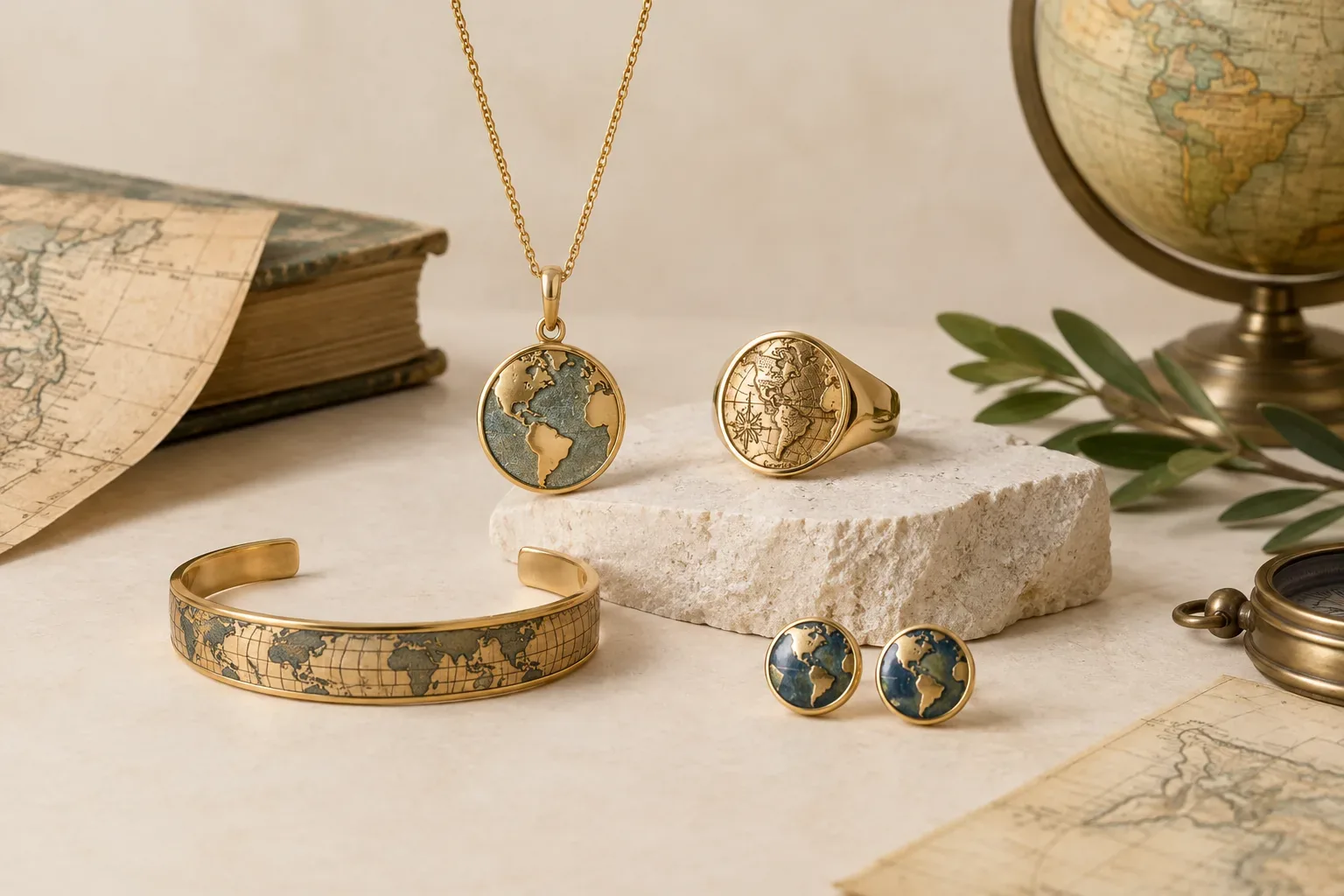
Map-related motifs appear in jewelry in several practical ways grounded in historic practice and modern techniques. Historically documented forms include small painted or enameled map panels set into lockets or cases, compass and cartouche decorations on pendants and brooches, and miniature globe objects reproduced as wearable curios. Museums like the V&A show many examples of jewellery and dress accessories incorporating decorative patterns that reference cartography or instruments of travel.
In modern craft and commercial jewellery, the motif appears as engraved outlines of places, enamel fills that reproduce map colors, miniature printed maps sealed into glass or resin, and personalization such as engraved coordinates. Gemstones are sometimes used to mark a specific place on a map motif: a small diamond or garnet can be set where a city sits, or a birthstone can be placed within the outline of a home country. The V&A’s A–Z of Gemstones helps with identifying traditional gemstone uses and historical context, showing how particular stones have been valued and deployed across periods in jewelry.
Buyers should also be aware of material realities: modern gemstones may be heat-treated, dyed, or synthetically produced, and imitations can be presented as natural stones. The Federal Trade Commission (FTC) provides guidance on required disclosures and consumer protections when buying gemstones, diamonds, and pearls. Provenance and honest treatment disclosure are essential if a piece’s meaning is tied to material authenticity.
Practical and respectful selection and gifting guidance
Choose purposefully: decide whether the piece is meant to mark a personal memory, to celebrate heritage, or to signal support for a place-based cause. That decision shapes design choices such as a discreet engraved coordinate versus a bold country outline. Think about the recipient’s relationship to the place represented—if a map motif refers to territory that is contested or sacred to an Indigenous community, prioritize approaches that avoid appropriation and harm.
Material and maker considerations matter. If gemstone authenticity or origin is important to the meaning you intend, ask the seller for disclosure about treatments and origin; the FTC encourages clear statements about gem treatment and imitation so consumers can make informed choices. For heirloom or sentimental gifts, choose durable settings and metals that suit everyday wear, and consider commissioning a local maker or a silversmith who can create a respectful bespoke piece.
Personalization can deepen meaning. Engraving a date, adding coordinates, or choosing a birthstone placed over a town can transform a decorative motif into a personal token. When gifting a cultural or place-based symbol to someone from that community, consult them or choose a neutral personalization if you are uncertain about the symbol’s cultural sensitivity.
Finally, consider documentation and care. Ask for receipts, maker notes, or treatment disclosures to preserve the piece’s story, and follow standard care guidance for the chosen materials so the object remains a reliable memento.
Provenance, ethical concerns, and care
Provenance affects both meaning and value. A map pendant made to commemorate a recorded voyage with maker’s marks and documented ownership will carry a different historical weight than a mass-produced souvenir pendant. Museums categorize and interpret such differences; the V&A’s treatment of jewellery history emphasizes how objects’ social meanings derive from their histories and contexts.
Ethical concerns include cultural sensitivity, material sourcing, and accurate disclosure. If a piece references Indigenous lands, sacred maps, or politically sensitive boundaries, avoid appropriation by seeking permission or selecting designs that respect those communities. For materials, request disclosure of gemstone treatments and origins and prefer reputable dealers who follow consumer-protection guidance like that provided by the FTC.
Care depends on materials. Enamel and painted surfaces are vulnerable to hard knocks; delicate insets of printed maps behind glass or resin require gentle handling. Precious metals and gemstones have standard cleaning and storage practices documented by museums and conservators; follow maker instructions and keep documentation for future stewardship.
Conclusion
Map jewelry meaning is not one thing. Museum evidence, as organized and discussed by the Victoria and Albert Museum, places map-like motifs and portable cartographic objects primarily in early modern and later European decorative traditions with practical and status-related uses. Modern map jewelry, by contrast, is overwhelmingly a vehicle for personal meaning—home, travel, memory, or political identity. When selecting or gifting map jewelry, balance respect for documented contexts with the recipient’s personal story, verify materials and disclosures in line with FTC guidance, and prioritize provenance, maker transparency, and cultural sensitivity.
Frequently asked questions
Does map jewelry have a single, historical meaning?
No. Museum documentation shows map-related motifs in early modern and later European contexts carried practical and status-related meanings, but modern uses are personal and varied rather than universally fixed.
How can I verify a gemstone used to mark a place on a map pendant?
Ask the seller for written disclosures about gemstone treatments and origin; the Federal Trade Commission recommends that dealers be transparent about heat treatments, dyeing, synthetics, or imitations so buyers can make informed choices.
Is it appropriate to gift map jewelry representing Indigenous or contested lands?
Exercise caution and respect. If a design references Indigenous territory or a politically sensitive area, consult the community or choose a design that avoids appropriation; prioritize culturally informed makers when possible.
What forms does map imagery take in jewellery historically and today?
Historically museums record decorated cases, compass and globe motifs, and enameled panels set into personal objects; today you will also find engraved outlines, coordinate engravings, printed-map resin insets, and gemstone markers used as personal signifiers.
Where can I learn more about gemstones used in map jewelry?
For historical context on gemstones, see the Victoria and Albert Museum’s A–Z of Gemstones, and for consumer protections and disclosure guidance consult the Federal Trade Commission’s guidance on buying gemstones, diamonds, and pearls.
Sources and further reading
- Bedazzled: A History of Jewellery — Victoria and Albert Museum
- An A-Z of Gemstones — Victoria and Albert Museum
- Buying Gemstones, Diamonds, and Pearls — Federal Trade Commission