Meaning at a glance
This guide explains the documented history and changing contexts of emeralds, separates historical meanings from modern personal interpretations, and sets out practical quality, disclosure and gifting guidance so you can evaluate emerald quality and value factors when choosing jewelry.
What history tells us — precise cultures and periods
Museum collections and exhibition notes collected by the Victoria and Albert Museum place emeralds in jewellery across many distinct cultures and periods. The V&A documents ancient and classical contexts where green gems appear in personal ornament, including items from ancient Egypt and the classical Mediterranean world where green stones were incorporated into personal adornment and amulets.
The museum’s surveys also identify use of emeralds in Byzantine and medieval European jewellery traditions, where gems served both decorative and devotional functions, and in South Asian courts such as Mughal India, where elaborate gem-set jewellery became integral to court dress and status. From the Renaissance through the eighteenth and nineteenth centuries into modern fashion, the V&A traces changing tastes and techniques that affected how emeralds were cut, set and displayed in rings, necklaces and other pieces.
These chronological and cultural attributions are drawn from the Victoria and Albert Museum’s research on jewellery history and gemstone identification, which emphasizes that the meaning and use of emeralds changed with social context and technology rather than remaining fixed across time.
Documented historical meanings versus modern personal interpretations
Documented historical meanings come from how societies used emeralds in context: for example, museums record when gems were used as status symbols in royal regalia, as components of devotional objects, or as fashionable accents in portrait jewellery. These are context-dependent observations about social practice rather than universal symbolic claims.
Modern personal and popular interpretations—such as assigning a single universal meaning of healing, protection or love to the emerald—are later cultural readings and personal attributions. They may be meaningful to individuals today, but they are not the same as the museum-documented social functions of emeralds in a specific time and place.
When discussing symbolism, therefore, distinguish the documented roles recorded by institutions like the V&A from contemporary, individual uses. Use the former to understand how a gem was valued historically and the latter to decide what an emerald might mean to the person who will wear it now.
How emeralds and the emerald motif appear in jewellery
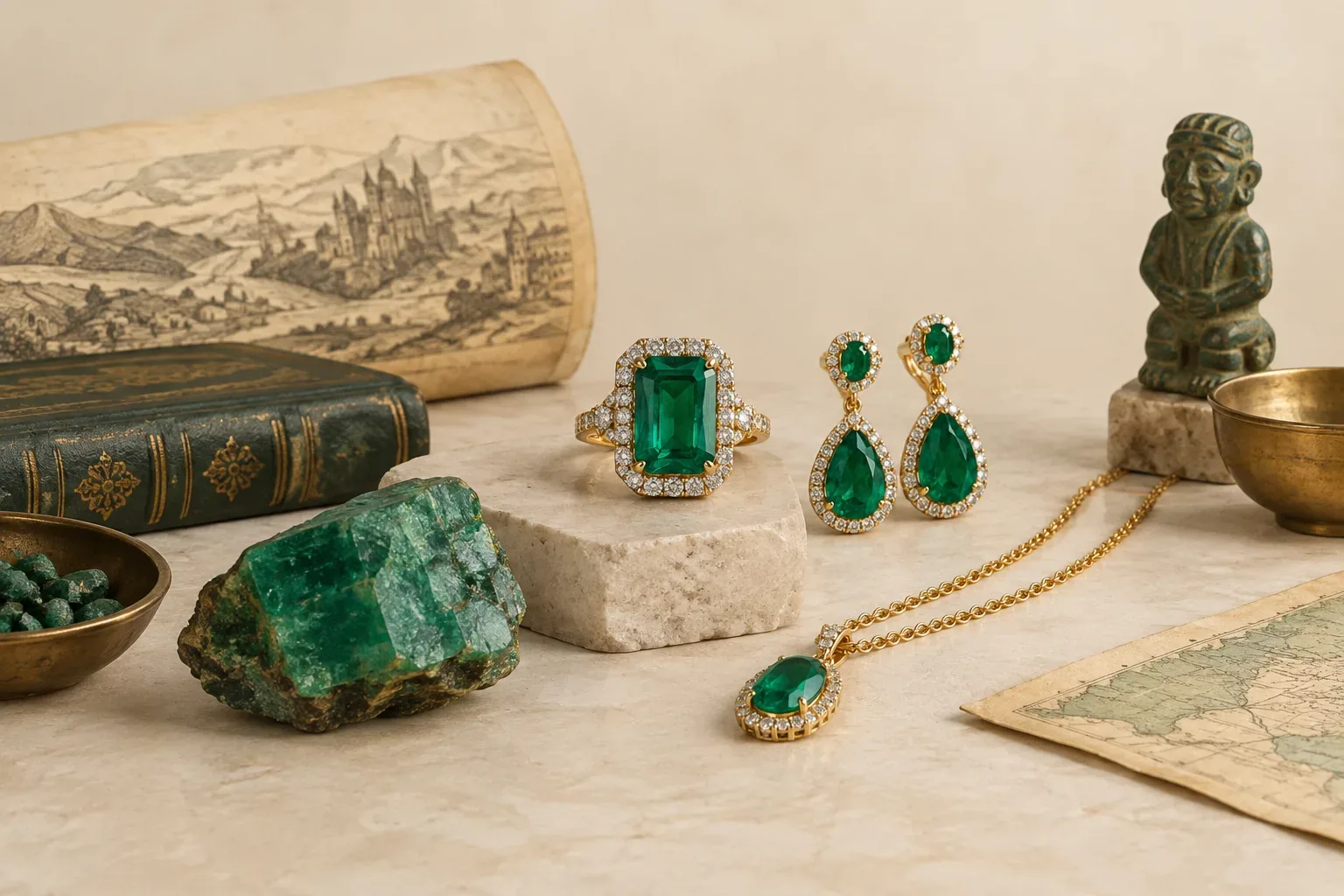
In museum collections and exhibition narratives, emeralds appear in a wide range of jewellery types: rings, necklaces, pendants, brooches and sets intended for formal dress. They are often used as centre stones in rings and as coloured accents in multi-gem compositions, and jewellery makers have historically paired emeralds with diamonds, pearls and other coloured gems to create contrast and emphasis.
The visual motif of green—the colour itself—has been used beyond single stones, appearing in enamel work, gem-inlaid surfaces, and in jewellery sets where matching colour and cut communicate coordinated taste. Museums document changes in cutting and setting styles over time: earlier pieces may show cabochons or large, irregular stones set to display colour, while later periods reflect advances in cutting that emphasise brilliance and symmetry.
Understanding how the emerald appears in jewellery collections helps you read a piece: is the gem presented as a focal centre, as part of a matched suite, or as a coloured accent? Each use signals a different historical or stylistic intent and will guide how the piece functions in modern wear.
Key quality and value factors to check
Colour is the primary factor many buyers associate with emerald value: museums and gem guides note that saturated green hues attract the eye and are often most prized. Assess colour for hue, tone and saturation rather than relying on a single descriptive word—look for an even, lively green that suits your taste and budget.
Clarity matters but behaves differently for emeralds than for some other gems. The Victoria and Albert Museum’s gemstone guidance observes that emeralds commonly contain internal features; these inclusions are part of the stone’s character and can influence both appearance and durability. Expect that many emeralds will show internal features, and treat clarity as a matter of degree rather than a binary pass/fail.
Cut and shape affect both how colour is displayed and how the stone sits in a setting. Museum pieces show a range of historical cuts; modern cuts aim to balance maximum colour retention with pleasing proportions. For emeralds, certain traditional cuts emphasise colour over brilliance, so evaluate whether the cut makes the gem look lively and even.
Carat weight influences price, but larger stones are not automatically better if colour or clarity suffer. Consider how size, colour and clarity combine to produce an attractive stone at your chosen budget.
Treatments and imitations are common market realities. The Federal Trade Commission requires sellers to disclose treatments and synthetic or imitation gems; read the FTC’s consumer guidance about buying gemstones to understand disclosure expectations. Ask sellers specifically whether a stone has been treated, how it was treated, and whether a lab report accompanies the piece.
Provenance and documentation can add value and confidence. Museum records demonstrate how provenance aids historical interpretation; in the market, certificates from reputable gemological labs and clear seller disclosure reduce uncertainty about treatment, authenticity and origin.
Practical, respectful selection and gifting guidance
Align the jewel to the wearer’s lifestyle and taste. If the recipient prefers low-maintenance jewellery or wears pieces daily, choose a setting and mounting proven for wear and ask the seller about care requirements. If the piece is intended as a collectible or occasional-wear heirloom, prioritize certification and documentation.
Use questions to guide purchase conversations. Ask the seller to describe the stone’s colour, clarity, cut and any treatments. Request any available laboratory reports and a written disclosure of treatment or enhancement, as recommended by the Federal Trade Commission’s consumer advice.
Balance emotional intent with material reality. If you are buying an emerald for its historical associations, communicate that context when giving it so the recipient understands the thoughtful connection. If you and the recipient value contemporary personal symbolism, choose a piece whose colour and style express that meaning rather than assuming a single historic symbolism will be understood.
When gifting, be transparent about what you know: include receipts, lab reports and care instructions. This respects the recipient’s ability to insure, clean and maintain the gem and preserves value for future decisions.
Consider budget trade-offs openly. A smaller, fine-coloured emerald with good documentation may offer more long-term satisfaction than a larger stone of poor colour or unknown treatment. Museum collections demonstrate that beauty and historical value often derive from thoughtful combinations of colour and craftsmanship rather than raw size alone.
Practical care and post-purchase steps
After purchase, follow care instructions from the seller and lab reports. If a piece requires special cleaning or setting maintenance, treat those recommendations as part of the purchase. Museums and consumer guidance both emphasise that proper care extends the life and appearance of jewellery.
Keep documentation in a safe place and consider professional appraisal for insurance if the piece has significant value. If you plan to resell in the future, provenance and clear treatment disclosure will preserve marketability.
If you have concerns about ethical sourcing, discuss them with the seller before buying. While the approved evidence here does not specify supplier policies, asking for supplier provenance and any sustainability claims is a reasonable consumer step and compatible with the museum focus on contextual understanding.
Conclusion
Evaluating emerald quality and value factors means balancing the gem’s physical attributes with the historical and social contexts that shape how it will be worn and understood. Use museum-based history to inform cultural meanings, follow consumer-protection guidance about treatment disclosure, and prioritize clear documentation, honest seller communication and the wearer’s preferences when choosing or gifting emerald jewellery.
Frequently asked questions
What are the main factors that determine an emerald’s value?
Value combines the stone’s colour, clarity, cut and carat weight together with documentation and market demand; vivid, evenly saturated green colour and well-executed cuts that display colour tend to command higher prices, while clarity affects appearance and potential durability. Museum references on gemstones emphasise colour and clarity as primary attributes to examine.
Are emeralds commonly treated and should sellers disclose this?
Yes. Sellers should disclose treatments and any synthetic or imitation materials according to Federal Trade Commission guidance. Ask for a written disclosure and any laboratory reports that describe treatments such as clarity enhancement or other processes.
How can I verify that an emerald is authentic and fairly described?
Request a report from a reputable gemological laboratory and written seller disclosure about treatments and origin. Compare the seller’s documentation with independent lab reports where possible and buy from reputable dealers who provide clear return policies.
Is an emerald a good everyday ring stone or better for occasional wear?
Choose based on the wearer’s lifestyle and the stone’s condition. Because many emeralds have internal features that can affect durability, discuss care and setting protection with the seller and follow their care instructions. If the wearer leads an active life, select a secure setting and confirm any special care needs before daily wear.
What should I include when gifting an emerald piece?
Provide any receipts, lab reports and care instructions with the gift. Explain any historical or sentimental context you intend the piece to carry, and be transparent about treatments and return or repair options to respect the recipient’s ability to insure and care for the jewellery.
Sources and further reading
- Bedazzled: A History of Jewellery — Victoria and Albert Museum
- An A-Z of Gemstones — Victoria and Albert Museum
- Buying Gemstones, Diamonds, and Pearls — Federal Trade Commission