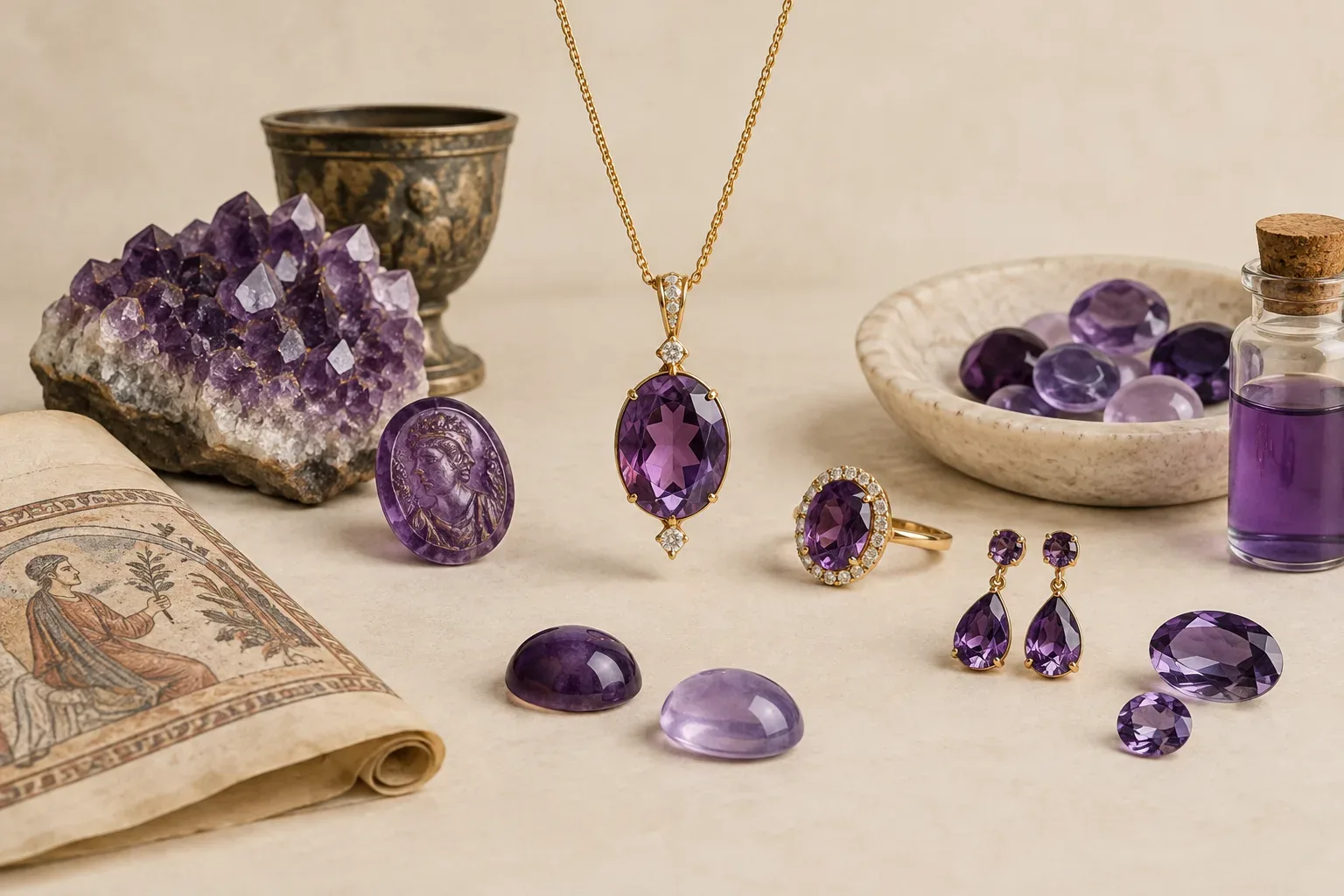
Meaning at a glance
Documented museum histories show amethyst has been used and valued across many periods; modern treatments and synthetic or imitation materials exist, so ask sellers for clear disclosure, origin or lab reports, and treatment details before buying or gifting.
What the historical evidence says (and how we know it)
Surveys of jewellery history assembled by institutions show that amethyst has been used in decorative and symbolic objects in many cultures and periods. The Victoria and Albert Museum’s presentations on jewellery and gemstones place amethyst within a long material history and explain how tastes and uses have changed over time. Those museum sources document amethyst as part of broader trends in colour, status, and religious ornament, rather than ascribing a single, unchanging meaning across cultures.
Because museums like the Victoria and Albert Museum compile objects, provenance records, and scholarship, they are the appropriate sources for tracing when and where a gemstone appears in surviving jewellery. Use such institutional accounts to identify the period and culture of a specific object rather than assuming a general global history for the stone.
Separating documented historical meanings from modern interpretation
Documented meanings come from how objects were used, recorded, or displayed in specific contexts. According to the Victoria and Albert Museum, purple gemstones were often associated with status and with particular fashions in dress and religious ornament in some periods. Those observations are anchored to surviving objects and archival records in particular places and times.
Modern personal meanings—for example, ideas about healing, sobriety, or personality traits tied to amethyst—are contemporary interpretations that people may attach to the stone today. Those personal or popular meanings are different from the documented historical record and can vary widely among individuals and communities. When choosing or gifting amethyst, decide whether you are emphasizing museum-documented history, contemporary symbolism, or purely aesthetic value, and make that distinction clear to recipients.
How amethyst appears in jewellery
Museum surveys note that amethyst has been used as faceted stones in rings, pendants, and brooches as well as in cabochons and beads. The way amethyst is cut, set, and combined with other materials reflects the fashion and technology of the time, so a Victorian ring with a deep purple amethyst will show different workmanship and setting styles from a contemporary minimalist pendant.
In modern commercial jewellery, amethyst is commonly set as the primary coloured stone in signet rings, cocktail rings, necklaces, and pairings with diamonds or silver. Designers may emphasize the stone’s colour, transparency, or crystal form, and historic or revival styles sometimes reference documented motifs from particular periods identified by museum collections.
Treatments and imitations: what they are (high level)
There are three broad categories buyers should understand: natural, treated, and synthetic or imitation. Natural stones are mined and sold without alterations to their chemical structure. Treated stones have undergone processes meant to improve colour or clarity; the exact treatment can vary and should be disclosed by the seller. Synthetic stones are laboratory-grown materials with the same chemical composition as natural gems, while imitations are different materials made to look like amethyst.
The Federal Trade Commission provides consumer guidance emphasizing disclosure when materials are treated, synthetic, or imitated. That guidance is the standard consumer-protection approach in many jurisdictions: sellers should tell buyers what they are purchasing rather than letting consumers assume ‘natural’ when materials have been altered or substituted.
Questions to ask sellers before buying or gifting
Ask whether the amethyst is natural, treated, synthetic, or an imitation. Request written confirmation of the answer. Sellers who comply with transparent disclosure will state if a stone has received heat treatment, irradiation, dyeing, or other enhancement and will indicate whether the piece contains lab-grown amethyst or a different material made to simulate it.
Request any available laboratory or vendor reports that describe treatment, origin, or identity. Independent gemological reports provide stronger, verifiable information than an unsigned label. If the seller cannot or will not provide clear information, treat that as a risk factor in the purchase.
Ask about origin only as descriptive information. Origin statements can be useful for understanding market value and ethical considerations, but they are not a substitute for a report that identifies treatments or confirms whether the stone is natural or synthetic.
Compare the price with similar pieces. An unusually low price can be a practical indicator that the material may be synthetic or an imitation. Combine price evaluation with the seller’s disclosure and any available paperwork to reach a reasoned decision.
How to evaluate the piece in context
Consider design, maker, and setting quality along with the stone. Museums such as the Victoria and Albert Museum place stones within the context of overall craftsmanship; a historically valuable mounting or high-quality maker can justify certain prices even if the gem itself is common.
If you are buying for meaning—whether historical or personal—be explicit about that with the seller. A piece chosen for historical authenticity should come with provenance and accurate identification. A gift chosen for contemporary symbolic reasons can prioritize clarity of the seller’s disclosure so that the intended meaning is not undermined by later revelations about treatments or imitation.
Respectful selection and gifting guidance
When gifting, be transparent about what you know. If you choose an affordable piece with synthetic or simulated amethyst because of colour or design, include a note explaining that choice. Recipients appreciate honesty, and framing your reason—whether aesthetic, budgetary, or symbolic—keeps the gesture respectful.
If the gift’s value hinges on the stone’s natural status or provenance, obtain and pass along any certificates or receipts that document treatments or origin. That documentation preserves the recipient’s choice to keep, alter, or sell the piece in the future with full information.
Finally, treat cultural meanings with respect. If you select amethyst because of a particular tradition or symbolic claim, check whether that interpretation is a documented historical practice or a modern personal layer you are adding. Distinguish museum-documented associations from current popular beliefs when explaining the gift’s significance.
Putting it all together
Use museum-based history to inform the cultural and stylistic context of a piece and use consumer-protection guidance when assessing material truth. The Victoria and Albert Museum’s resources help you understand how amethyst has appeared in different jewellery types and styles over time, and the Federal Trade Commission’s consumer advice explains why accurate disclosure about treatments and imitations matters to buyers.
A transparent seller, clear documentation, and an alignment between the gift’s intended meaning and the piece’s documented attributes make for a thoughtful, responsible purchase or present.
Frequently asked questions
Are amethysts commonly treated?
Treatments to improve colour or clarity do occur in the trade, and such changes should be disclosed. The Federal Trade Commission advises that sellers disclose treatments and material status so buyers know whether a stone is natural, treated, synthetic, or an imitation.
How can I tell if an amethyst is synthetic or an imitation?
The most reliable method is to request an independent gemological report or vendor documentation. Visual inspection alone can be inconclusive; the FTC recommends relying on seller disclosure and lab reports rather than assumptions.
Should I ask about the stone’s origin?
Origin can be useful context for value and ethical considerations, but origin statements do not replace confirmation about whether the stone is natural or has been treated. Ask for both origin information and any treatment or lab reports available.
What paperwork should I expect with a higher-value amethyst purchase?
Expect written treatment disclosure and, for higher-value pieces, an independent gemological report identifying whether the stone is natural, treated, lab-grown, or an imitation. Receipts and provenance notes are also important if historical authenticity matters.
If I’m gifting amethyst for its symbolic meaning, what should I disclose?
Be clear whether your gift’s symbolism refers to documented historical associations or contemporary personal meanings. If the physical material matters to that symbolism, include any documentation about the stone’s status so the recipient can understand both the gesture and the piece.
Sources and further reading
- Bedazzled: A History of Jewellery — Victoria and Albert Museum
- An A-Z of Gemstones — Victoria and Albert Museum
- Buying Gemstones, Diamonds, and Pearls — Federal Trade Commission