Meaning at a glance
This article explains the documented history and changing contexts of emerald cuts and settings, distinguishes museum-documented evidence from later popular or personal meanings, and gives practical, respectful guidance for selecting and gifting emerald-cut gemstones today.
Quick answer
Documented sources show that practical concerns about emeralds — their natural inclusions and sensitivity to pressure and impact — encouraged cutters and setters to develop step-style cuts and protective settings; museum research explains how changing tastes and technology then reshaped those forms. Separate from that recorded history, modern symbolic or emotional meanings attached to emerald cuts and settings are mostly personal or commercial interpretations rather than consistent historical facts. When choosing or gifting an emerald-cut gem today, prefer settings that protect the stone’s edges, ask for written disclosure of treatments or imitations, and match style to the wearer’s lifestyle and aesthetic.
What the historical evidence actually says
The Victoria and Albert Museum’s exhibition material and reference articles describe jewelry as a social and technical practice that changes with fashion, technology and material availability. The V&A’s overview of jewellery history explains how tastes and manufacture evolved across centuries, affecting how gems were cut and set for both practical and stylistic reasons.
On gemstones specifically, the V&A’s A–Z of Gemstones notes that emeralds commonly contain inclusions and internal fissures that make them more vulnerable to pressure and impact than many other gem materials. Those material properties shaped how cutters approached emeralds: cutters favoured shapes and faceting styles that reduced mechanical stress and avoided exposing fragile edges.
The combination of a relatively flat, rectangular step cut (now commonly called an 'emerald cut') together with settings designed to protect the stone’s edges is therefore grounded in documented material concerns and workshop practice reported by museum sources. The V&A connects these practical choices to changing aesthetic trends and available techniques, so that what is now a named cut and certain protective settings reflect both craft response and evolving taste.
Separating documented historical meanings from modern interpretation
Museum documentation focuses on observable changes — what craftsmen did and why — rather than on fixed symbolic meanings. The V&A materials demonstrate that many decisions about cuts and settings were driven by material properties, technological capability and fashion cycles rather than by a single, stable cultural symbolism.
By contrast, contemporary descriptions of emerald cuts and settings sometimes layer on symbolic or emotional meanings (for example, describing the cut as 'classic and dignified' or suggesting a protective setting implies emotional safeguarding). Those are modern, subjective interpretations that can be meaningful for an individual or marketed by retailers, but they are not the same as the documented workshop and stylistic history recorded by museums.
When discussing specific cultural or religious meanings, avoid presenting them as universal. Museum sources document how jewelry functions in social life and how forms changed in particular places and periods, but they do not support a single cross-cultural symbolic reading of the emerald cut or of settings.
How the motif — the emerald cut and protective settings — appears in jewelry
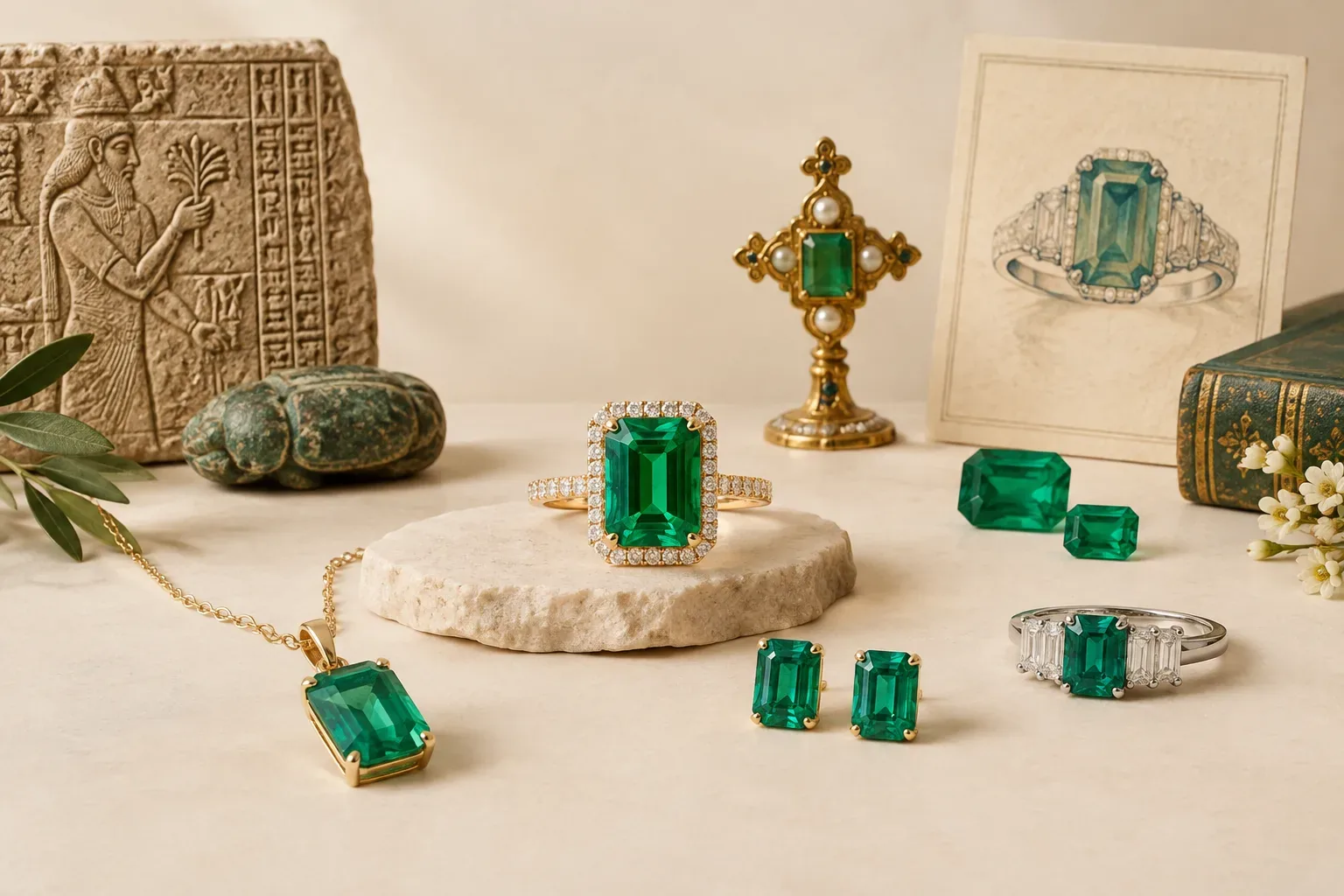
The 'emerald cut' used today is a rectangular step cut characterised by parallel facets that produce a hall-of-mirrors effect rather than the brilliant sparkle of faceted brilliant cuts. Although the name derives from the stone type for which the style was often used, museums explain that the form became used across many gem types because it suited certain aesthetic preferences and highlighted colour while limiting stress on fragile stones.
Protective settings appear wherever jewelers needed to minimise the risk of chipping or pressure to a vulnerable girdle or table. Bezel settings, where a metal rim surrounds and secures the stone, and settings that raise a protective collar or use more substantial prongs have long appeared in practice when durability was a priority. The V&A’s discussion of jewellery history shows how conservatory techniques and design choices evolved in conversation with material needs and fashion.
Design motifs combining an emerald-cut centre stone with surrounding accents — for example, halo arrangements of smaller stones, side stones that visually lengthen the centre, or low-profile frames to protect edges — are common ways of balancing durability with visible beauty. These combinations are a continuation of the practical and stylistic responses recorded in the museum literature rather than purely symbolic statements.
Practical guidance for selecting an emerald-cut gem
Match setting to use. If the wearer is highly active or plans to wear the ring daily, favour protective settings such as a low bezel, a partial bezel, or prongs with a reinforced gallery rather than high, exposed prongs. These options reduce the chance of contacting and chipping the stone’s edges while still showing the cut.
Consider the stone’s material and clarity. Because the step-style facets of an emerald cut emphasise colour and clarity more than brilliance, inclusions and surface-reaching fissures will be visually noticeable. For coloured stones, prioritise colour saturation and eye-clean appearance over higher brilliance that you would seek from a brilliant-cut diamond.
Ask about treatments and imitations. The U.S. Federal Trade Commission advises consumers to request disclosure of treatments and any imitations or enhancements. Emeralds and other gems may be oiled, resined, heat-treated, dyed, or otherwise treated to improve appearance. For valuable purchases, request a written disclosure and, when appropriate, an independent gemological report.
Choose metal and design to protect the girdle. A wider, sturdier mounting channel or a bezel that overlaps the girdle slightly will protect the most fragile part of a faceted gem. Consider a setting that keeps the table somewhat recessed if the wearer is likely to knock the stone against hard surfaces.
Balance scale and finger size. An elongated emerald cut suits longer fingers, but too large a stone can be impractical. Think about proportion: a moderately long centre stone set low will read as elegant while reducing exposure to impact.
Mind maintenance and repair expectations. Emeralds and other included stones may require gentler cleaning and occasional re-seating. Ask your jeweller about recommended cleaning methods and whether they will re-tighten prongs or rebuff bezels as needed.
Respectful selection and gifting guidance
Ask about the recipient’s daily life and style before deciding on a design. A visually striking, higher-profile setting may delight someone who rarely wears jewellery, while a protective low-profile style will better suit someone who uses their hands frequently. Matching jewellery to lifestyle shows respect for the recipient’s comfort and longevity of the piece.
Be transparent about treatments and provenance. When gifting a high-value gemstone, tell the recipient whether the stone has documented treatments and provide any paperwork you received from the seller. The FTC emphasises transparency about treatments and imitations, and sharing this information avoids surprises and preserves trust.
Consider cultural context. If the recipient has a cultural background that attaches particular significance to certain colours, cuts, or settings, do a bit of research or ask sensitively how they feel about those associations. Museum sources such as the V&A make clear that jewellery meanings change with time and place; personal deference to the recipient’s understanding of meaning is more appropriate than assuming a universal symbolism.
Include care instructions with the gift. A short note about recommended cleaning methods and any necessary precautions communicates that you value both the recipient and the longevity of the piece.
When to seek professional verification
For higher-value purchases or heirloom pieces, request an independent gemological report that describes the stone’s identity, treatments, and any enhancements. The V&A’s materials highlight the importance of documentary and technical understanding in museum practice, and the Federal Trade Commission recommends written disclosure of treatments and imitations for consumers.
If you inherit an emerald-cut stone and need conservation advice, consult a professional jeweller or conservator before attempting home repairs or aggressive cleaning. Because some treatments (such as oiling) are reversible but sensitive, a professional assessment will protect both value and appearance.
Final considerations
The form known today as the emerald cut and the protective settings commonly paired with it arise from a mixture of material necessity and changing taste. The Victoria and Albert Museum’s reference materials show how craft, technology and fashion interact; the U.S. Federal Trade Commission reminds consumers to expect transparent disclosure about treatments. Separate the documented, workshop-driven history from later symbolic language, and select settings that reflect the wearer’s life, desired look, and the stone’s material needs.
Frequently asked questions
Are emerald cuts less durable than other cuts?
The cut itself is not inherently weaker, but the emerald cut is typically used on stones with inclusions and flat facets that emphasise clarity and colour rather than sparkle. Because inclusions and surface-reaching fissures make some emeralds more vulnerable to chipping, jewelers historically paired this cut with protective settings. Choose a protective setting and consult a professional if durability is a concern.
What settings best protect an emerald-cut stone?
Low bezels, partial bezels, settings with reinforced prongs or a protective gallery help shield the girdle and edges from knocks. A recessed table or a collar that slightly overlaps the stone’s edge will reduce exposure to impact. Match the setting to the wearer’s lifestyle to balance protection with the desired look.
Should I worry about treatments on emeralds and other coloured gems?
Yes. The Federal Trade Commission recommends consumers ask for disclosure of treatments and any imitations. Emeralds are commonly oiled or otherwise treated to improve appearance; always request written disclosure and, for significant purchases, consider an independent gemological report.
Can other gemstones use an emerald cut?
Yes. The rectangular step or 'emerald' cut is used on many gem types because it highlights colour and clarity and can be gentler on fragile materials. Museums note the form’s adoption across gem types as both a practical and stylistic response to material properties and changing tastes.
How should I care for emerald-cut jewellery?
Avoid ultrasonic cleaners for stones that may have been oiled or compromised. Use gentle cleaning methods recommended by a trusted jeweller, have prongs and bezels checked periodically, and store pieces to minimise contact with harder objects. For valuable or sentimental pieces, seek professional maintenance rather than DIY repairs.
Sources and further reading
- Bedazzled: A History of Jewellery — Victoria and Albert Museum
- An A-Z of Gemstones — Victoria and Albert Museum
- Buying Gemstones, Diamonds, and Pearls — Federal Trade Commission