Meaning at a glance
Explain the documented history and changing contexts of emerald treatments and imitations, distinguish recorded cultural meanings from modern personal interpretations, describe how emeralds and their imitations appear in jewelry, and give clear questions and respectful guidance buyers should use when choosing or gifting emerald jewelry.
Documented historical evidence and precise cultural contexts
The use of emeralds in personal ornament and royal regalia spans many regions and periods. The Victoria and Albert Museum describes emeralds and other gemstones as recurring materials in jewelry across ancient civilizations, through medieval and Renaissance Europe, and into modern decorative arts. Museum evidence shows that high-status jewelry frequently featured emeralds in settings that emphasized their color and rarity, and that gem use and tastes changed with fashion, technology, and trade.
In practical terms, the V&A’s work on gemstones and jewelry history documents shifts rather than a single continuous meaning: for example, gems that signalled elite status in one court could be reinterpreted as sentimental or fashionable in a later century. The museum’s A–Z of gemstones and its exhibitions on jewelry trace those changing social contexts rather than asserting a single symbolic meaning for emeralds worldwide.
Separating documented historical meanings from modern interpretations
Historical sources such as museum collections, inventories, and portraiture reliably show that emeralds have been associated with wealth, prestige, and high craftsmanship in many societies. Those associations are documented by institutions like the Victoria and Albert Museum, which records how gems appear in changed fashions and social contexts.
Modern personal meanings—such as claims that an emerald universally represents a particular emotion, health benefit, or spiritual power—are contemporary interpretations and vary widely by individual, community, and seller marketing. These modern meanings may be meaningful to the wearer, but they are not uniform across cultures and are distinct from the historical evidence preserved in museums and archives.
How treatments and imitations appear in historical and modern jewelry
Historically, jewelers and gem traders used techniques available in their time to enhance gems’ appearance or to make attractive substitutes when natural stones were scarce or expensive. The Victoria and Albert Museum’s materials on gemstones and jewelry history outline how artisans adjusted design, setting, and cutting to highlight a stone’s color and to suit changing tastes.
In the modern marketplace, the distinction between a natural emerald, a treated emerald, a synthetic (lab-grown) emerald, and a simulant (a different material that looks like emerald) is important for appearance, care, and value. While museum documentation shows long-standing practices of improving and imitating gemstones for aesthetic reasons, contemporary consumer protection rules require sellers to disclose treatments and whether a gemstone is natural or not.
Why disclosure matters: what official guidance recommends
The Federal Trade Commission advises consumers to seek clear, honest information about gemstones, including whether a stone is natural, treated, synthetic, or an imitation. The FTC’s guidance frames these distinctions as material facts that affect the price and expected performance of the item and therefore must be disclosed by sellers.
As a buyer, you should expect straightforward answers about treatments and imitations. Request written confirmation when possible, and ask whether the seller’s return policy or certificate reflects the disclosed treatment or origin information.
Practical questions to ask before you buy
Begin by asking whether the emerald is natural, treated, synthetic (lab-grown), or a simulant. Ask the seller to explain any treatments and to state them in writing. If the stone is advertised as a natural emerald, request evidence such as a laboratory report or a clear, written disclosure from the seller.
Ask about provenance and condition: where the stone was sourced, whether it has been re-cut or re-set, and whether repairs or restorations have been performed on the mount. For older pieces, museum documentation shows that stones may have been reworked to match successive fashions, so clear provenance helps you understand whether you are buying an intact period piece or a later adaptation.
If certification from an independent gemological laboratory is important to you, ask which laboratory provided the report and whether the lab’s assessment addresses treatments and origin. The FTC recommends that sellers disclose material information and that buyers verify any claims that affect value or use.
How emeralds and their imitators typically appear in jewelry and what to look for
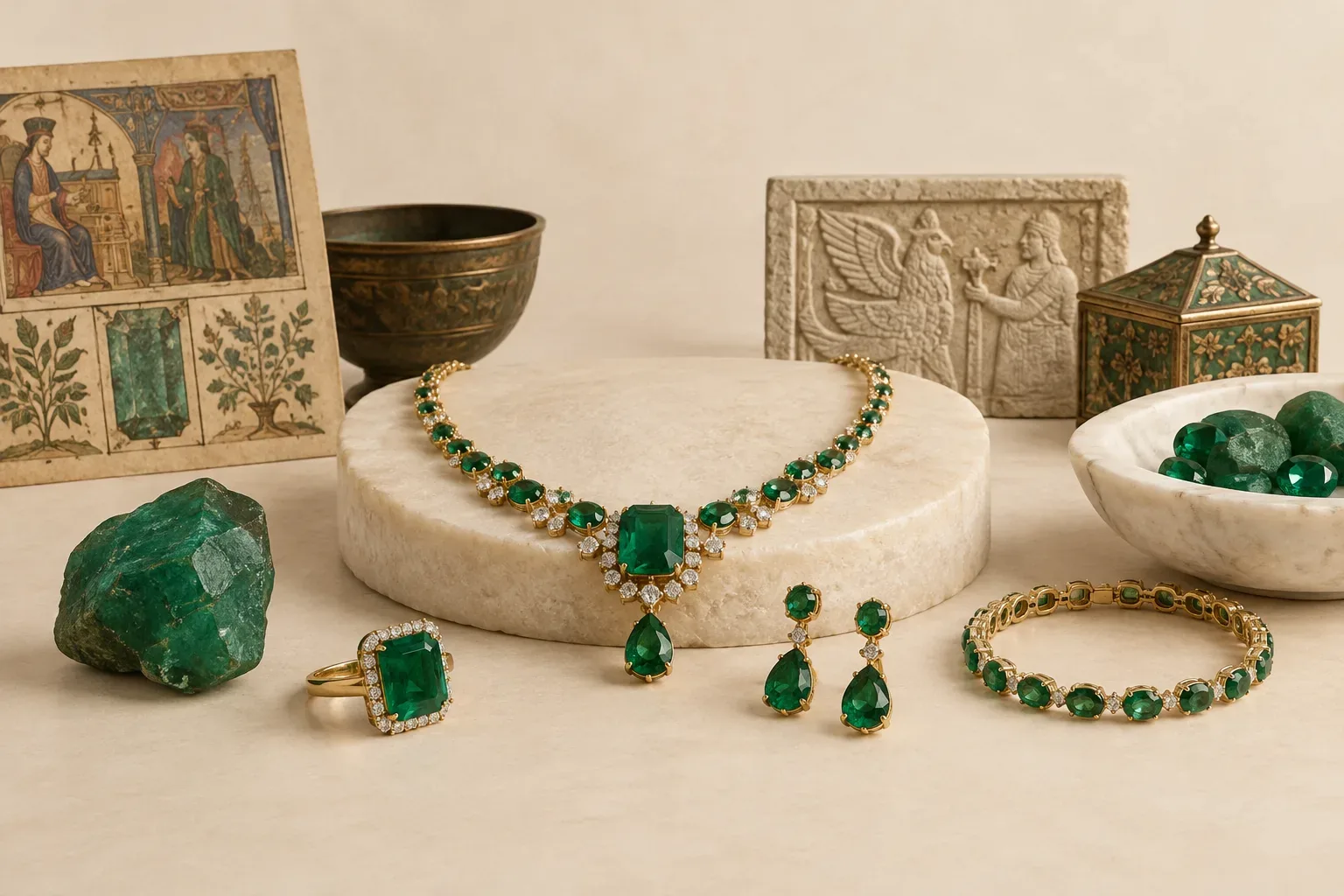
Emeralds historically appeared in a range of jewelry types including rings, pendants, brooches, and diadems, often set to emphasize color and to contrast with diamonds or enamel. The Victoria and Albert Museum collections illustrate these design choices across centuries and continents, showing how mounts and settings change to suit fashion and function.
Imitations and less expensive green stones or manufactured substitutes are commonly used in costume and fashion jewelry to achieve the visual effect of emeralds at lower cost. In historic pieces, artisans sometimes paired lower-cost materials with high-quality settings to create items that were attractive and wearable without the expense of large, high-quality natural stones.
Selecting and gifting with respect
When choosing an emerald for yourself or as a gift, match the stone and disclosure to the occasion. For a gift intended to mark a major life event or to be an heirloom, prioritize clear documentation of origin and treatment and consider an independent lab report. For a fashion purchase, a simulant or treated stone may be perfectly appropriate, but expect a different price point and care requirements.
Be sensitive to cultural and personal meanings. Museums record many contexts in which gems symbolized status, allegiance, or religious significance; given that history, ask whether a design or motif has particular cultural importance to the recipient. If you are uncertain, a short conversation about the intended message and any relevant customs is respectful and practical before purchase.
If sustainability, ethical sourcing, or charitable provenance matters to you or the recipient, request clear information about the stone’s supply chain. Museums and modern ethical buyers both acknowledge that provenance is part of an object’s story; sellers who can document mining origin, labor practices, or responsible sourcing will help you make an informed, respectful choice.
Care considerations tied to treatments and imitations
Different stones and treatments behave differently under cleaning and in everyday wear. Because treatments can affect toughness and how a stone responds to heat or chemicals, ask the seller for specific care advice tied to the disclosed treatment or material. When in doubt, treat the gem gently and ask a jeweler or the seller for safe cleaning methods.
For older or museum-style pieces, consider professional conservation advice if the item is an antique or has been heavily restored. Museums’ conservation practices show that older settings and materials can require specialist care, and a conservator or experienced jeweler can advise you on appropriate maintenance.
Frequently asked questions
What should I ask a seller about an emerald?
Ask whether the stone is natural, treated, synthetic, or a simulant; request written disclosure of any treatments; ask about provenance, any repairs or re-setting, and whether an independent laboratory report is available. The Federal Trade Commission advises that such material information should be disclosed by the seller.
Are treated emeralds less valuable than natural, untreated stones?
Treatment affects value but not always in a simple way. Historically, jewelers used techniques to improve appearance, and museums record those practices as part of jewelry’s changing social context. Today, disclosure matters: a treated stone may be less valuable than an equivalent untreated stone, but the precise difference depends on the type and extent of treatment and market demand.
How can I tell if an emerald is an imitation or a real emerald?
Visual inspection by eye is not reliable for a definitive determination. Ask for written disclosure, seek a report from an independent gemological laboratory, and buy from a reputable seller. The FTC recommends obtaining clear information on whether a stone is natural, treated, synthetic, or a simulant.
Is a synthetic emerald a 'real' emerald?
Synthetic emeralds are grown in laboratories and have the same mineral composition as natural emeralds, but their origin differs. Whether a synthetic stone is acceptable depends on the buyer’s preferences for natural origin, budget, and the occasion; sellers should disclose lab-grown origin in accordance with consumer-protection guidance.
What should I consider when gifting an emerald to someone from another culture?
Consider asking whether the recipient attaches particular cultural or religious meaning to emeralds or certain motifs. Museums document varied historical uses of gemstones, so being attentive to personal and cultural significance, and asking respectful questions before purchase, is sensible and shows care.
Sources and further reading
- Bedazzled: A History of Jewellery — Victoria and Albert Museum
- An A-Z of Gemstones — Victoria and Albert Museum
- Buying Gemstones, Diamonds, and Pearls — Federal Trade Commission