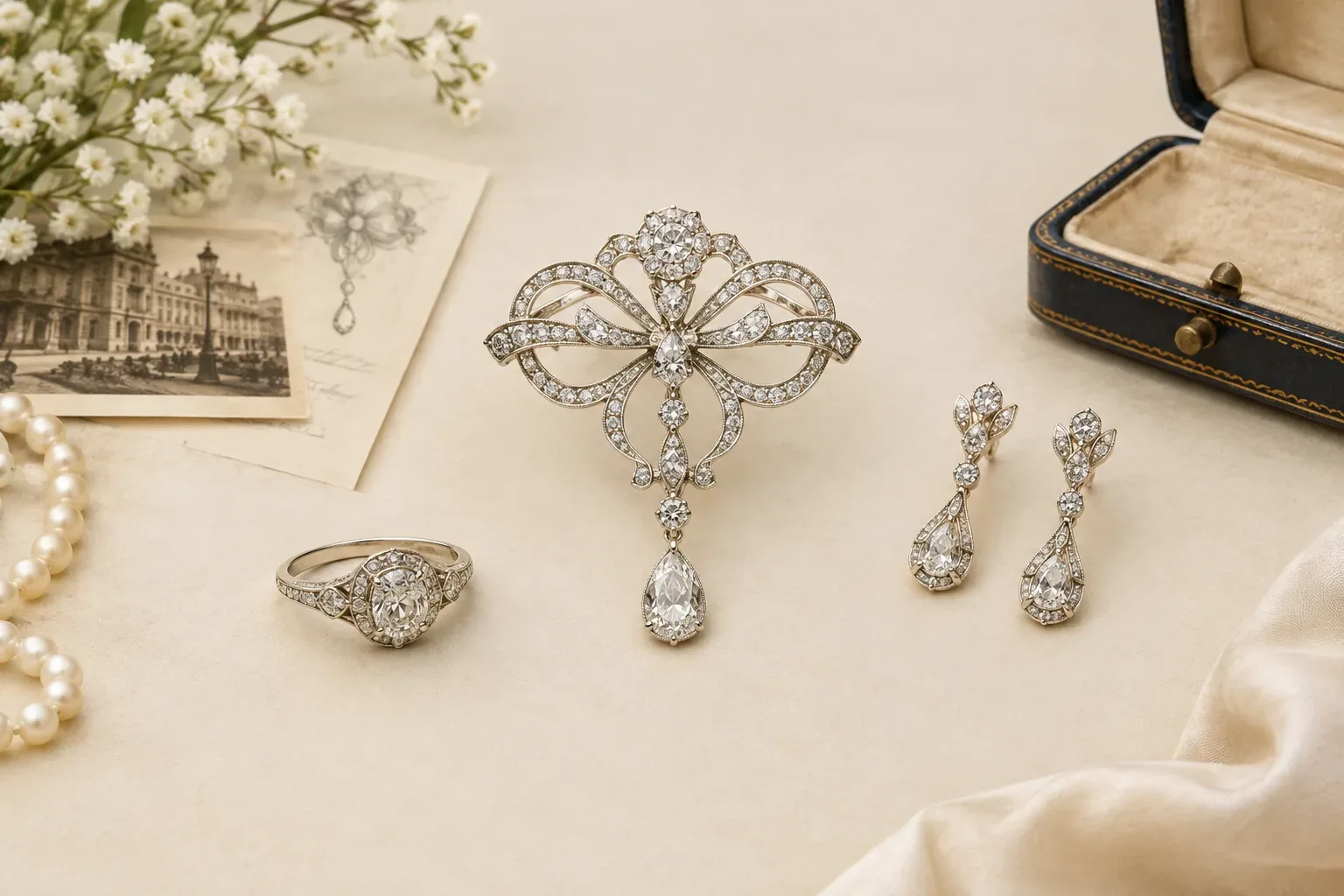
Meaning at a glance
Use museum-backed criteria—dated range, materials, construction, and typical motifs—to distinguish true Edwardian pieces from later copies; rely on reputable gem documentation and consumer guidance when assessing gemstones and treatments.
Historical evidence and precise period identification
When curators and historians place jewelry in an Edwardian context they refer to a particular historical window and a set of social and aesthetic conditions. The Victoria and Albert Museum frames jewelry history in linked periods and exhibitions, describing the late Victorian, Edwardian, and Belle Époque fashions as distinct but overlapping cultural moments that influenced design and technique. For clarity, many scholars and curators date the Edwardian era to the early years of the twentieth century associated with the reign of King Edward VII; museum classifications use stylistic and technical markers from that era to group objects.
Museum evidence matters because it links surviving examples to documented makers, dated provenance, and contemporary fashion plates. The V&A’s historical overviews emphasize that designers and manufacturers in this period emphasized refined, delicate ornament, often adapting lapidary and metalworking techniques developed in the late nineteenth century. Those technical details—how pieces were constructed and finished—are as important as the visible motif for correct identification.
Documented historical meanings versus modern interpretations
Museum documentation records how people in the period used and understood jewelry, and curators are careful not to universalize symbolism. The V&A explains designs in social and technological context rather than assigning a single, timeless meaning to every motif. For example, garlands, bows, and delicate floral sprays appear frequently in Edwardian pieces as fashionable motifs that reflected a taste for elegance and a high society culture of leisure; the museum frames these elements in terms of fashion history rather than fixed symbolism.
By contrast, modern sellers and wearers sometimes attach contemporary or personal meanings—romantic, spiritual, or political—to Edwardian motifs. These modern interpretations are valid as individual meanings but are not the same as documented historical usage. When evaluating a claim about a motif’s "original" meaning, check whether the source is a museum catalog or a modern marketing description. Use museum-backed texts for claims about period intention and contemporary sources for modern sentiment.
How motifs, gemstones, and traditions appear in Edwardian jewelry
Motifs: Edwardian pieces commonly display lace-like, openwork patterns such as garlands, bows, trellis or lattice designs, and fine floral sprays. These motifs are usually executed with an overall sense of lightness and symmetry rather than heavy, densely packed ornament. The V&A’s surveys of jewelry history describe this visual language as part of the early twentieth century aesthetic that favored refinement and intricate metalwork.
Materials and gemstones: Platinum figured prominently in higher-end Edwardian jewelry because its strength allowed for fine, delicate settings and openwork that held small stones securely. Diamonds and pearls were frequent choices for center and accent stones. The V&A’s gemstone resources provide historical context for which gems were fashionable and how they were combined in period pieces. When assessing a single stone, modern technical information about treatments and simulants is essential; U.S. consumer guidance from the Federal Trade Commission recommends clear disclosure of treatments, imitations, and origins when buying gemstones, diamonds, and pearls.
Construction and technique: True period examples often reveal hand-finishing and soldering marks consistent with pre‑mass‑production workshop techniques. Settings may be delicate and individually pierced or sawed, and metal surfaces show period-appropriate finishing. Later reproductions sometimes use modern machine-made components or different soldering and assembly approaches that are detectable under magnification. Museum conservation practice examines these technical details to date and attribute pieces, as recorded in museum catalogs and exhibitions.
Common mislabels and how to spot them
The phrase "Edwardian" is frequently used today as a stylistic descriptor rather than a strict date marker. Retailers and private sellers often label pieces "Edwardian-style" to describe a look rather than proven provenance. Museum practice emphasizes the distinction between documented period objects and later pieces inspired by Edwardian design. To avoid mislabeling, evaluate claims by asking about provenance, hallmarks, and maker records when available.
Watch for red flags: an absence of hallmarks where they would normally appear, modern clasp types on supposedly early pieces, or machine-pressed filigree that lacks hand‑worked irregularities. Also be cautious when a single motif (for example, a bow) is used as the sole proof of age; curators advise using multiple lines of evidence—materials, technique, and documentary provenance—to make a strong identification. For gemstones, rely on documented gem references and request disclosure of any treatments or imitations in accordance with FTC guidance.
Practical and respectful selection or gifting guidance
If you are choosing or gifting what is described as Edwardian jewelry, first decide whether you want an authentic period piece or a modern item with an Edwardian aesthetic. Authenticity can be meaningful to collectors and recipients who value historical provenance, while an Edwardian-style piece can be a tasteful and often more affordable way to give the look without requiring antique condition or specialist conservation.
When seeking genuine Edwardian jewelry, prioritize reputable sellers who provide provenance, clear photographs, and the option to examine hallmarks and construction. Museums and experienced dealers rely on multiple forms of evidence—documented provenance, consistent manufacturing techniques, and appropriate materials—to establish date and origin. If a piece contains gemstones, ask for documentation about any treatments, enhancements, or simulants; the FTC recommends sellers be transparent about such modifications.
If you choose a modern Edwardian-style piece as a gift, respect the historical source by selecting workmanship and materials that echo the original aesthetic—fine openwork, balanced motifs, and appropriate gemstone combinations—rather than caricatured or heavy-handed reproductions. For personal and cultural sensitivity, avoid assigning historical or religious meanings to motifs unless the giver and receiver share the same understanding; instead, offer the piece with an explanation of why you chose the style and what it personally signifies for you.
Care, appraisal, and next steps for identification
Conservators and museum documentation emphasize careful handling of antique jewelry. If you suspect a piece is Edwardian and valuable or historically significant, seek a professional appraisal from an accredited appraiser or a museum specialist rather than basing decisions solely on online descriptions. Appraisers and gemologists can confirm metal type, gemstone identity, and any treatments—information the FTC highlights as important for consumers.
For DIY preliminary checks, compare the piece to museum examples and documented images in reputable catalogs, look for hallmarks and consistent construction, and request magnified photographs of settings and solder joints. Use the V&A’s historical overviews and gemstone references as comparative resources, and follow consumer-protection advice about disclosure and certification when purchasing.
Frequently asked questions
What years count as the Edwardian period for jewelry?
Museum and curatorial practice generally associates Edwardian jewelry with the early twentieth century, closely tied to the reign of King Edward VII; museums use stylistic and technical markers from that era to classify pieces rather than relying on a single calendar year.
Are all lacy, bow, or floral pieces Edwardian?
No. Similar motifs reappear in later revival pieces and modern reproductions. Museums such as the Victoria and Albert Museum distinguish original examples by construction techniques, materials like platinum, and provenance—so use multiple indicators rather than motif alone.
How can I tell if gemstones in an Edwardian piece are original or treated?
Confirming originality and treatments requires gemological testing or trustworthy seller documentation. The Federal Trade Commission advises buyers to request disclosure of treatments, enhancements, and imitations and to obtain written information when possible.
Is it acceptable to gift an Edwardian-style piece instead of an authentic antique?
Yes. A modern piece with Edwardian influence can be a meaningful and appropriate gift. Be clear about whether the item is a reproduction or an original to avoid misleading the recipient and to respect the historical context.
When should I seek a professional appraisal?
Seek a professional appraisal when a piece is described as antique, when you plan to insure it, when its provenance is unclear, or when gemstones and precious metals might affect value. Accredited appraisers and museum specialists can evaluate materials, construction, and provenance.
Sources and further reading
- Bedazzled: A History of Jewellery — Victoria and Albert Museum
- An A-Z of Gemstones — Victoria and Albert Museum
- Buying Gemstones, Diamonds, and Pearls — Federal Trade Commission