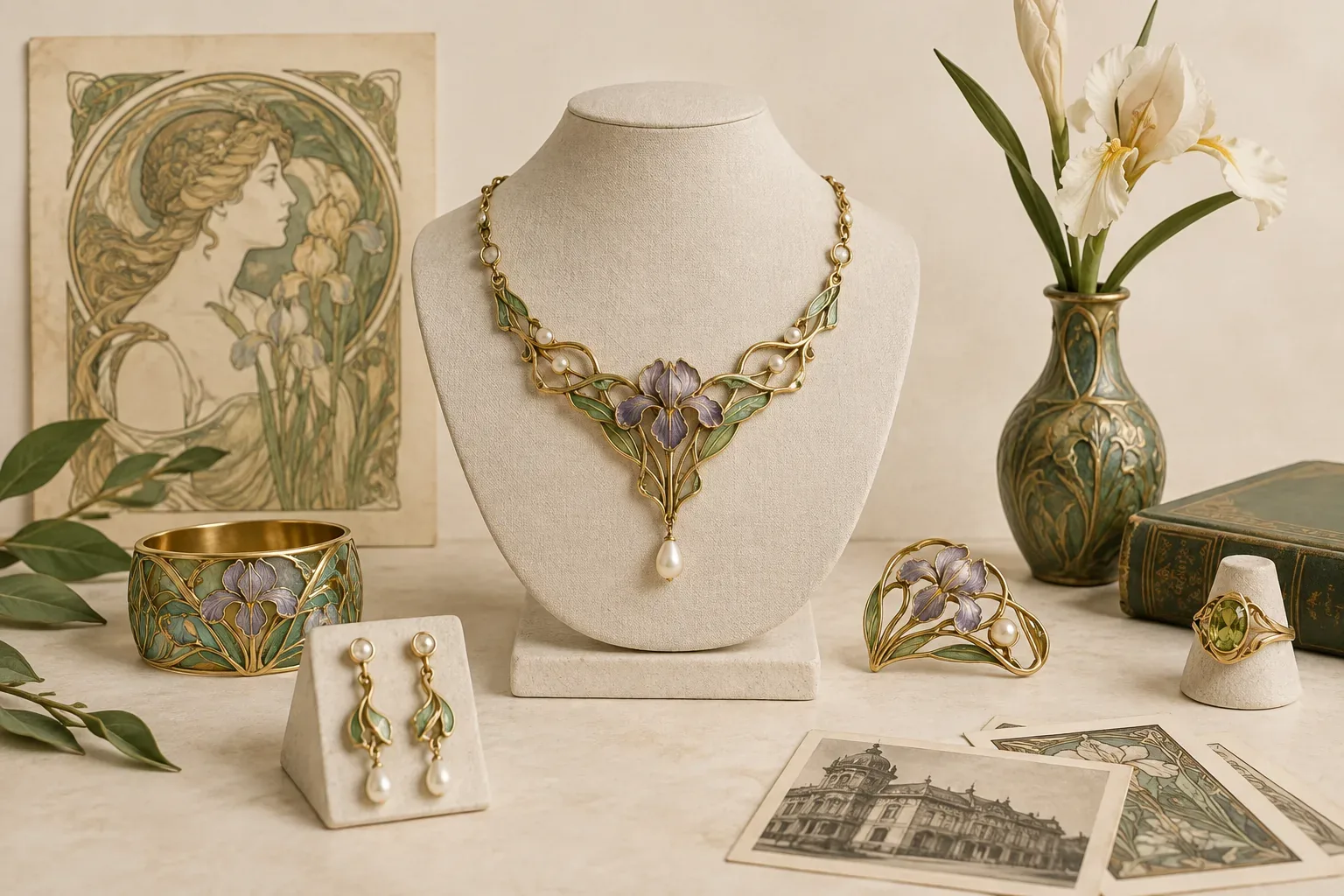
Meaning at a glance
Explain the documented history and changing contexts of the art nouveau jewelry history motif, separate cultural or religious evidence from later popular interpretations, and give practical guidance for choosing and wearing the motif in modern jewelry.
What the historical evidence shows and where it comes from
Contemporary scholarship and museum documentation identify Art Nouveau as an international design tendency that flourished roughly between the 1890s and the first World War. Collections and curatorial texts at the Victoria and Albert Museum describe it as a movement that responded to industrial production by emphasizing handcrafted detail, flowing organic lines, and motifs drawn from plants, animals, and the female form. Those museum records and exhibition materials are the primary evidence used here to describe how designers worked and how objects circulated.
The V&A places Art Nouveau within a broader history of jewelry and changing social contexts, showing that the movement was not a single national style but appeared differently in France, Britain, Belgium, Austria, and other places. The museum documentation traces how designers and workshops experimented with enamelling techniques, metalwork and the use of semi‑precious stones, and how these objects were displayed and worn in contemporary society.
Materials, gemstones, and techniques documented by museum research
Museum descriptions at the Victoria and Albert Museum note that Art Nouveau makers favored materials and techniques that enhanced colour and line rather than the glitter of large diamonds alone. Enamelling—especially techniques that allowed translucent colour like plique‑à‑jour—feature prominently in museum collections as characteristic of the period. Metalwork was often worked to show flowing contours rather than rigid geometry.
Gemstones recorded in museum inventories and articles tend to be opals, moonstones, pearls, and a variety of coloured semi‑precious stones used for their optical qualities and hues, not solely for carat weight. The V&A’s writings on gemstones place these choices in context: makers preferred stones that conveyed iridescence or soft colour to complement the organic motifs rather than overt sparkle.
Because treatments, imitations and enhancements affect both value and appearance, prospective buyers should follow government guidance on disclosure. The Federal Trade Commission provides consumer guidance on how gemstones, diamonds and pearls may be treated or enhanced and advises that sellers disclose such treatments. This regulatory context is important when assessing whether a piece is original, a period restoration, or a modern revival using altered stones.
Social status and how Art Nouveau jewelry was worn
Museum scholarship at the Victoria and Albert Museum links Art Nouveau jewellery to changing social habits around dress and display. Some pieces were bespoke or artisanal luxury items for affluent clients who collected avant‑garde design, while other, simpler examples were produced for a growing middle class eager for fashionable objects. The movement blurred the earlier strict boundary between fine jewellery as a static social marker and adornment as personal, artistic expression.
Art Nouveau pieces appear in museum catalogues and exhibition narratives as being used in everyday dress as well as in salon and evening wear, depending on scale and finish. Large, highly detailed parures and brooches tended to be special‑occasion pieces held by collectors, while smaller items with durable settings could have been worn more frequently. The V&A’s documentation illustrates this range rather than presenting one single social use.
Documented historical meanings versus later personal interpretations
When historians and curators at the Victoria and Albert Museum describe Art Nouveau motifs, they do so as aesthetic choices and cultural responses to industrial modernity, not as universally fixed symbolic codes. Contemporary designers used plant tendrils, female figures and animals to explore movement, sensuality and modern tastes; museum texts treat those motifs as part of design language rather than fixed religious or cultural symbols.
Modern wearers and sellers often attach personal or popular symbolic meanings to Art Nouveau imagery—for example, reading specific flowers as romantic tokens or female subjects as feminist icons. Those interpretations are valid as personal or contemporary cultural readings, but they are distinct from what museum documentation records as the original creators’ intentions and the objects’ historical contexts. The V&A materials distinguish between aesthetic program and later appropriation or reinterpretation.
How Art Nouveau motifs and gemstones appear in jewelry designs
In objects catalogued by the Victoria and Albert Museum, motifs appear integrated with technique: a brooch might use plique‑à‑jour enamel to suggest a dragonfly’s translucent wing, or a pendant may set an opal to imitate the iridescence of moonlight on water. Metals are worked into whiplash curves so motifs read as continuous movement rather than isolated symbols.
Gemstones are typically used to support that pictorial or sensual aim rather than to dominate the piece by size alone. Pearls, opals and moonstones are set to catch light and produce mood; coloured stones are selected for hue and tonal match with enamel. Construction details in museum examples—closed versus open settings, backing metals, and soldering—also tell museum curators whether an item was conceived for frequent wear or as a showpiece for controlled environments.
Practical guidance for selecting and gifting Art Nouveau pieces today
If you are choosing an Art Nouveau piece—whether an original, a documented period revival or a contemporary design inspired by the style—decide first whether you want historical authenticity or merely the aesthetic. For historical examples, consult museum catalogues and reputable dealers who can provide provenance, condition reports and details about any restorations. The Victoria and Albert Museum’s approach to cataloguing illustrated pieces is a good model for how to evaluate documentary evidence.
Ask sellers about gemstone treatments and disclosure. The Federal Trade Commission recommends clear disclosure when gems have been treated, dyed, heat‑enhanced, or otherwise altered, and you should get that information in writing. For wearable gift choices, prioritize the recipient’s lifestyle: choose smaller, lower‑relief pieces in durable settings for daily wear, and reserve large, delicate, or heavily enameled items for occasional use. Consider comfort—pinbacks, chain thickness, and how a piece sits against clothing—because many Art Nouveau designs are sculptural and can catch on fabric.
When gifting an original or high‑value period example, include documentation and care guidance. If the piece is a modern commission or revival, clarify materials and manufacturing techniques so the recipient understands whether it is an artisanal one‑off or a commercially produced item. For both authenticity and future resale, request any hallmarks, maker’s marks, or certificates and keep them with the object.
Wear, care, and ethical considerations
Art Nouveau jewellery often depends on delicate enamelling, fragile stone settings, and softer metal work; museum conservation practices highlight that many original pieces need careful handling. Avoid moisture, abrasive cleaners, and rough contact; store enameled objects flat and separately so edges don’t chip. Museums such as the Victoria and Albert record how condition affects long‑term display, and following similar precautions protects original surfaces.
Ethical considerations include confirming provenance for high‑value historical lots and asking about the environmental and labour practices behind modern versions. For gemstones and pearls, use the FTC’s consumer guidance to confirm proper disclosure about treatments and sources, and consider seeking a professional appraisal or lab report for expensive purchases.
Frequently asked questions
What time period does Art Nouveau jewelry come from?
Art Nouveau is generally associated with the late 19th century into the early 20th century, roughly the 1890s through the years before World War I; museum documentation treats it as an international movement rather than a single national style.
Which materials and gemstones are typical of Art Nouveau pieces?
Museum records commonly cite enamelling (including translucent techniques), soft metals worked into flowing lines, and stones such as opal, moonstone, pearls and various coloured semi‑precious gems chosen for hue and optical effect rather than sheer size.
Are Art Nouveau motifs symbolic in a fixed way?
Curators at the Victoria and Albert Museum describe motifs like plants, animals and female figures as aesthetic language within a design movement; later symbolic readings—romantic, feminist or personal—are modern interpretations distinct from original documented contexts.
How can I tell if an Art Nouveau piece is authentic or a modern reproduction?
Ask sellers for provenance, maker’s marks, condition reports and any restoration records; compare construction details with museum examples and request written disclosure about gemstone treatments as recommended by the Federal Trade Commission.
Is Art Nouveau suitable for daily wear?
Some Art Nouveau pieces were made for frequent wear while others were delicate showpieces; choose lower‑profile, well‑set items with durable settings for daily use and reserve heavily enameled or fragile pieces for occasional wear.
What should I ask about gemstones when buying an Art Nouveau item?
Request written information on whether stones have been treated, enhanced, dyed or replaced, and consider an independent appraisal or lab report for high‑value purchases in line with FTC consumer guidance.
Sources and further reading
- Bedazzled: A History of Jewellery — Victoria and Albert Museum
- An A-Z of Gemstones — Victoria and Albert Museum
- Buying Gemstones, Diamonds, and Pearls — Federal Trade Commission