Meaning at a glance
This article explains the documented history and changing contexts of the bear motif, separates cultural and religious evidence from later popular interpretations, describes how the motif and related gemstones appear in jewelry, and offers practical, culturally respectful guidance for choosing and gifting bear-themed pieces.
Short answer
The bear motif in jewelry has a long, changing history: museums and jewelry historians document animal imagery appearing from prehistoric ornament through medieval and modern decorative arts, and the motif has been read in different ways by different societies. This article follows the evidence-based approach summarized by museum literature to separate documented historical meanings from later popular interpretations and to give practical guidance for choosing and wearing bear jewelry today.
What the historical evidence shows
Overviews of jewellery history compiled by museum collections and curators show that animal motifs have recurred across many periods and places, and that the social meanings of such motifs shift with context. The Victoria and Albert Museum highlights how motifs and materials in jewellery reflect changing social roles, fashions, and symbolic languages rather than a single, unbroken meaning.
Archaeological and museum records identify bear imagery and imagery of large mammals in prehistoric personal ornaments and regional decorative arts across Eurasia. In those contexts the motif appears in small carved amulets, toggles, and metalwork, sometimes stylized and sometimes naturalistic. Later periods with documented bear imagery include medieval Northern Europe, where animals appear in metalwork and seals, and indigenous traditions of North America and northern Eurasia where the bear figures in material culture and ritual items. The V&A's broad surveys of jewellery history place these recurring animal themes within evolving social and craft histories rather than asserting identical meanings across cultures.
Separating documented historical meanings from modern interpretations
Where historical evidence records the use of bear imagery, museums and specialists typically describe the motif in terms of the object's function and the cultural context rather than assigning a single symbolic message. For example, a carved bear pendant from a given archaeological layer may be interpreted as a personal emblem, talisman, hunting token, or decorative motif depending on associated finds and ethnographic parallels. The V&A emphasises that the function and social meaning of jewellery must be assessed in each culture and period.
Modern popular interpretations—such as reading a bear pendant universally as 'strength' or 'motherhood'—are contemporary layers added by marketing, sentimental fashion, and personal attribution. These modern readings may be meaningful to wearers, but they are not the same thing as the specific beliefs or ritual uses documented in historical sources. Treat modern symbolism as an individual or recent cultural choice rather than an automatic continuation of an ancient meaning.
Cultural contexts in more detail
Prehistoric and early metal-age material. Small animal forms and stylised mammal motifs appear among prehistoric personal ornaments and early metalwork across Eurasia. Archaeological interpretation often links such motifs to identity, status, or a group's relationship to animals, but meaning is reconstructed from context rather than recorded statements of belief.
Medieval and early modern Europe. In medieval northern Europe animal imagery, including bears, occurs in jewelry, seals, and heraldry. Those items can indicate lineage, local symbolism, or attributes assigned to a patron or workshop. Museum catalogues and exhibitions at institutions such as the V&A present these works as part of evolving artistic traditions and social signification.
Indigenous and northern Eurasian traditions. Ethnographic and museum collections document bear imagery in the material cultures of some Indigenous peoples of North America, Arctic and sub‑Arctic Eurasia. Where available, ethnographic sources—often held or interpreted in museums—describe ritual roles or clan associations tied to bears in particular communities. These are specific cultural meanings and should not be generalized beyond their documented contexts.
How the bear motif appears in jewelry (motif, materials, gemstones)
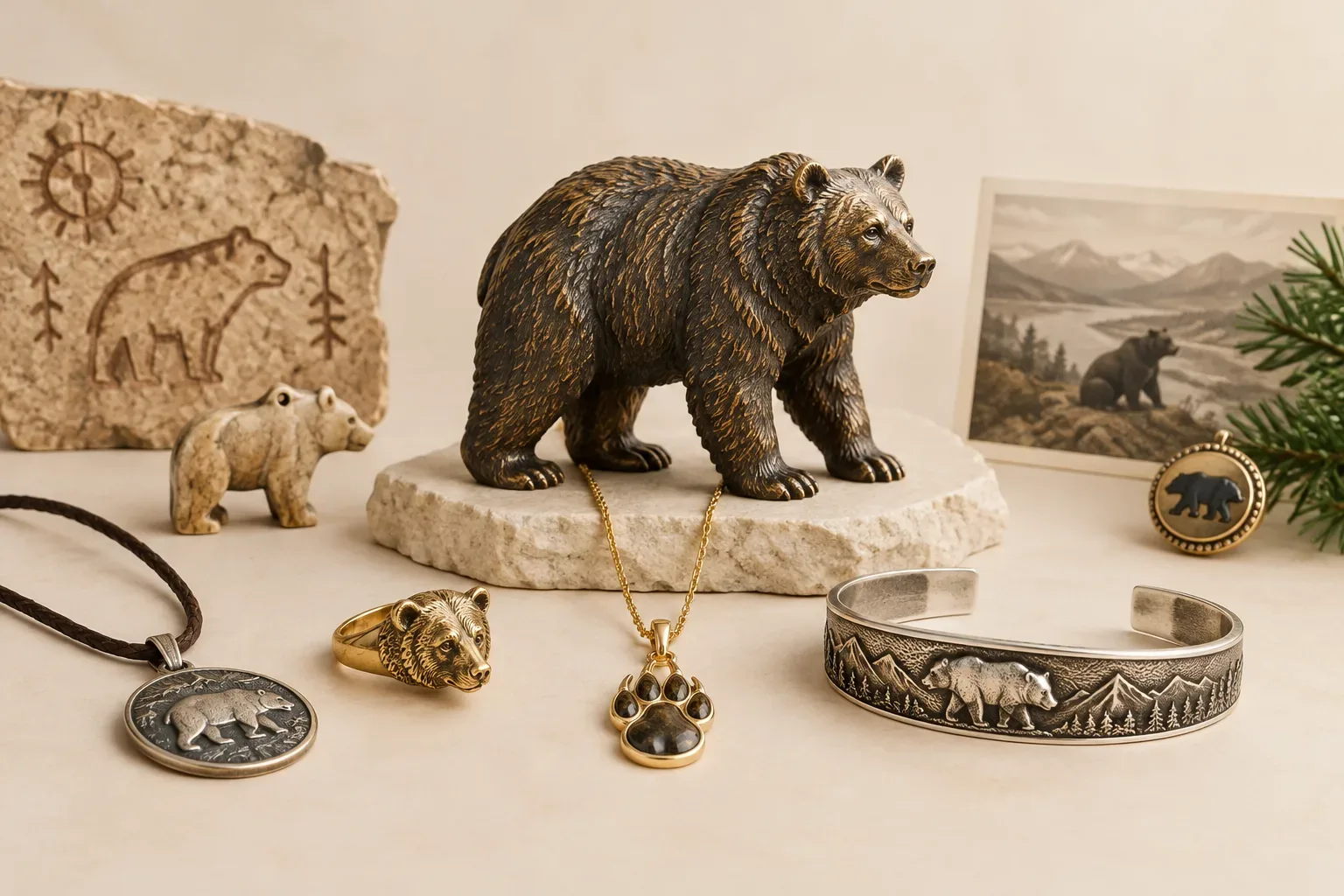
Design motifs. The bear motif appears in jewelry as realistic naturalistic carvings, stylised geometric forms, silhouettes, charms, and figural pendants. It can be a focal ornament—such as a pendant, brooch, or signet—or a repeating motif in a patterned band or panel. Designers also use mother-and-cub groupings to evoke familial relationships in contemporary pieces.
Materials and techniques. Historically, bear motifs have been executed in metalwork, bone, ivory, carved stone, and later in cast and stamped precious metal. In modern commercial and artisan jewellery the motif appears in silver, gold, and mixed metals, and in enamel, carved gemstones or composites. The Victoria and Albert Museum's surveys of craft and techniques provide a framework for understanding how such motifs travel between materials and periods.
Gemstones and accents. Designers often combine the bear motif with accent gemstones to add color, sparkle, or meaning. For practical advice about individual gemstones and their properties in decorative use, museum resources such as the V&A's A–Z of Gemstones give identifications and historical uses for many stones. When buying gemstones—whether natural, treated, or synthetic—follow consumer-protection and disclosure rules described by regulators such as the U.S. Federal Trade Commission, which covers material treatments, imitations, and required disclosures for gemstones and pearls.
Modern personal and cultural interpretations
Many modern wearers ascribe personal symbolism to bear jewelry: courage, protection, maternal care, grounding, or a connection to nature. These interpretations are contemporary and meaningful to individuals and communities, and they often coexist with commercial narratives that market 'strength' or 'mama bear' themes.
It is important to distinguish such personal or popular meanings from historically documented ritual or clan associations. If a piece carries a known cultural or spiritual significance for a living community, that significance should be acknowledged and treated with respect. Museum practice, as described by institutions like the V&A, encourages attention to provenance and context when interpreting cultural objects.
Practical, respectful guidance for choosing or gifting bear jewelry
Start by thinking about why you or the recipient want a bear motif. Are you choosing the motif for a personal sentiment such as family, protection, or nature affinity, or do you want a piece with documented cultural roots? Being clear about intent helps you select appropriate makers, materials, and messaging.
If the design is inspired by the material culture or spiritual traditions of a particular living community, look for pieces made by artisans from that community or by makers who properly credit their sources and share profits or permissions where appropriate. Museums and ethical craft organisations encourage supporting origin communities through direct purchase from credentialed artists or certified ethical suppliers.
For everyday wear choose a metal and construction suited to the recipient's lifestyle and skin sensitivity. Sterling silver and gold alloys are common; the FTC provides guidance about gemstone disclosures and treatment if your selection includes stones. Ask sellers about gemstone origin and whether stones are natural, treated, or synthetic, and request hallmarks or guarantees for metal purity when relevant.
If you are giving a piece as a sentimental gift, include a short note explaining why you chose that motif and whether the symbolism is a personal interpretation rather than a documented cultural meaning. This both personalises the gift and signals respect for any cultural origins of the design.
Avoid cultural appropriation by not presenting sacred motifs from a living culture as fashionable tokens. When in doubt, favour contemporary designs that express the meanings you intend without claiming historic or spiritual authority that belongs to another community.
Care, buying tips, and further research
Caring for bear-themed pieces follows the same practices as for comparable jewellery: keep metals and stones away from harsh chemicals and store pieces separately to avoid scratches. Follow maker care instructions for any plated finishes or delicate inlays.
When purchasing gemstone-accented bear jewelry, ask for documentation about treatments, origin, and whether gems are natural or synthetic. The Federal Trade Commission provides consumer guidance on buying gemstones, diamonds, and pearls, including disclosure obligations for treatments and imitations.
If you want to research a piece's historical or cultural background, start with museum catalogues and reputable collections. Internal resources on this site, such as our Symbols category, a practical gift guide, and articles about researching symbols and the history of lockets, can help contextualise a motif and suggest follow-up questions to ask a seller or collector.
Closing thought
Bear jewelry carries many possible meanings that depend on where and when the piece was made and how it is used today. Use museum literature and trustworthy consumer guidance to understand provenance and materials, and choose or gift bear pieces in a way that respects any living cultural connections while acknowledging modern personal meanings.
Frequently asked questions
Is a bear symbol always a sign of strength?
No. While 'strength' is a common modern interpretation, historical evidence shows that animal motifs had different meanings depending on culture and context. Museum studies emphasise that each instance should be evaluated on its provenance and associated cultural information.
Can I wear a bear motif from another culture?
Yes, but do so respectfully. If the design is tied to a living group's spiritual or clan identity, seek pieces made by, credited to, or sold with permission from that community and avoid presenting sacred symbols as fashion.
How can I check whether gemstones in bear jewelry are authentic or treated?
Ask the seller for documentation about gemstone origin and treatments. Consumer guidance from authorities such as the U.S. Federal Trade Commission explains disclosure obligations for treated, synthetic, and imitation gems.
Are there specific gemstones traditionally paired with animal motifs?
There is no single rule. Museums and historic jewellers have used a wide range of materials. The V&A's A–Z of Gemstones describes common historic uses for many stones, but modern pairings are often driven by colour, contrast, and design rather than a fixed symbolic code.
How should I gift bear-themed jewellery to make it meaningful?
Explain why you chose the motif, confirm the recipient's comfort with any cultural associations, choose appropriate materials for daily wear, and consider buying from makers who credit cultural sources when relevant.
Sources and further reading
- Bedazzled: A History of Jewellery — Victoria and Albert Museum
- An A-Z of Gemstones — Victoria and Albert Museum
- Buying Gemstones, Diamonds, and Pearls — Federal Trade Commission