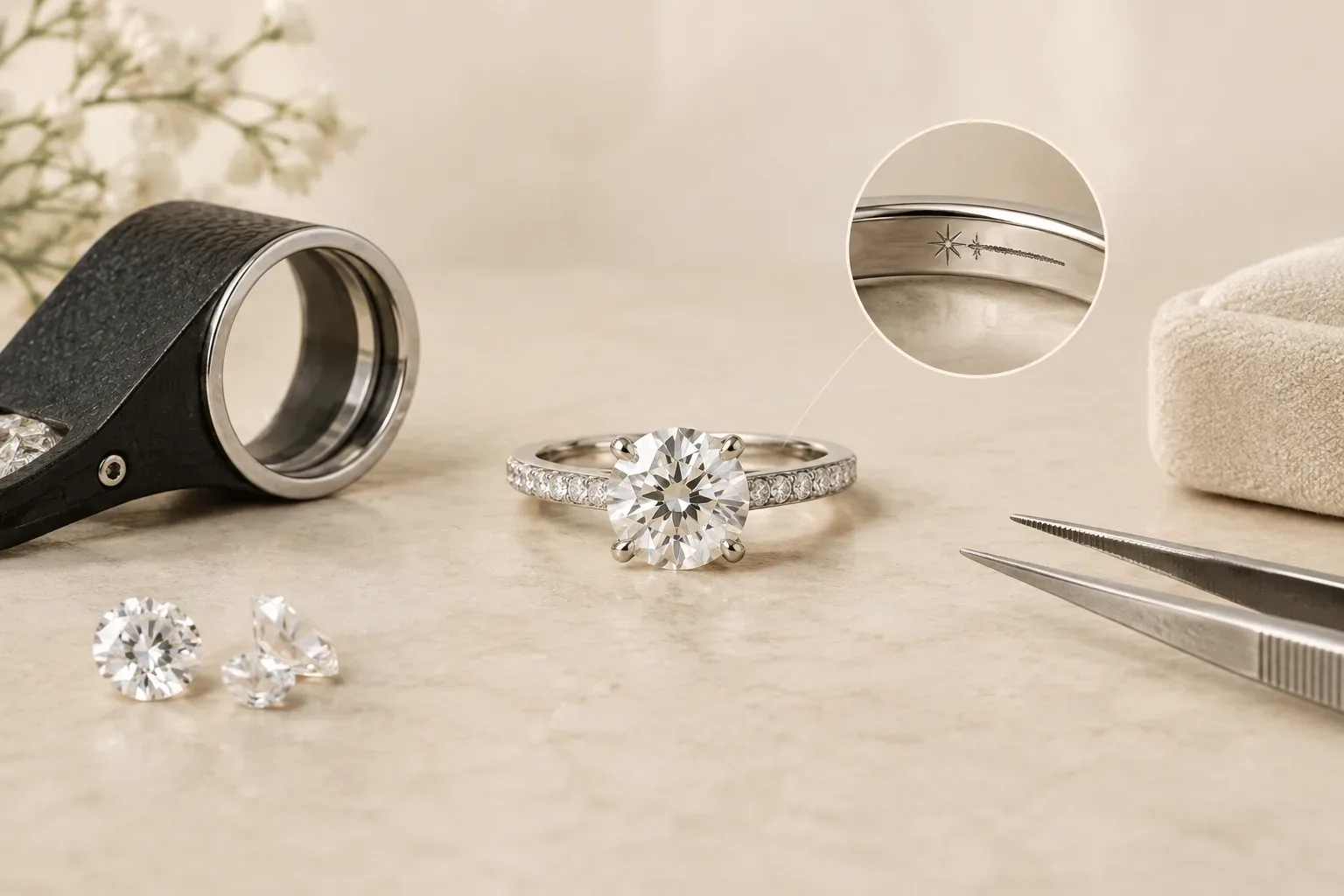
Meaning at a glance
A diamond laser inscription links a stone to paperwork, a brand, or a short personal message; it usually does not change the gem’s grade or origin, and many important verifications—like whether a diamond is natural or treated—require a qualified gemologist or laboratory. Use inscriptions for traceability and personalization, expect trade-offs in visibility and permanence, insist on written disclosure and a matching certificate, and ask the seller for inspection tools or lab verification when provenance matters.
What a laser inscription is and how it appears in jewelry
Laser inscriptions are microscopic characters or symbols applied with focused lasers. On loose diamonds they are commonly placed on the girdle or another non-faceted area; on finished jewelry they may also appear on a metal band or mounting as micro-engraving. The marks are intentionally tiny so they do not change a diamond’s visible appearance, and are usually legible only with magnification or a specialized viewer.
Historical evidence and why "laser" inscriptions are modern
There is no archaeological or historical tradition for laser inscriptions—the method is a modern, machine-based technique used for identification and micro-personalization. Historical practices of engraving or carving gems (for seals, talismans, or signet rings) belong to many cultures and periods, but those are distinct crafts from laser inscription and require archaeological sources to discuss precisely. The approved evidence used for this guide focuses on modern consumer and gemological issues rather than ancient practices, so this article does not assign specific historical meanings to cultural periods.
Documented purposes versus modern personal meanings
Documented, practical uses of laser inscriptions are identification and traceability: inscribing a certificate number or brand helps match a loose diamond to its paperwork and deters misplacement. Regulatory and consumer-protection concerns about disclosure of treatments, origin, and synthetic materials are central to what inscriptions can and cannot prove; the Gemological Institute of America highlights that treatments, detectability and disclosure are distinct consumer questions and that laboratories are the authority for identifying treatments. The U.S. Federal Trade Commission emphasizes that sellers must make written distinctions among natural, lab-created, treated and imitation materials, which inscription alone does not guarantee.
Modern personal meanings are separate: buyers commonly use inscriptions for initials, a date, or a short message on engagement diamonds and wedding bands. Those personal messages add sentimental value to the owner but are not a documented attribute that changes gemological grading or origin.
What inscriptions can and cannot verify
Can: An inscription can link a diamond to a certificate number, a jeweler’s serial, or a brand’s internal record; you can reasonably verify the link by asking to see the matching paperwork. Can also: provide a discreet personal message that survives normal wear.
Cannot: An inscription cannot by itself prove that a diamond is natural, lab-grown, treated, or untreated. The Federal Trade Commission requires clear written disclosure on those distinctions, and the Gemological Institute of America explains that detectability and disclosure of treatments are technical matters best handled via laboratory testing. To confirm origin, treatment history, permanent grading statements, or geographic provenance you need documentation from a reputable grading laboratory or an independent qualified gemologist.
Decision criteria: when to choose an inscription
Choose an inscription when traceability or matching to a certificate is important to you, when you want a short personal message that will endure, or when a brand’s serial number is part of a warranty or buyback program. Inscription is also useful for estate identification or theft deterrence because an inscribed certificate number makes it harder for a stone to be resold unnoticed.
Avoid or pause on inscription if your priority is absolute resale neutrality or if you plan radical re-cutting or significant repolishing—extensive cutting work can remove or obscure a girdle inscription—and if you want a message longer than a few characters (those won’t fit legibly). If verification of origin or treatment is critical, buy only with a laboratory report and do not rely on inscription alone.
Practical trade-offs
Visibility versus discretion: inscriptions are intentionally tiny; this preserves the diamond’s look but makes verification harder without magnification. Permanence versus modification: most laser inscriptions are durable, but aggressive repolishing, re-cutting, or some mounting changes can remove them. Cost versus benefit: inscribing a certificate number or short message usually adds little to the retail price, but the main cost is the potential loss of legibility if the diamond is later reworked.
Liability and disclosure: an inscription tying a stone to a certificate gives buyers evidence for claims, but sellers still must follow disclosure rules for origin and treatments. Imaginaire Digital’s market research also shows strong demand for engagement rings and related categories where inscriptions are commonly used for personalization, so inscriptions are part of contemporary gifting practice.
What you can check yourself and when to get expert help
What you can check without a lab: ask the seller to show the inscription under magnification and to present the matching certificate; confirm that characters match exactly. Request written disclosure that ties the inscription to a specific laboratory report or to the seller’s serial system. Check return and warranty terms in writing.
When to consult a professional: if you need to know whether the diamond is natural or lab-grown, whether it has undisclosed treatments, or whether the inscription affects grading or structural integrity, a qualified gemologist or independent gemological laboratory is necessary. The Gemological Institute of America emphasizes that treatments and detectability raise technical questions best decided with lab testing, and the Federal Trade Commission requires sellers to provide accurate written disclosure—so rely on accredited reports for high-stakes purchases.
Selection and gifting guidance
For selection: decide whether the inscription’s purpose is traceability (certificate number), branding, or sentiment. If traceability matters, insist that the inscription exactly matches the lab report and obtain a copy of that report. If sentimental text is the goal, keep the message short—three to twelve characters is often the most reliably legible—and confirm where the inscription will be placed.
For gifting: consider future owners. A short, discreet inscription such as initials or a date generally keeps options open for resale or resizing. Avoid overly specific personal messages that could limit the gemstone’s future market or emotional flexibility. If you plan to insure the piece, note the inscription in the insurance paperwork and keep the certificate and any seller receipts together in a safe place.
For sellers and resellers: provide clear, written linkage between inscription and documentation and disclose any repairs, recuts or polishing that may have removed or altered the mark.
Care and maintenance
Normal cleaning will not remove a laser inscription, but aggressive repolishing or a re-cut can. If a diamond is removing or reworking, discuss preservation of the inscription with the jeweler beforehand. Keep original paperwork and any images of the inscription with the certificate. If you are having a ring resized or re-tipped, tell the jeweler you want the inscription preserved and ask whether their work risks altering it. For questions about treatment durability or special care related to a gem, consult gemological guidance; the Gemological Institute of America notes that treatments and special care considerations create distinct consumer questions.
Checklist: questions to ask before you buy
Ask to see the lab report and confirm the inscription matches the certificate number. Ask whether the inscription is the seller’s serial or a lab serial, and get that in writing. Ask whether the diamond has ever been recut, repolished or repaired. Ask for disclosure about origin, synthetic status, and treatments—the Federal Trade Commission requires clear written distinctions. Ask whether inscription images are available and whether you can view the mark under magnification. If provenance or grading is critical, ask about independent lab verification and the seller’s return and warranty policy.
Summary
Laser inscriptions are a useful modern tool for identification, branding and short personal messages, but they are not a substitute for laboratory verification of origin, treatments, or grading. Inscription can add traceability and sentimental value with limited cost and visual impact; the practical trade-offs are legibility, permanence under reworking, and the need to rely on documented certification for technical claims. Insist on written disclosure, a matching certificate, and a qualified gemologist or gemological laboratory when origin or treatment matters.
Frequently asked questions
Does a laser inscription increase a diamond’s value?
A laser inscription primarily adds traceability or sentimental value, but it does not intrinsically change the gem’s grade. Some buyers value an inscription that matches a lab report; others prefer none for resale aesthetics. For market-impact questions in a specific case, obtain an independent appraisal and lab documentation.
Can a laser inscription prove that the diamond is natural or lab-grown?
No. An inscription can record a certificate number or a seller’s serial, but it does not replace laboratory testing. The Federal Trade Commission requires sellers to disclose status, and the Gemological Institute of America advises that origin and treatments are technical matters for accredited labs.
Are laser inscriptions permanent?
Laser inscriptions are durable under normal wear and cleaning, but extreme re-cutting, repolishing or some mounting changes can remove or alter them. If preserving the inscription is important, discuss this with your jeweler before any modifications.
How can I verify an inscription matches a certificate?
Ask to see the lab report or seller documentation and confirm the inscription characters match exactly. Request to view the inscription under magnification or ask the seller for images. For high-value purchases, verify the report with the issuing laboratory or seek an independent gemologist’s inspection.
Will getting an inscription void warranties or affect repairs?
Typically an inscription itself does not void manufacturer warranties, but any later repair, resizing or recutting could affect the inscription. Always check written warranty and repair policies and tell the jeweler about the inscription before work is done.
Sources and further reading
- Imaginaire Digital — Imaginaire Digital
- Gemological Institute of America — Gemological Institute of America
- Federal Trade Commission — Federal Trade Commission