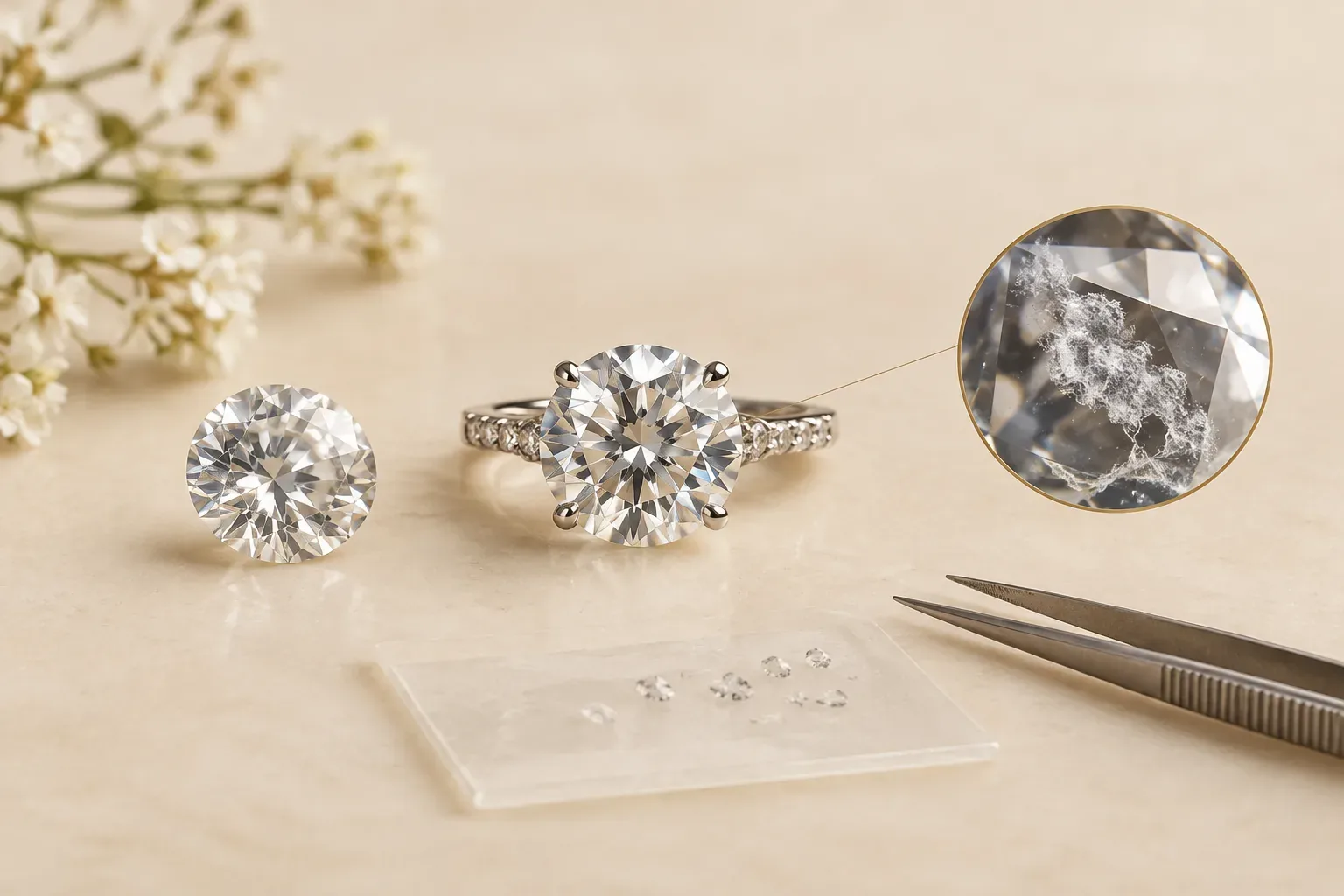
Meaning at a glance
A diamond cloud inclusion is a cluster of tiny internal features that can give a hazy or milky look in a stone; whether that matters depends on how visible the cloud is, the diamond's cut and purpose, and whether you accept trade-offs between clarity, size, and price. Buyers should insist on written disclosure and a grading report, ask for close-up images or loupe inspection, and rely on a qualified gemological laboratory or experienced independent appraiser to confirm treatments, origin, and any durability concerns.
Direct answer: diamond cloud inclusion explained — short and practical
A diamond cloud inclusion is an internal grouping of very small inclusions that can create a faint haziness or milky patch in a stone. In plain terms, the presence of a cloud may be purely cosmetic at typical viewing distances or it may lower brilliance and apparent clarity if the cluster is large or centrally located. Whether a cloud matters depends on how visible it is to the unaided eye, what clarity grade you want, and whether you prefer a larger, more affordable diamond with character or a cleaner stone at higher cost. For serious questions about treatments, natural origin, or structural concerns you should rely on a qualified jeweler or a gemological laboratory rather than unaided inspection.
What gemologists mean by a 'cloud' and how it looks in jewelry
In gemological usage, the term cloud describes a concentrated area of many tiny inclusions that together produce a soft, diffuse haze within the diamond. The visual effect ranges from a barely perceptible mist to a noticeable milky area, depending on inclusion density, size, and position relative to the table and facets. Clouds are one of several inclusion types that graders consider when assigning a clarity grade, and their visual impact depends strongly on the diamond’s cut and how light travels through it.
In finished jewelry, a cloud may be easy to miss in settings that use smaller crowns or halo treatments, while a centrally located cloud in a solitaire can be more obvious. Some shoppers and designers embrace small, internal features as part of a stone’s character; others prefer stones where such features are not visible to the naked eye.
Historical evidence and cultural notes
Among the approved references consulted for this article there is no specific documentation tying the motif or symbolic meaning of 'cloud' inclusions to a particular historical culture or period. The Gemological Institute of America material used here addresses treatments, detectability and consumer care rather than cultural symbolism, and the Federal Trade Commission guidance focuses on disclosure and consumer protection rather than historical beliefs. Imaginaire Digital reports modern market demand trends but does not record traditional cultural meanings for cloud inclusions.
Because authoritative historic sources linking cloud inclusions to a named cultural symbolism are not present in the references for this article, any claims about long-standing cultural meanings would be modern interpretation rather than documented history. If a buyer or recipient attaches personal or cultural meaning to a cloud—such as seeing it as a 'soft' or 'mysterious' quality—that is a valid personal interpretation but not a documented historical fact in the cited material.
Documented history versus modern personal interpretations
Documented history in the consulted sources centers on technical, legal, and market aspects: how inclusion visibility affects clarity grading and consumer expectations, the need for treatment disclosure, and current market demand for diamond jewelry categories. The Gemological Institute of America emphasizes that treatments, detectability, and durability are central consumer concerns, and the Federal Trade Commission emphasizes accurate seller disclosures for consumers deciding between natural, lab-created, or treated materials.
Modern personal interpretations—such as seeing a cloud as a symbol of softness, weather, transformation, or individuality—are subjective and vary by wearer, designer, or culture. Those personal meanings can be powerful in gifting and custom jewelry decisions, but they are not the same as documented historical symbolism and should be presented as contemporary or personal choices rather than universal truths.
How cloud inclusions affect value, durability, and appearance: decision criteria and trade-offs
When deciding whether a cloud inclusion is acceptable, evaluate three primary factors: visibility, location, and impact on light performance. A faint cloud located near the pavilion or under a prong is often less noticeable than a dense cloud located under the table or in the centre of a stone where it interrupts light return. Cut quality also influences whether a cloud affects overall brilliance; a well-cut diamond can mask some internal features by directing light more effectively.
Buyers choose trade-offs differently: some accept a visible cloud to achieve a larger carat weight for the same budget, while others prioritize a higher clarity grade and smaller size. Because market demand for engagement rings and other diamond jewelry remains strong, shoppers commonly balance clarity against carat, color, and cut when making a purchase decision, as reflected in contemporary market analyses of style demand.
What you can verify yourself and what requires expert testing
You can verify certain practical facts without a lab: ask for the diamond’s grading report, examine the stone under a jeweler’s loupe, request high-resolution photos taken at multiple angles, and check the seller’s written disclosure about treatments and origin. The Federal Trade Commission specifically advises that consumers receive clear written information distinguishing natural, lab-created, treated and imitation materials.
However, confirming whether a diamond has undergone particular treatments, whether an inclusion-like effect is caused by internal features versus a surface flaw, or assigning an origin (natural vs lab-grown) often requires specialized instruments and the expertise of a gemological laboratory. The Gemological Institute of America notes that treatments, detectability, and durability create distinct consumer questions and that some issues cannot be resolved by visual inspection alone. For structural or durability concerns related to inclusions, an independent, qualified appraiser or gemological laboratory is the appropriate resource.
Practical buying and gifting guidance
If you are shopping for an engagement ring or a gift, begin by asking the seller for a recent, reputable grading report and for written disclosure about any treatments. Inspect the diamond in person under magnification if possible, or request clear, close-up images and videos. Compare stones side by side to see how each cloud affects appearance and to judge whether the visual character is acceptable to you or the intended recipient.
If symbolism matters, clarify whether the recipient prefers a 'clean' stone or one with visible natural character. Because modern market demand for engagement rings and related categories remains high, consider working your budget across the four Cs—cut, color, clarity and carat—so that selection reflects your priorities. For sentimental gifting, a personally meaningful interpretation of a cloud is valid, but it is still important to document the diamond’s technical facts in writing so the recipient has accurate information.
Care and maintenance advice
Cloud inclusions are internal and typically do not change with normal wear, but specific care guidance depends on whether the stone has treatments and on the overall condition of the setting. The Gemological Institute of America emphasizes that treatments, detectability and durability shape care needs and that certain treatments can require special handling. Ask the seller or a qualified jeweler whether the diamond (or accompanying gemstones) has been treated and whether there are cleaning or service limitations.
As a routine measure, have mounted diamonds inspected by a professional periodically to confirm prongs and settings are secure and to check for any structural issues. For cleaning and maintenance, follow the recommendations of a qualified jeweler and the documented care advice linked to any disclosed treatments; when in doubt, seek guidance from a certified gemological laboratory or an independent appraiser.
Where to go for independent verification
For authoritative answers about treatments, durability and origin, rely on a respected gemological laboratory or an independent appraiser. The Federal Trade Commission recommends clear, written seller disclosure as part of a consumer’s decision, but laboratory reports and independent appraisals provide the technical confirmation you cannot obtain by casual inspection.
If you need help weighing trade-offs between clarity and other attributes, ask an independent jeweler or appraiser to compare candidate stones and to explain how a cloud affects appearance in a mounted ring or pendant. That comparative, hands-on assessment will help translate technical facts into a purchase decision you can feel confident about.
Frequently asked questions
Are cloud inclusions bad in a diamond?
Cloud inclusions are not inherently "bad," but their acceptability depends on visibility and the buyer’s priorities. A faint cloud that does not affect brilliance may be perfectly acceptable and allow you to allocate budget to a larger carat or better cut. A dense, centrally located cloud that reduces sparkle may be less desirable. For technical concerns or to understand how a cloud affects durability, consult a qualified jeweler or lab.
Do cloud inclusions make a diamond weaker or more likely to chip?
Clouds are clusters of small internal features and do not automatically mean a diamond is structurally unsound. However, if a cloud is associated with fractures or cleavage-related features, there could be durability implications. Only a professional inspection or a lab report can determine whether an inclusion indicates a structural weakness.
Can I remove or treat a cloud inclusion?
There is no simple consumer method to "remove" an internal cloud without altering the diamond. Certain enhancement procedures exist for some gemstones, and treatments or modifications should be disclosed by the seller. The Gemological Institute of America emphasizes that treatments, detectability and disclosure are important consumer considerations; any treatment must be documented and evaluated by a qualified lab.
Will a cloud show up in photos or only under magnification?
Whether a cloud shows up in photos depends on its size, location and the photo’s resolution and lighting. Some clouds are only visible under magnification, while others are noticeable in standard close-up product images. Ask sellers for multiple, high-resolution images and videos, or inspect the stone in person under magnification when possible.
Can I trust the seller’s word about a diamond having a cloud?
You should ask for written disclosure and, ideally, an independent grading report. The Federal Trade Commission advises that consumers receive clear, written information distinguishing natural, lab-created, treated and imitation materials. For disputes or technical confirmation, an independent gemological laboratory or appraiser is the correct resource.
How should I care for a diamond with a cloud?
Routine care for a diamond with a cloud is typically the same as for other diamonds: regular professional inspections and cleaning. If the diamond has disclosed treatments, follow any specific maintenance advice tied to those treatments. For any uncertainty about care or potential fragility, consult a qualified jeweler or a gemological laboratory for tailored guidance.
Sources and further reading
- Imaginaire Digital — Imaginaire Digital
- Gemological Institute of America — Gemological Institute of America
- Federal Trade Commission — Federal Trade Commission