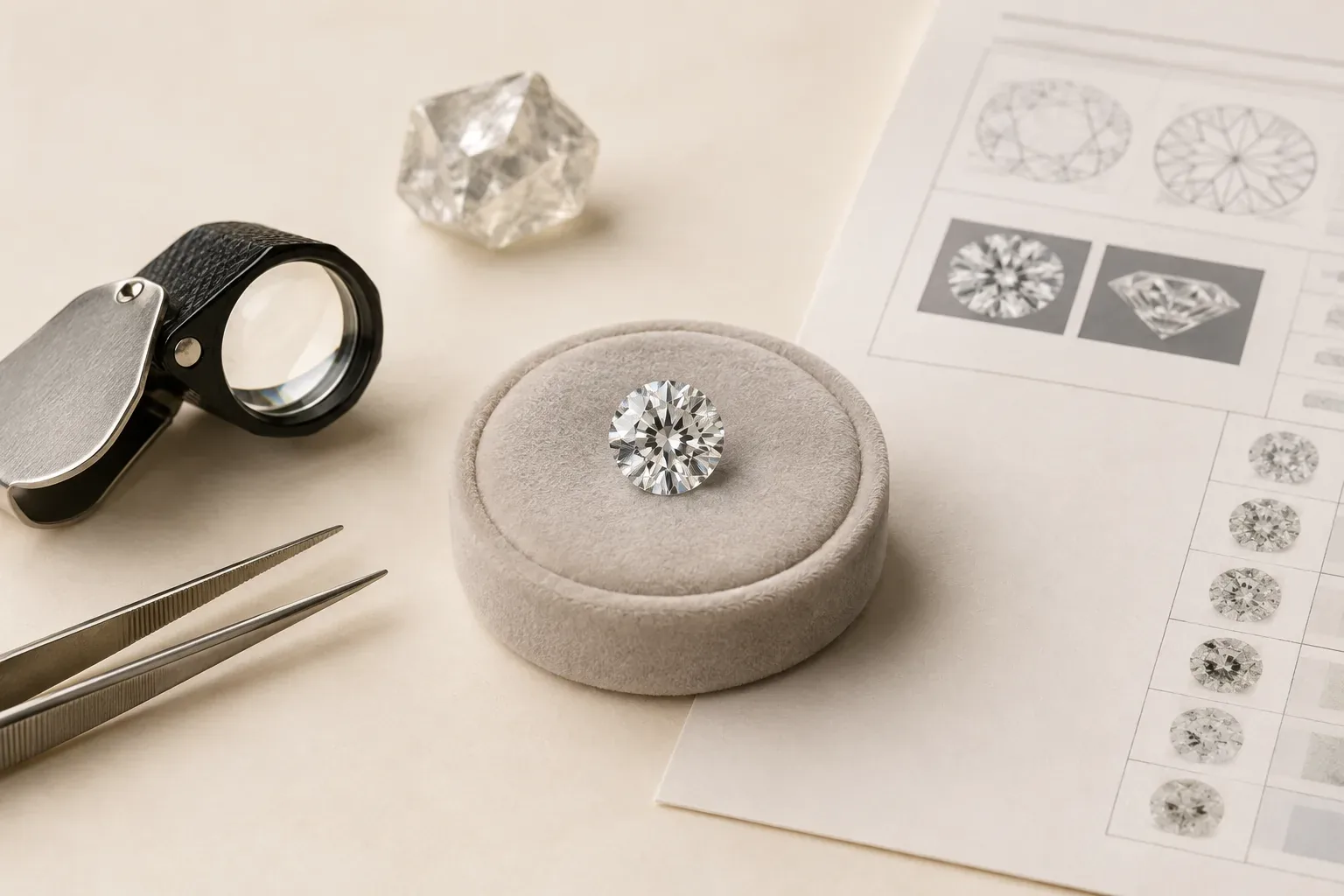
Meaning at a glance
This guide explains, with evidence-led definitions and consumer limits, how to read a diamond clarity grade report, what clarity grades mean, what a shopper can check without a lab or qualified jeweler, the practical trade-offs among clarity, cut, color and price, and simple care and gifting guidance.
Concise answer — what this guide proves
A diamond clarity grade report is a laboratory document that records the number, type, size, position and visibility of internal and surface characteristics (inclusions and blemishes) observed by trained graders under magnification and standardized lighting. Read the report to learn a diamond’s clarity grade, plotted characteristics, and any treatments or origin disclosures. Use the report together with other graded facts (cut, color, carat, and any treatment disclosures) to make trade-offs that match your budget and wearer’s lifestyle. Independent verification of a clarity grade or detection of treatments requires a qualified gemological laboratory or a trained jeweler; a buyer cannot reliably reproduce a laboratory clarity grade with the naked eye alone.
Historical evidence and where diamonds show up in the record
Diamonds have a long presence in human material culture. Institutions that document gemstones and consumer protections, including the Gemological Institute of America and consumer authorities, note that diamonds and other gems have been valued across many regions and periods, and that modern standards for grading and disclosure developed as trade and science advanced. The exact social meanings given to diamonds differ by culture and era, but the existence of diamonds in jewelry and trade networks is well attested in multiple historical records and through scholarly work summarized by gemological authorities such as the Gemological Institute of America.
In contemporary markets, demand patterns influence how clarity is marketed and priced. Industry research for 2026 shows persistent consumer interest in engagement rings, diamond studs, tennis bracelets and specific cut shapes—detail that helps explain why clarity grade reports are commonly requested for engagement diamonds and high-value pieces (Imaginaire Digital).
Documented historical meanings versus modern personal interpretations
Documented historical meanings are the beliefs, ceremonial uses, or trade functions recorded by historians and by institutional research into gemstones. These documented meanings vary by region and period and should be treated as historical fact about beliefs or practices, not as universal truths about diamonds today. Institutions that research gems, including gemological bodies, separate material facts about stones (composition, treatments, optical properties) from cultural meanings.
Modern personal interpretations are individual or cultural ideas about what a diamond symbolizes today—many people view diamonds as symbols of commitment, prestige, or longevity, but those are contemporary social meanings, not scientific facts. When choosing a diamond for a gift, respect that a modern symbolic meaning is a personal or cultural choice rather than a universal property of the gemstone.
How clarity and the diamond motif appear in jewelry
Clarity affects appearance when inclusions or blemishes are large or positioned under the table or in locations that impact light return. Jewelry styles that prioritize visible sparkle—solitaires, studs, and classic engagement cuts—often lead buyers to weigh clarity more heavily because the center stone’s face-up appearance is crucial. Market research indicates high demand for engagement rings, studs, tennis bracelets and oval cuts, which helps explain why clarity grade reports are frequently supplied for those items (Imaginaire Digital).
Manufacturers and setters may also mask or minimize the visual impact of lower clarity with design choices: halos, side stones, settings that hide the girdle, and certain mounting styles all influence perceived clarity. These are design strategies rather than changes to the gemstone itself, so clarity grade reports remain important for objective comparison.
How to read a clarity grade report: definitions, decision criteria, and verification limits
A clarity grade report typically includes a clarity grade on an established scale, a plotted diagram of inclusions and blemishes, a description of any treatments, and identification of whether the diamond is natural or lab-created. Laboratories differ in grading scales and strictness; the report should name the issuing laboratory. A laboratory report is evidence of the observations and the lab’s assignment based on their methods and standards.
Key definitions to expect on a report are the laboratory’s clarity grade (for example, a named grade on the lab’s scale), a plotted map showing the location and type of inclusions, comments about fluorescence, and an explicit statement about any treatments. The Gemological Institute of America highlights that treatments, detectability, durability and care create distinct consumer questions and that laboratories and sellers should disclose treatments when they affect appearance or stability (GIA).
Decision criteria: use clarity grade together with cut, color and carat to decide value. A higher clarity grade reduces visible inclusions but often costs more. For many buyers, a well-cut diamond with slightly lower clarity will appear more brilliant than a higher-clarity stone with a poor cut. Consider the setting and the wearer’s sensitivity to visible inclusions when trading off clarity and budget.
Verification limits: clarity grading requires magnification, controlled lighting, and trained graders. A shopper can visually inspect a stone to see obvious surface chips or large visible inclusions, compare a plotted diagram against the stone under magnification, and verify that the seller provides a named laboratory report. However, a buyer cannot reliably duplicate the laboratory’s clarity grade or detect some treatments without access to laboratory instruments or a qualified gemological laboratory. The Federal Trade Commission makes clear that consumers need written seller disclosures to distinguish natural, lab-created, treated, and imitation materials (FTC).
Practical selection, gifting guidance, and safe care
Selection guidance: request a named laboratory clarity grade report and compare stones using the same lab when possible. Balance clarity against cut, color and carat to meet your aesthetic and budget goals. If you expect heavy daily wear, prioritize a secure setting and consider slightly higher clarity to avoid inclusions that could weaken the stone over time. If the recipient prefers visible brilliance, prioritize cut quality even if it means a modest compromise in clarity.
Gifting guidance: for engagement rings and heirloom pieces, ask the seller for the lab report, a written return policy, and any available provenance or treatment disclosure. If the stone is lab-created or has been treated, those facts must be disclosed in writing under U.S. consumer protection guidance (FTC). Including a certificate from a reputable laboratory with the gift supports long-term resale or insurance needs.
Care guidance: handle diamonds by the band rather than the stone to avoid loosening the setting. Clean diamonds with warm water, mild soap and a soft brush or with cleaners recommended by reputable gemological sources. Avoid harsh abrasives or household chemicals that can affect metal settings or filler treatments. For any concerns about treatments or potential damage, consult a qualified jeweler or a gemological laboratory. The Gemological Institute of America explains that different treatments and materials require different care and disclosure practices (GIA).
Insure and inspect: for higher-value pieces, get a professional appraisal or verification from a qualified jeweler and consider insurance that covers loss, theft and accidental damage. Have prongs and settings inspected annually if the piece is worn frequently.
Frequently asked questions
What exactly is a diamond clarity grade report?
A clarity grade report is a laboratory document that lists a diamond’s clarity grade, plots internal and surface characteristics, and notes any treatments or origin statements. The issuing laboratory’s name and methods matter because grades are lab-specific.
Can I trust a clarity grade report from the retailer?
You can trust a report if it comes from an independent, reputable gemological laboratory named on the document. The Federal Trade Commission requires sellers to disclose whether a stone is natural, lab-created, or treated, so ask for written documentation and confirm the lab’s name on the certificate (FTC).
What can I verify about clarity without a gemologist or lab?
You can check for obvious surface chips, large visible inclusions with a loupe, whether the seller provides a plotted diagram and lab name, and whether the report includes treatment disclosures. You cannot reliably reproduce a laboratory clarity grade or detect many treatments without specialized instruments and training.
How do treatments affect clarity grades and care?
Some treatments can alter appearance or stabilize fractures; they must be disclosed by sellers. The Gemological Institute of America explains that treatments affect detectability, durability and care needs, and therefore influence consumer questions about a stone (GIA).
Does a higher clarity grade mean a more durable diamond?
Not necessarily. Clarity refers to internal and surface characteristics; a large inclusion in a structurally sensitive location could affect durability, but many clarity differences are cosmetic. Consider setting, expected wear and any documented treatments when assessing durability.
Sources and further reading
- Imaginaire Digital — Imaginaire Digital
- Gemological Institute of America — Gemological Institute of America
- Federal Trade Commission — Federal Trade Commission