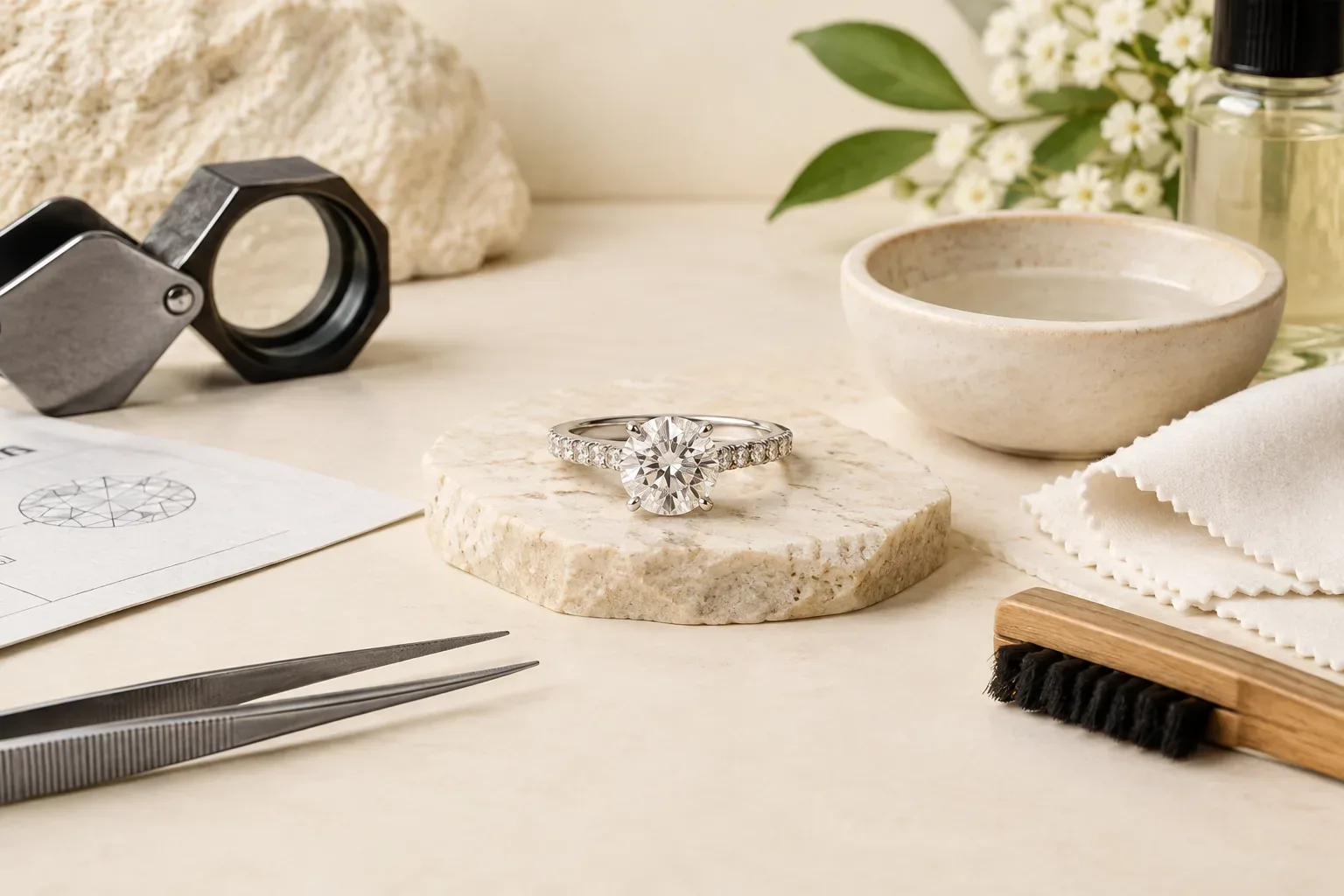
Meaning at a glance
A diamond certification care guide should define what a certificate does and does not prove, give decision criteria for buying and maintaining certified stones, outline safe cleaning and repair precautions, and clearly state what verification requires a qualified jeweler or gemological laboratory.
What diamond certification means and what it does not
A written diamond certificate (also called a report) documents attributes that a laboratory or credentialed grader measured or observed. Typical items on a report include carat weight, shape and cut description, measurable dimensions, clarity grade, color grade, and any treatments or enhancements the laboratory detected. The Gemological Institute of America (GIA) describes how treatments, detectability, disclosure and durability raise distinct consumer questions for gemstones and explains that laboratories report what they can reliably test and identify.
A certificate does not by itself guarantee market value, future durability in service, or provenance such as mining origin unless the issuing laboratory explicitly states such findings. The Federal Trade Commission (FTC) reminds consumers that clear, written seller disclosures are essential and that distinctions among natural, lab-created, treated, and imitation materials must be made in writing. That means a certificate is one important verification tool but not a complete warranty or provenance record unless the issuing body specifies those services.
Historical evidence relevant to certification and trade
When we speak of the historical evidence that affects modern certification and care, the approved, evidence-based record available to consumers today focuses on the history of treatments, disclosure practices, and consumer protection rather than symbolic meanings. The GIA documents how gemstone treatments and the ability to detect them have shaped disclosure expectations and laboratory practices. The FTC documents how consumer protection law requires sellers to make clear distinctions among natural, lab-created, treated, and imitation stones.
Industry attention to transparency and testing grew as treatment technologies and laboratory-grown diamond production advanced, producing new consumer questions about detectability and disclosure. Imaginaire Digital's market analysis further shows contemporary demand patterns in the retail market, which influences what buyers commonly seek when they look for certificates and post-purchase care.
Documented historical meanings versus modern personal interpretation
The authoritative sources used here do not catalogue symbolic meanings across cultures. What is documented in these sources concerns trade, treatment disclosure, and the technical attributes laboratories record. Any statement about historical or cultural symbolism would need corroboration from historical or anthropological sources not cited in this guide.
Modern personal interpretations—such as choosing a certified diamond for an engagement ring because a certificate suggests objective verification—are consumer-driven and practical rather than universal symbolic truths. Treat modern symbolic meanings as personal or cultural preferences rather than guarantees supported by laboratory reports.
How certification affects care, cleaning, and repair choices
Certification often identifies treatments that matter for care. For example, the GIA explains that certain treatments and enhancements can affect how a stone responds to heat, chemicals, and mechanical stress. Knowing whether a diamond has been fracture-filled, HPHT-treated, or is lab-grown influences which cleaning methods and repair procedures are safe.
Routine cleaning (warm water, mild dish soap, a soft brush) is safe for durable, untreated diamonds in secure settings. Ultrasonic cleaners and steam cleaners can be effective for many diamonds but are not universally safe. The presence of treatments, fracture fills, or fragile mounting components may make ultrasonic or steam cleaning risky; a certificate that notes treatments should prompt you to ask a qualified jeweler whether those cleaning methods are advisable for that specific stone.
What you can reasonably verify yourself and what requires a professional
At-home checks you can do: confirm that the certificate corresponds to the stone by comparing basic metrics on the report such as carat weight, shape, and visible proportions; inspect the setting for loose prongs, chips, or surface dirt; and perform simple cleaning to judge sparkle. These checks help with everyday maintenance and can reveal obvious mismatch or damage.
Questions that require a qualified jeweler or a gemological laboratory: distinguishing natural from lab-created stones when a reliable certificate is absent or ambiguous; detecting and identifying many treatments and enhancements; and determining origin or specialized provenance claims. The FTC stresses the importance of written seller disclosures; if a seller cannot provide a clear, recognized laboratory report for a claim such as 'natural, untreated origin,' seek laboratory testing or choose a certified stone from a reputable lab instead.
Cleaning and storage: practical, safe steps
Start with a gentle cleaning routine: soak the piece in warm water with a drop of mild dish soap, use a soft-bristled brush to remove oils and debris, rinse with clean water, and dry on a lint-free cloth. For ordinary, well-set diamonds this method removes the everyday oils that dull brilliance.
Before using ultrasonic or steam cleaners, confirm that the certificate shows no treatments that could be damaged and that the setting has no loose or fragile components. Ask your jeweler whether soldered or glued elements exist that ultrasonic vibration could loosen. When in doubt, avoid aggressive mechanical cleaning and seek professional advice.
Store diamonds separately from other jewelry to prevent metal scratches and to keep prongs and settings safe from knocks. Even though diamond is the hardest mineral, settings, inclusions, or treatments can introduce points of weakness that justify careful storage and handling.
Repair precautions and working with a jeweler
If a diamond or its setting needs repair, always start with the certificate and any seller documentation. Present that paperwork to the jeweler so they can assess treatments, mounting details, and recommended approaches. Repairs that involve heating, laser work, or re-cutting should be done by qualified professionals who understand the stone's treatment history and the certificate findings.
Be explicit about the limits of in-store testing. Many jewelers provide basic tests and services, but determinations about treatment type, origin, or subtle enhancements often require a full laboratory report. If a repair could alter a stone (for example, significant re-cutting or re-polishing), discuss how that action would affect the original certificate and whether the lab would need to re-certify the modified stone.
Selection and gifting guidance
When selecting a certified diamond as a gift, prioritize a certificate from a respected laboratory and verify that the report matches the actual stone. Ask the seller for a full copy of the report and whether the lab is independent, internationally recognized, and detailed enough to answer the questions that matter to you. The FTC emphasizes that sellers must disclose whether a stone is natural, lab-created, treated, or imitation; insist on written confirmation.
Balance decision criteria for your budget and values. Some buyers prioritize an internationally recognized clarity and color grading report; others accept a local or in-store appraisal for a lower price but should understand the trade-offs in standardization and resale liquidity. Imaginaire Digital's market analysis shows strong consumer interest in engagement rings, studs and tennis bracelets, so consider common settings and the recipient's lifestyle when choosing metal type and secure mounting. For a sentimental gift, include the certificate in the presentation—documentation adds both emotional reassurance and practical value.
When to seek a laboratory re-examination
Request re-examination when you suspect a mismatch between the certificate and the stone, when you buy from a less transparent seller, or when the seller or a jeweler identifies possible treatments not listed on the report. The GIA explains that detectability and disclosure of treatments directly affect consumer questions, and laboratories are best equipped to provide conclusive results.
A re-examination is also warranted after substantial repair or alteration. Significant re-cutting, remounting that alters dimensions, or repairs that affect the stone's surface can change the attributes a certificate records; ask whether a new laboratory report is appropriate after major work.
Frequently asked questions
Does a certificate guarantee a diamond's origin or permanence?
No. A certificate records the attributes tested or observed at the time of examination, but it only guarantees provenance or permanence if the issuing laboratory expressly states those findings. The Federal Trade Commission requires sellers to disclose whether a stone is natural, lab-created, treated, or imitation, so look for clear written disclosure and an independent laboratory report for origin claims.
Can I clean all certified diamonds with an ultrasonic cleaner?
Not always. Many untreated, well-mounted diamonds tolerate ultrasonic cleaning, but stones with certain treatments or fracture fills, or pieces with fragile mountings, can be damaged. The Gemological Institute of America recommends checking treatment information and consulting a qualified jeweler before using ultrasonic or steam cleaners.
What should I do if a certificate does not match the stone I received?
Ask the seller for clarification and provide the certificate for comparison. If the discrepancy persists, request that the seller arrange a re-examination by a recognized gemological laboratory or contact an independent lab yourself. The FTC emphasizes the importance of written disclosures and accurate representations; insist on documentation.
How can I tell at home if a diamond is lab-grown or natural?
You generally cannot make a definitive determination at home. Many distinctions between natural and lab-grown diamonds, or between treated and untreated stones, require specialized instruments and laboratory expertise. If origin matters, insist on a certificate from a reputable laboratory that explicitly identifies the stone's origin.
Will routine polishing or re-setting invalidate a certificate?
Minor cleaning and polishing usually do not change the attributes recorded on a certificate, but significant re-cutting, re-polishing that alters dimensions, or re-setting that requires reshaping can change the recorded measurements and appearance. If material alteration occurs, consider obtaining an updated laboratory report.
Sources and further reading
- Imaginaire Digital — Imaginaire Digital
- Gemological Institute of America — Gemological Institute of America
- Federal Trade Commission — Federal Trade Commission