Meaning at a glance
This article explains documented historical uses and shifting contexts of crystal in jewellery, separates historical meanings from modern personal interpretations, and offers practical guidance on durability, tarnish, wear, selection, gifting, and care.
What the historical record shows (and how we know it)
Museum research and curatorial summaries provide the primary, documented backbone for understanding how crystals have appeared in jewellery through time. The Victoria and Albert Museum’s exhibition material and articles frame jewellery as an object class whose form and social meaning shift across cultures and historical periods. The V&A describes how materials such as rock crystal, quartz, and other transparent or translucent stones were used in personal ornament from ancient to modern times and how their use and fashion changed with technique, trade and social context.
The V&A’s A–Z of gemstones offers identification and historical context, noting the presence of many crystalline minerals in the archaeological and collecting record and outlining how lapidary work—cutting, carving, and polishing—has shaped jewellery forms. Those museum resources document that stones commonly called “crystal” appear in a wide range of historical objects and were worked in differing ways depending on period and culture.
Separating documented historical meanings from modern interpretations
Documented historical meanings recorded by museums and curators are grounded in object studies, provenance, inscriptions and contemporary writings. For example, period display labels and catalogues reviewed by the Victoria and Albert Museum explain how certain gemstones were used as status symbols, amulets, or trade commodities in particular times and places. These accounts focus on material, technique and social function rather than universal symbolic claims.
Modern personal and spiritual interpretations—such as assigning a universal energetic property to a particular crystal—are frequently layered onto historical practices but are not the same as documented historical meanings. Contemporary wearers and designers often adopt or invent symbolic associations for aesthetic or personal reasons. Those contemporary meanings can be meaningful to an individual but should not be presented as historically universal or as a direct continuation of a specific religious practice unless specific evidence links them.
How crystal motifs and gemstones appear in jewellery
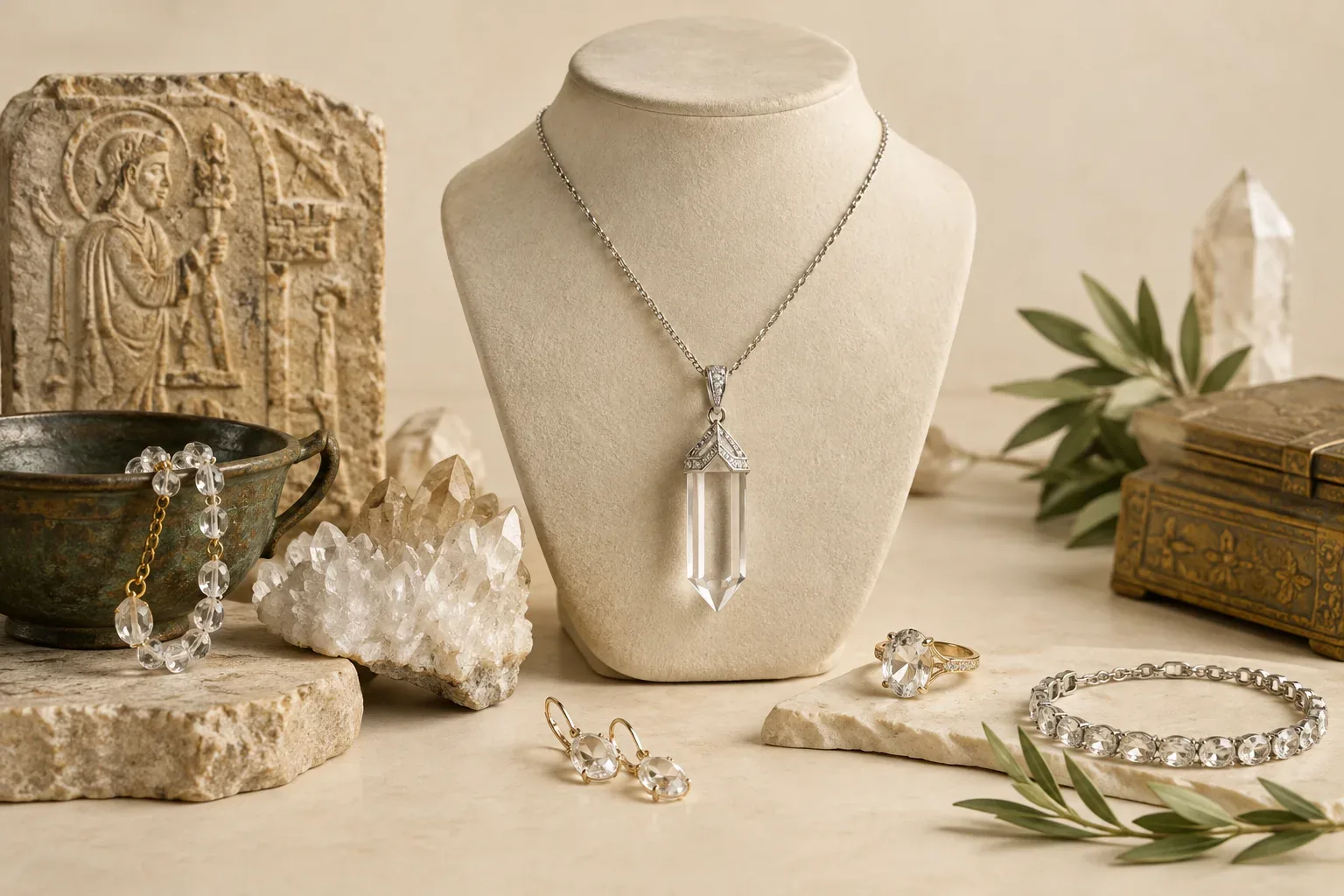
Crystal and crystal-like materials enter jewellery in multiple ways that affect durability. Historically and today, transparent and translucent stones have been used as beads, faceted stones set in metal, cabochons, carved intaglios and cameos, and in unsecured bead strands. Modern costume jewellery often uses lead crystal glass or strung crystal beads to achieve the look at lower cost.
Where crystals are cut and set in metal, the durability depends not only on the stone but also on the setting type, the metal's hardness, and whether any surface finish or plating is used. Strand and bead work rely on cord or wire strength and knotting technique. Because museums such as the V&A document the variety of forms, those collections are useful references for understanding how a crystal-related motif has been realized in different techniques and periods.
Tarnish, wear, and factors that affect longevity
What people often call “tarnish” refers mainly to oxidation or surface changes in metals rather than to the stones themselves. Silver, base metals and plated metals may darken, discolor or wear where they contact skin, sweat or chemicals. The visible appearance of a crystal jewellery piece will therefore change depending on the metal alloy, whether a finish or plating is present, and how the wearer uses the piece.
Stones can show wear in different ways. Some crystals and glass components scratch or chip with impact or abrasion; others are relatively resistant. Strung beads are vulnerable at their holes where friction weakens cord or wire. Settings with thin prongs or glue-mounted stones are more likely to lose stones than robust bezel or channel settings. These material realities are the most reliable way to predict longevity, rather than any assumed symbolic property of a gemstone.
Practical care and maintenance
Avoid exposing crystal jewellery to harsh household chemicals, chlorinated water, cosmetics and perfumes, which can degrade metal finishes and some adhesives. Remove jewellery for activities that expose it to impact, abrasion or repeated moisture. Regularly wipe metal and stone surfaces with a soft, dry cloth to remove oils and grit that accelerate wear.
For pieces with delicate settings or strung beads, have the tension and integrity of stringing material checked periodically and consider re-stringing when wear appears. For plated metals, be aware that plating can wear away in high-contact areas; a jeweller can re-plate items if desired. When in doubt, consult a qualified jeweller for cleaning and repair rather than attempting aggressive home treatments that could harm stones or settings.
Buying, disclosure, and what to ask sellers
Be prepared to ask direct questions about what you are buying. The U.S. Federal Trade Commission offers consumer-oriented guidance that emphasizes asking sellers whether a gemstone has been treated, whether a metal is plated, and whether components are natural, synthetic, or imitation. Those disclosures affect both value and care requirements.
Ask about the stone’s identity (for example, whether it is natural quartz, a synthetic crystal, or lead crystal glass), any treatments such as dyeing or coating, the type of metal and any plating, and recommended cleaning methods. Ask for a return policy and, if the piece is expensive, for lab documentation or a written description of treatments and materials. Clear answers help you estimate how a piece will wear and what maintenance it will need.
Selection and gifting guidance (practical and respectful)
Choose a piece with the recipient’s lifestyle in mind. For an active wearer, select low-profile settings, durable metals and well-seated stones rather than fragile bead strands or heavy costume pieces. For a sentimental gift, consider documented historic forms such as lockets or simple faceted pendants that are robust and can be worn daily.
When a piece carries cultural or religious imagery, check provenance and context and avoid appropriating symbols in ways that might misrepresent their origin or sacred function. If a giver wants to reference a historical motif, present it as inspired by a period or region rather than as an authentic sacred object unless the piece is certified and presented with appropriate cultural context. Practical considerations—repairability, ease of cleaning and clear vendor disclosure—are as important to respectful gifting as symbolism.
Final takeaways
Crystal jewellery durability is a function of materials, construction and care, not of an intrinsic lasting power of the motif. Use museum research to understand how crystals and related designs have been used historically and use consumer guidance to confirm what you are buying. Treat modern symbolic meanings as personal or stylistic choices unless contemporaneous evidence ties them to a particular culture or time.
If you want a lasting piece, prioritize clear disclosure from the seller, appropriate metals and settings, routine maintenance, and respectful attention to the cultural context of any symbolic design.
Frequently asked questions
Will crystal jewellery tarnish like silver?
Tarnish usually refers to metal oxidation; crystals themselves do not tarnish but can scratch, chip or lose polish. Metal parts such as silver, base metals or plated surfaces can darken or wear, and those changes will affect the overall appearance of the piece.
How can I tell if a crystal is natural, synthetic or glass?
Ask the seller for a clear description and any documentation. Reputable sellers will disclose whether a stone is natural, synthetic, treated or imitation. The Federal Trade Commission encourages consumers to request information about treatments and material identity before purchase.
Are certain crystal designs more durable for everyday wear?
Yes. Low-profile, bezel-set or channel-set stones and pieces made in durable metals generally withstand daily wear better than glued settings, delicate prongs or strung bead necklaces. Consider the recipient’s activities and choose robust construction for everyday pieces.
How should I clean crystal jewellery safely?
Use a soft, dry cloth for routine cleaning and avoid harsh chemicals, ultrasonic cleaners or steam cleaners unless you have confirmation from the seller or a qualified jeweller that the piece and any treatments are safe for those methods. When in doubt, seek professional cleaning advice.
Is it disrespectful to wear historically inspired crystal motifs from other cultures?
Context matters. Wearing historically inspired designs can be respectful when accompanied by accurate context and acknowledgement. Avoid presenting sacred or culturally specific symbols as fashion without understanding their meaning, and consult reputable sources or community voices when in doubt.
Sources and further reading
- Bedazzled: A History of Jewellery — Victoria and Albert Museum
- An A-Z of Gemstones — Victoria and Albert Museum
- Buying Gemstones, Diamonds, and Pearls — Federal Trade Commission