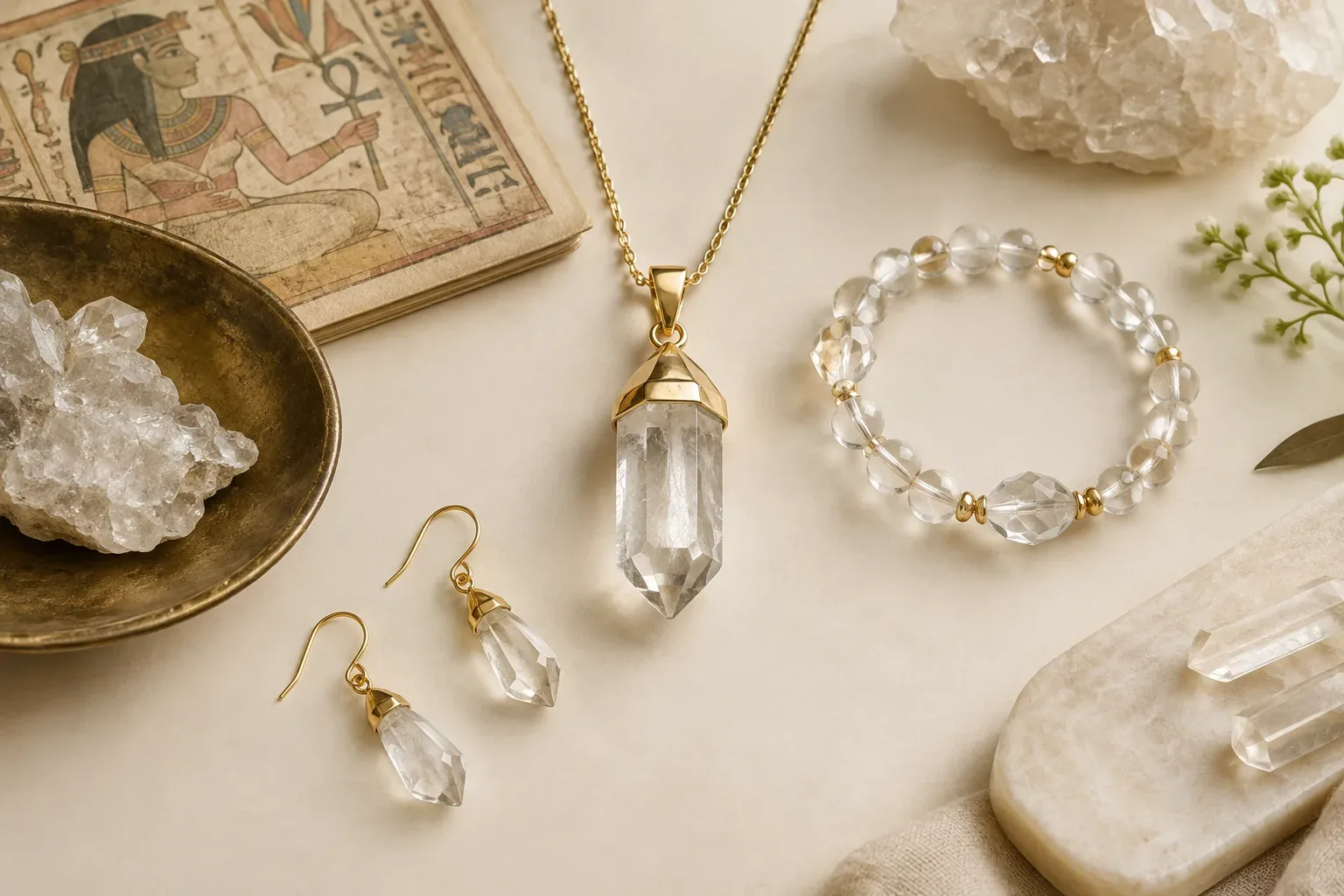
Meaning at a glance
This guide explains documented historical uses and changing social meanings of crystal and gemstone jewelry (drawing on the Victoria and Albert Museum), separates those historical records from modern personal or spiritual interpretations, and gives practical, evidence-backed advice on selecting, evaluating, and gifting crystal jewelry while noting important consumer protections described by the Federal Trade Commission.
Documented history and cultural contexts
Museum scholarship shows that crystals and gemstones have long been materials of adornment whose meanings and uses changed with culture, technology, and social context. The Victoria and Albert Museum presents this as a history of object-making and social meaning: gemstones appear in very different roles in ancient Egyptian and Near Eastern jewellery, in classical Greek and Roman pieces, in medieval European reliquaries and rings, in Mughal Indian courts, and in the fashionable jewellery of Georgian and Victorian Britain. The V&A emphasizes that jewellery must be read in context: the same material or motif may signal status, devotion, trade connections, or fashion rather than a single, stable meaning.
Those distinct cultural contexts are important. For example, the V&A describes how certain stones and settings functioned as markers of wealth and political alliance in court contexts, while in other periods gemstones were used for portrait jewelry, mourning pieces, or as trade commodities. Where the museum can identify a historical purpose or social function, that documentation is reported here as a context-specific fact rather than a universal symbolic claim.
Separating documented history from modern interpretations
Historical evidence recorded by museums like the V&A documents how people used particular stones and motifs — for display, commemoration, religious practice, or trade — but it does not support later, generalized spiritual claims. The V&A’s work on gemstones and jewellery emphasizes provenance, technology, and changing social meaning rather than modern metaphysical assertions.
In contrast, many contemporary sources and consumer communities present personal or spiritual interpretations about crystals, such as claims about specific healing energies, chakras, or universal metaphysical properties. Those modern interpretations are personal or spiritual belief systems and are not the same as historically documented functions of jewellery. Treat modern symbolic meanings as subjective and culturally variable; do not assume they were part of the original historical context unless a specific culture’s sources or the museum record indicate so.
How crystals and gemstone traditions appear in jewellery
Crystals and gemstones enter jewellery through choices of material, cut, setting, and motif. The V&A’s overview of gemstones explains that different stones have been worked in ways suited to their hardness and fashion: soft or brittle minerals are often used as cabochons or beads, while harder stones are faceted to enhance brilliance. The same crystal material can be presented as a faceted stone in a ring, a rounded cabochon in a brooch, a drilled bead in a necklace, or a raw point set into a pendant depending on cultural preferences and technical practices.
Design motifs — floral patterns, geometric mounts, portrait lockets, or religious symbols — are vehicles for gemstones. In many museum collections the gemstone’s place in the object matters as much as its identity: a small colored stone set into a devotional pendant expresses a different purpose from a large, prominently faceted gem set into a courtly ring. Modern makers also use crystal forms and raw points as stylistic motifs, but that modern aesthetic choice should be distinguished from historical meanings recorded by curators.
Assessing quality: what to look for
Quality in crystal and gemstone jewellery combines the properties of the gemstone, the skill of the cut and setting, and the overall craftsmanship of the piece. The Victoria and Albert Museum’s resources on gemstones provide context about how materials and workmanship affect the look and durability of jewellery. When assessing a stone, consider its clarity (absence of visible inclusions to the naked eye), color (how evenly and vividly it presents), cut (proportions and symmetry for faceted stones), and hardness relative to the intended use.
Also inspect the setting and metalwork. A well-executed setting secures the stone without obscuring its best surfaces, and good metalwork indicates care in manufacture. For vintage or historical pieces, the museum context can help you evaluate whether repairs or replacement stones affect the piece’s authenticity or value.
Price drivers and buyer protections
Price depends on rarity, size, color intensity, clarity, cut quality, and craftsmanship. Beyond gemstone characteristics, provenance and maker reputation can increase price, as can historical significance. The Federal Trade Commission cautions buyers about treatments, imitations, and necessary disclosures: sellers must accurately describe treatments (such as heating or irradiation), identify simulants or synthetics, and be transparent about whether a gemstone is natural or laboratory-grown. Rely on documented disclosures when comparing prices.
Ask for written information about treatments, country of origin when available, and any certification from reputable gemological laboratories. Where certification is not provided, detailed written claims from the seller about origin, treatment, and return policy are essential. The FTC’s consumer guidance recommends skepticism of unverifiable claims and careful attention to return policies and guarantees when purchasing higher-value gemstones.
Practical buying considerations: matching use to material
Choose stones and settings that match the wearer’s lifestyle. Harder stones (higher on the Mohs scale) better withstand everyday wear in rings and bracelets, while softer stones are safer in pendants and earrings. Consider secure settings for active wearers and low-profile mounts for pieces that must resist knocks or snagging.
For heirloom or daily-wear pieces, prioritize workmanship and durable metals such as solid gold or platinum rather than plated bases. For fashion or occasional-wear items, lighter materials and trends may be appropriate, but be aware these typically command lower resale values.
Respectful selection and gifting guidance
When choosing or gifting crystal jewellery, be culturally and personally respectful. If a design uses symbols, motifs, or materials tied to a living religious or cultural tradition, research that use and, when appropriate, select designs created by makers from that culture or ask permission before gifting. The V&A’s contextual approach to jewellery shows how meanings change across time and place; apply the same caution in contemporary contexts so that cultural signification is not assumed or misapplied.
Ask about any spiritual or symbolic preferences the intended recipient may hold rather than assuming meanings. Consider practical preferences such as metal allergies, ring size, lifestyle needs, and whether the recipient prefers subtle or statement pieces. Include care instructions and a receipt with return options so the recipient can exchange the piece if it does not suit them.
Care, maintenance, and verification
Care depends on the stone and setting. Some crystals are sensitive to heat, chemicals, or ultrasonic cleaning; others handle routine cleaning and polishing well. Ask the seller for specific care recommendations and keep documentation of any treatments or certifications. For vintage jewellery, request information about restorations or replacement stones, and have high-value items appraised or examined by a qualified gemologist when provenance and condition are important to you.
For verification, written disclosures about treatments and clear provenance are the first line of defense. For significant purchases, independent laboratory reports from recognised gemological organisations are a useful supplement, and the FTC advises that sellers disclose any material facts that would affect a buyer’s decision.
Final thoughts
A practical crystal jewelry buying guide distinguishes what we know from history, what craftsmen intended, and what modern wearers and buyers personally interpret. Use museum sources to understand documented historical roles and contexts, and follow consumer-protection guidance to navigate treatments, imitations, and price claims. Above all, select pieces with respect for cultural origins and with attention to the recipient’s tastes and practical needs.
Frequently asked questions
How can I tell if a crystal or gemstone is natural, treated, or synthetic?
Ask the seller for written disclosures about treatments and whether the stone is natural, laboratory-grown, or a simulant. The Federal Trade Commission advises that sellers must accurately describe treatments and identify synthetics or simulants. For high-value purchases, request an independent laboratory report from a recognised gemological organisation.
Are historical meanings of gemstones the same as modern spiritual claims?
No. Museum research, such as the Victoria and Albert Museum’s work, documents how gemstones functioned in particular historical and cultural contexts — as status markers, devotional objects, or fashion items. Modern spiritual or healing claims are contemporary personal or community beliefs and are not the same as historically documented uses unless specific historical evidence supports them.
What should I prioritize if I want a durable everyday crystal ring?
Prioritise a hard stone with good clarity and a secure setting, and choose metals durable enough for daily wear such as solid gold or platinum. Avoid softer or brittle materials in rings intended for everyday use and ask the seller for care recommendations.
How should I approach gifting jewellery that uses cultural or religious motifs?
Research the motif and its cultural context, consider commissioning or buying from makers of that culture when appropriate, and ask the recipient about any personal or religious sensitivities. The V&A’s emphasis on context underscores the importance of respecting living traditions and not assuming meanings.
What consumer protections should I expect when buying gemstones?
Expect clear written disclosure of treatments, accurate identification of natural versus lab-grown stones, transparent return policies, and receipts that document claims. The Federal Trade Commission recommends confirming these details before purchase and being wary of unverifiable assertions.
Sources and further reading
- Bedazzled: A History of Jewellery — Victoria and Albert Museum
- An A-Z of Gemstones — Victoria and Albert Museum
- Buying Gemstones, Diamonds, and Pearls — Federal Trade Commission