Meaning at a glance
Cluster setting engagement ring styling balances visual coverage, finger proportion, durability and disclosure: choose cluster size and profile to suit finger width and lifestyle, prioritize secure settings for small stones, follow safe care routines, and understand that only a qualified jeweler or gemological laboratory can reliably confirm treatments, origin or exact durability of gemstones.
Short answer (concise, direct)
Style a cluster setting engagement ring by matching the cluster’s visible face and profile to the wearer’s finger width and hand proportions, selecting stone types and setting height for the wearer’s lifestyle, and confirming disclosure of treatments or origin in writing. The practical trade-offs are coverage versus comfort, sparkle versus snag-risk, and affordability versus long-term service needs. Remember that verification of natural versus lab-grown stones, detectability of some treatments, and precise gem identity require a qualified jeweler’s testing or a gemological laboratory report—this guide explains decisions, care, and limits to what you can verify without lab work.
What we mean by 'cluster setting' and styling goals
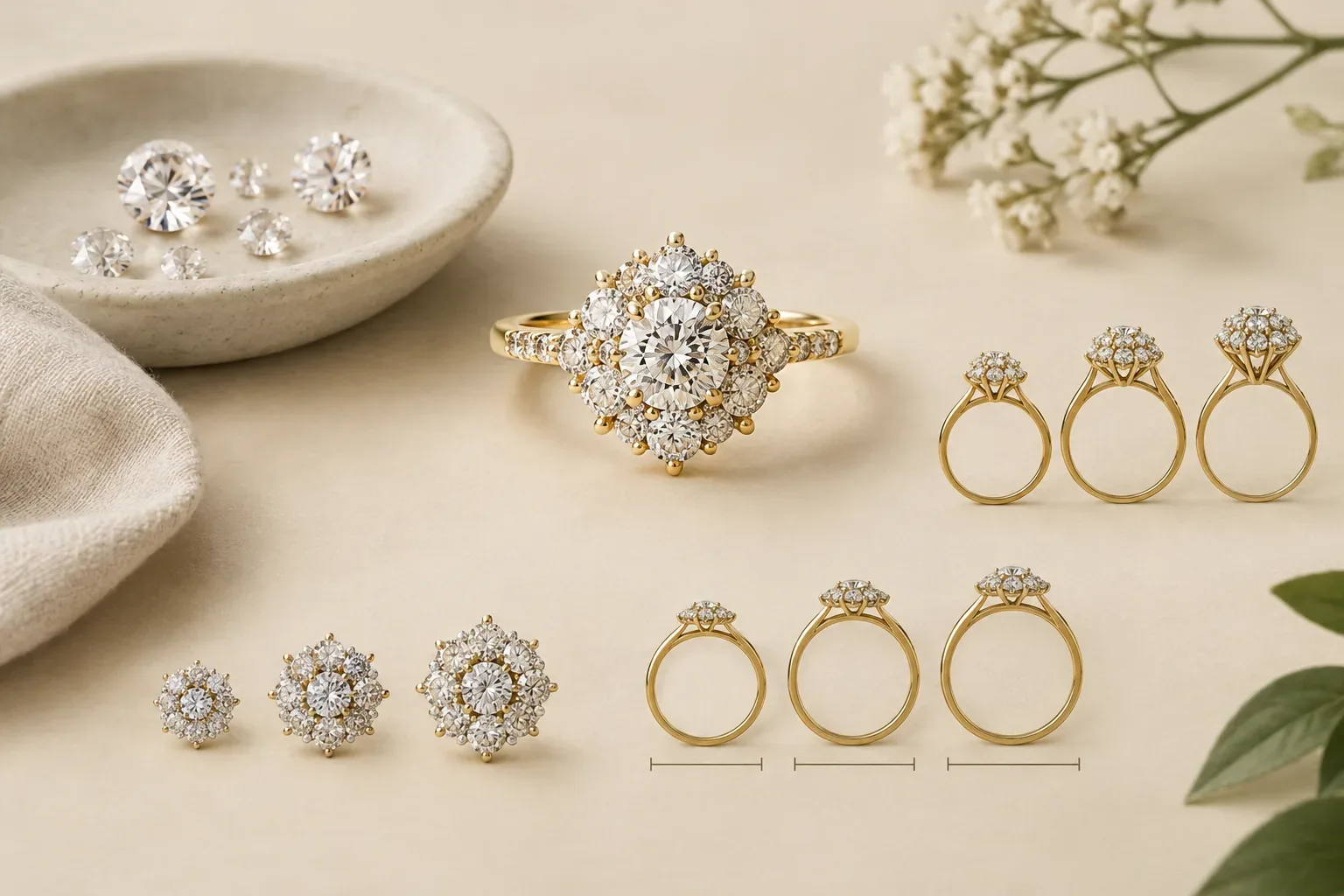
A cluster setting arranges multiple stones—often smaller diamonds or colored gems—close together to read as a larger visual mass. Styling a cluster engagement ring means choosing the cluster’s overall dimensions, the setting profile (low and close to the finger or higher and more three-dimensional), stone type and color, and metalwork so the finished ring flatters the wearer and suits their daily activities.
Primary styling goals are proportion (how the cluster’s visible width and length relate to finger size and hand proportions), coverage (how much of the finger’s surface the cluster should cover), balance with adjacent rings or stacking arrangements, and practical durability for normal wear.
Historical evidence and cultures (what the approved sources document)
The approved sources for this article document modern market demand and consumer protections rather than providing a primary historical account of cluster settings. Imaginaire Digital and Jewelers Mutual report contemporary demand trends and styling preferences (for example, fluid forms and versatility), but they do not serve as sources for the historical origins or specific cultural usages of cluster settings. Because the supplied evidence does not include museum catalogues, primary historical records, or academic history texts, we cannot responsibly assert precise historical claims about which culture first developed cluster settings or when particular motifs were adopted.
If you need historically specific provenance—such as whether a particular cluster motif was typical in Victorian Britain, Georgian jewelry, Mughal India, or another period—you should consult specialist historical jewellery catalogues, museum collections, or academic sources. Our separation here follows the evidence: contemporary trade and consumer guidance are documented by the provided publishers, while precise cultural or period attributions are outside the supplied evidence and therefore are explicitly left unasserted.
Documented historical meanings versus modern personal interpretations
Because the approved sources do not provide documented historical meanings for cluster motifs, we cannot claim an authoritative historical symbolism tied to a given culture or century. Any historical meaning asserted without primary historical sources would be speculative.
Modern interpretations, by contrast, are well documented in current-market reporting: cluster rings are often chosen today for their visual impact at lower cost than a single large stone, for the ability to combine colored gems, and for stylistic versatility such as stacking or pairing with wedding bands. Jewelers Mutual notes contemporary consumer demand for craftsmanship, versatility and gender-neutral styling, all of which influence why modern shoppers select cluster settings.
How the motif, gemstone or tradition appears in jewelry
In modern jewelry, cluster settings appear as compact groups of small stones arranged in floral, geometric or free-form patterns. Designers use clusters to create a focal surface larger than individual stones, to combine colors, or to produce a halo or pavé-like look without relying on a single center stone.
Gemstone choices affect both appearance and care. Small diamonds in clusters maximize sparkle and hardness, while colored stones—sapphires, emeralds, rubies—add hue but carry different durability and treatment considerations. The Gemological Institute of America explains that treatments and durability vary across gem materials, and those differences should shape both design decisions and maintenance plans. The Federal Trade Commission requires clear disclosure about whether a gemstone is natural, lab-grown, treated or an imitation; that affects both resale value and care instructions.
Finger coverage and proportion: practical styling guidance
Assess the wearer’s finger width and hand proportions visually and by feel. A cluster that spans most of a narrow finger can overwhelm, while a very small cluster on a broad finger can appear out of scale. The core principle is visual balance: the visible face of the cluster should complement the finger without dominating it or looking insignificant.
For narrow fingers, choose clusters with a narrower profile that run slightly lengthwise to elongate the finger. For wider fingers or larger hands, broader clusters or circular designs can sit harmoniously. Consider ring shank width—thinner shanks emphasize the cluster face, while a wider shank can anchor a larger face. If the wearer stacks rings, leave appropriate negative space so the cluster and adjacent rings do not compete visually or catch on each other.
Profile matters: a low-profile cluster sits closer to the finger and reduces snag risk, which benefits active wearers. A higher profile creates drama and three-dimensionality but is more likely to catch on clothing or require protective settings such as bezel accents or secure prongs.
Decision criteria and practical trade-offs
Coverage versus comfort: Larger clusters increase visual coverage but can reduce comfort and increase snag risk. If daily hand use is high, prefer lower profiles and secure settings over maximal coverage.
Sparkle versus service needs: More small stones offer intense sparkle and redundancy (if one stone is lost the effect remains), but many small stones mean more settings to check and potentially higher maintenance over time. Secure prongs and regular inspection reduce the risk of stone loss.
Affordability versus longevity: Cluster rings can be more affordable than single-stone rings for the same apparent size, but stone treatments, small-stone re-setting costs, and potential future repolishing or rhodium plating should be factored into lifetime cost.
Stackability and coordination: If the engagement ring will be worn with a wedding band or fashion rings, test pairings to ensure the cluster does not overhang or press into adjacent bands.
Care guidance and what you cannot verify without a lab
Safe care: Clean cluster rings gently. Use a soft-bristled brush, warm water and mild detergent for routine cleaning; dry with a soft cloth. Avoid ultrasonic cleaners for clusters containing fragile or treated gems unless a qualified jeweler confirms safety. Check settings periodically for loose prongs or missing stones and have a jeweler retip prongs or re-seat stones as needed.
Treatments, disclosure and detectability: The Gemological Institute of America explains that treatments can affect both appearance and durability and that some treatments require special care. The Federal Trade Commission requires sellers to disclose whether gems are natural, lab-grown, treated or imitations. However, as the FTC guidance makes clear, written disclosure and professional testing are necessary to be certain about origin and treatments.
Limits on verification: A consumer or retail salesperson cannot reliably determine natural versus lab-grown origin or identify certain treatments without instrumentation and expertise. A qualified jeweler can perform a preliminary examination, but definitive identification often requires a gemological laboratory report. The thesis of this guide is to answer styling intent while making clear the practical limits: only a qualified jeweler and a gemological laboratory report can confirm origin, detect some treatments, and provide authoritative durability assessments.
Selection and gifting guidance (practical and respectful)
Ask about lifestyle first. If the recipient works with their hands, prioritize a low-profile cluster with secure settings and hard gem choices. If they value dramatic visual impact and have a less manual lifestyle, a higher-profile, larger cluster can be appropriate.
Request full disclosure in writing. When buying, ask for written confirmation of whether stones are natural, lab-grown, or treated, and request any available certificates. The Federal Trade Commission expects such disclosures; insist on them before purchase.
Try ring proportions in person when possible. Sizing and proportion are best judged on the hand. If buying remotely, obtain accurate finger measurements and confirm return or resize policies.
Consider personalization over symbolism. Because documented historical meanings are not supplied in the approved evidence, focus gifting on meanings you and the recipient agree on—color choices, a floral arrangement, a shared memory—rather than asserting a specific historical symbolism that is unverified by the provided sources.
Final practical checklist before purchase
Confirm written disclosures about stone origin and treatments. Ask whether the seller will provide a gemological lab report for the center or representative stones, and what the return, resize and warranty terms are. Have a trusted jeweler check the setting if you are unsure about durability or suitability for daily wear. These steps reflect both consumer-protection guidance from the Federal Trade Commission and the practical market trends reported by professionals like Jewelers Mutual and Imaginaire Digital.
Frequently asked questions
How much of my finger should a cluster engagement ring cover?
There is no single correct percentage; aim for visual balance. Narrow fingers typically suit narrower or lengthwise cluster shapes, while wider hands can carry broader clusters. Try the ring on and check for balance with the finger length and any rings you wear alongside it.
Will a cluster setting look larger than a solitaire?
Yes: clusters of small stones can read as a larger surface area than a single stone of similar total carat weight, often with more dispersed sparkle. But clusters involve more settings and potential maintenance than a single-stone mount.
Can I verify that stones are natural or untreated at the point of sale?
You should insist on written disclosure from the seller. A preliminary jeweler's inspection can provide guidance, but definitive verification of natural origin or certain treatments generally requires a gemological laboratory report. The Federal Trade Commission requires disclosure but a lab report is the gold standard for confirmation.
Are cluster rings harder to care for than single-stone rings?
They can require more frequent inspection because they have multiple settings. Routine gentle cleaning is usually safe, but avoid ultrasonic cleaning for clusters with fragile or treated gemstones unless a qualified jeweler confirms it is safe. The Gemological Institute of America advises that treatments and material durability affect care recommendations.
Is a low-profile cluster always the best choice?
Not always. Low-profile clusters are better for active wearers and reduce snag risk, but higher-profile clusters create a more dramatic, three-dimensional look. Choose based on daily activities, comfort preferences and aesthetic priorities.
Sources and further reading
- Imaginaire Digital — Imaginaire Digital
- Jewelers Mutual — Jewelers Mutual
- Gemological Institute of America — Gemological Institute of America
- Federal Trade Commission — Federal Trade Commission