Meaning at a glance
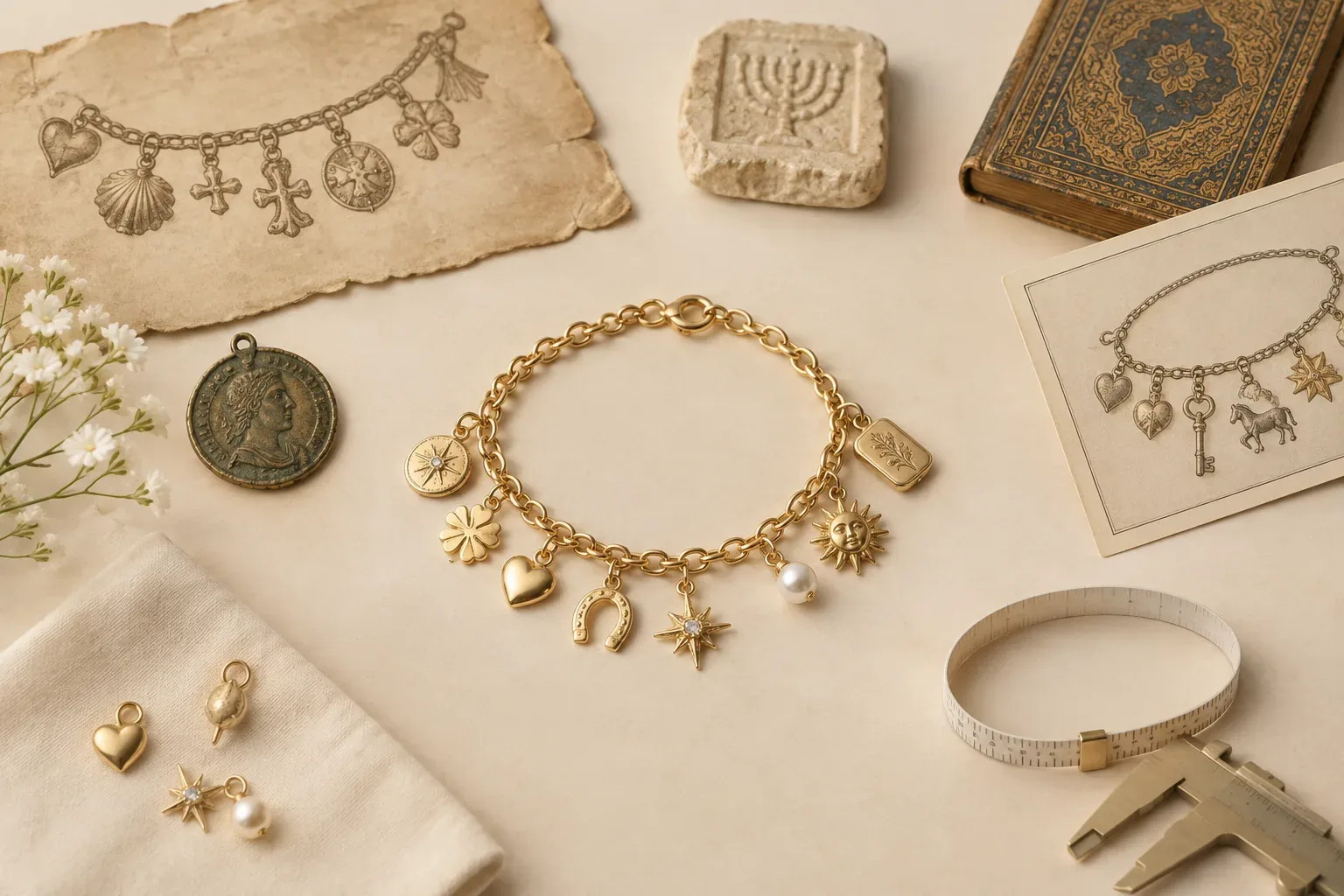
Measure the wearer's wrist with a flexible tape or string, decide whether you want a snug, fitted, or loose look, and add the appropriate extra length to account for charms, chain type, and comfort; historical sources show charm and sentimental bracelets have shifted meaning across cultures and periods, so treat symbolic interpretations as culturally specific rather than universal.
Historical evidence: what the record shows and which cultures or periods it names
Museum scholarship documents that personal ornaments including charms and bracelet forms have appeared in many societies and changed function over time. The Victoria and Albert Museum frames jewellery as a social and cultural practice whose meanings shift with context, fashion, and technology. Their materials show that items now called 'charms' or 'sentimental jewellery' often served as portable memory pieces, markers of identity, or decorative status objects in different eras and places rather than carrying one single universal meaning.
The museum's overview of gemstones and jewellery practices places stones and small decorative motifs in long histories of use and exchange. That evidence supports reading charm bracelets as part of wider jewellery traditions where materials, motifs, and wearer practices are embedded in specific historical settings. Use the Victoria and Albert Museum's accounts when interpreting past uses: they provide documented context rather than sweeping statements about universal symbolism.
Separating documented historical meanings from modern personal interpretation
Documented historical meanings come from material culture, inventories, and museum scholarship that link particular objects to functions such as mourning, protection, commemoration, or social display. The V&A's work demonstrates that such meanings are often specific to place, class, or occasion. For example, a pearl-set mourning brooch documented in a collection tells a different story than a modern heart-shaped charm gifted between friends.
Modern personal interpretations—how someone today reads a motif like a heart, star, or animal—are valid on a personal level but are not the same as a historically documented cultural meaning. Contemporary marketing, celebrity trends, and social media also shape what a charm signifies now, and those influences can be distinct from or even unrelated to earlier practices recorded by curators and historians.
How motifs, gemstones, and traditions appear in charm bracelets
Motifs appear as small cast or stamped elements, engraved tags, enameled pieces, or set stones hung from links. Museums such as the V&A catalogue shows how gem materials were selected and worked into small-scale jewelry across periods. A motif can be attached as a dangling piece, be integrated into a fixed link, or be incorporated as a bead on a threaded bracelet.
Gemstones enter charm work either as small cabochons or faceted stones set into miniature bezels or used as spacer beads. The V&A's guide to gemstones explains how material choice influences durability, visual effect, and working methods. Practically, hard stones and metal motifs hold up better as dangling charms; softer stones or pieces with fragile settings require protection and a more considered mount.
Traditions such as gifting a bracelet to mark a life milestone, using a charm to remember a person, or collecting charms to record experiences are documented in different ways across collections. Those traditions can be traced in museum records as ongoing practices that change form and emphasis depending on era and locale.
Practical fit and measurement guidance
Begin with an accurate wrist measurement. Wrap a flexible measuring tape or a length of non-stretch string around the narrowest part of the wrist where a bracelet will sit. Mark the point where the tape or string overlaps and measure that length against a ruler. That number is the wrist circumference and the baseline for sizing.
Decide on the intended fit. A snug fit (close to the wrist measurement) keeps charms from swinging much and suits heavier, rigid pieces; a fitted look adds a small allowance so the bracelet drapes without catching; a loose fit adds more length so charms can move freely and show their profile. For charm bracelets, most wearers prefer some drape so charms sit and turn, rather than being trapped against the wrist.
Account for chain type and clasp position. Thick link chains and cable chains sit differently from flat bracelets or rigid bangles. A broad or stiff band reduces the drape and may need extra length, while a thin chain will show more movement with the same extra length. Where the clasp sits also influences comfort: if a large, decorative clasp sits on the top of the wrist, the wearer may need a slightly different length than if the clasp sits beneath the wrist.
Consider charm weight and number. Each additional charm adds weight and can cause a bracelet to pull down; heavier collections often mean you add extra length so the bracelet does not constrict. If you are building a charm bracelet over time, plan for more room than a single-wear configuration.
Use extenders and adjustable findings for flexibility. An extender chain or a clasp with multiple jump rings allows smaller or changing wrists to wear the same bracelet comfortably. For gifting, an adjustable option is often the safest choice when you cannot measure precisely.
Choosing materials, motifs, and gemstones responsibly
When selecting gemstones, be aware of treatment and imitation practices and look for clear disclosure from sellers. The Federal Trade Commission advises consumers to ask about treatments, imitations, and the nature of the gemstone before buying. These considerations affect durability and care as well as price and expectation.
Pick mounting and clasp styles that suit how the bracelet will be worn. Soldered jump rings or secure lobster clasps are sensible for charm bracelets that will carry weight. For delicate gemstones or fragile enamels, prefer settings that offer a protective bezel rather than exposed prongs. Museum documentation emphasizes that physical construction matters to how an object survives daily use.
Gift-giving and respectful selection
When gifting a charm bracelet, think about the receiver's lifestyle and cultural context. Some symbols have specific meanings in particular communities; use museum resources and dedicated research to check whether a motif carries a cultural or religious meaning that might be sensitive. Treat popular interpretations as personal rather than universal unless there is clear historical or cultural evidence to the contrary.
If you cannot ask for measurements, choose adjustable bracelets or include a generous return or resizing option. Consider starting with a single meaningful charm on an adjustable chain so the wearer can add more pieces over time. For heirlooms or pieces meant to mark a public milestone, document any provenance or symbolism you know; such records increase the object's future historical and sentimental value.
Practical care and when to seek professional help
Charms and their chains receive different stresses than simple bracelets because they move and collide. Regularly check jump rings and clasps for wear and have a jeweller replace or solder them if they show thinning. For gemstone-containing charms, follow care recommendations for the particular stone and setting: fragile gems benefit from protective mounts and careful storage away from harder pieces.
Buy from sellers who disclose treatments and materials, and retain receipts and any certificates. The FTC stresses transparency for gemstones and treatments; having clear information supports informed decisions about care, insurance, and future resale.
Putting it together: a simple sizing workflow
Measure the wrist, choose desired fit, add allowance for charm movement and chain type, and decide on adjustability. If gifting, err toward adjustability and conservative sizing rather than a fixed, exact length. Remember that documented histories show charm bracelets have played many roles; prioritize function and the recipient's preferences over assumptions about symbolic meaning.
Frequently asked questions
How do I measure a wrist for a charm bracelet?
Wrap a flexible measuring tape or a non-stretch string around the narrowest part of the wrist where the bracelet will sit, mark where the tape or string meets, and measure that length against a ruler to find the wrist circumference.
How much extra length should I add for charms?
Add extra length so charms can move without pressing into the wrist; a modest addition gives a fitted drape while a larger allowance creates a loose, swinging look. The exact amount depends on the number and weight of charms, chain thickness, and the wearer's comfort preference.
Can I resize a charm bracelet later?
Yes—many charm bracelets can be shortened by removing links or lengthened with extenders or added chain. If the bracelet has soldered links or a complex design, resizing is best done by a professional jeweller.
Should I worry about gemstone treatments when buying charms?
Yes. Ask the seller about any treatments, imitations, or enhancements. The Federal Trade Commission recommends disclosure of treatments and imitations because they affect durability, care, and value.
Is a weighty charm bracelet uncomfortable?
Heavier charm collections can pull at the wrist and may require extra length or a sturdier chain. If comfort is a priority, choose lighter charms or increase the bracelet's allowance for movement.
How should I choose a cultural or religious motif for a gift?
Research the motif's cultural or religious significance before gifting. Use reputable sources, museum materials, or community consultation to ensure the symbol is appropriate and respectfully used rather than assumed to have the same meaning for everyone.
Sources and further reading
- Bedazzled: A History of Jewellery — Victoria and Albert Museum
- An A-Z of Gemstones — Victoria and Albert Museum
- Buying Gemstones, Diamonds, and Pearls — Federal Trade Commission