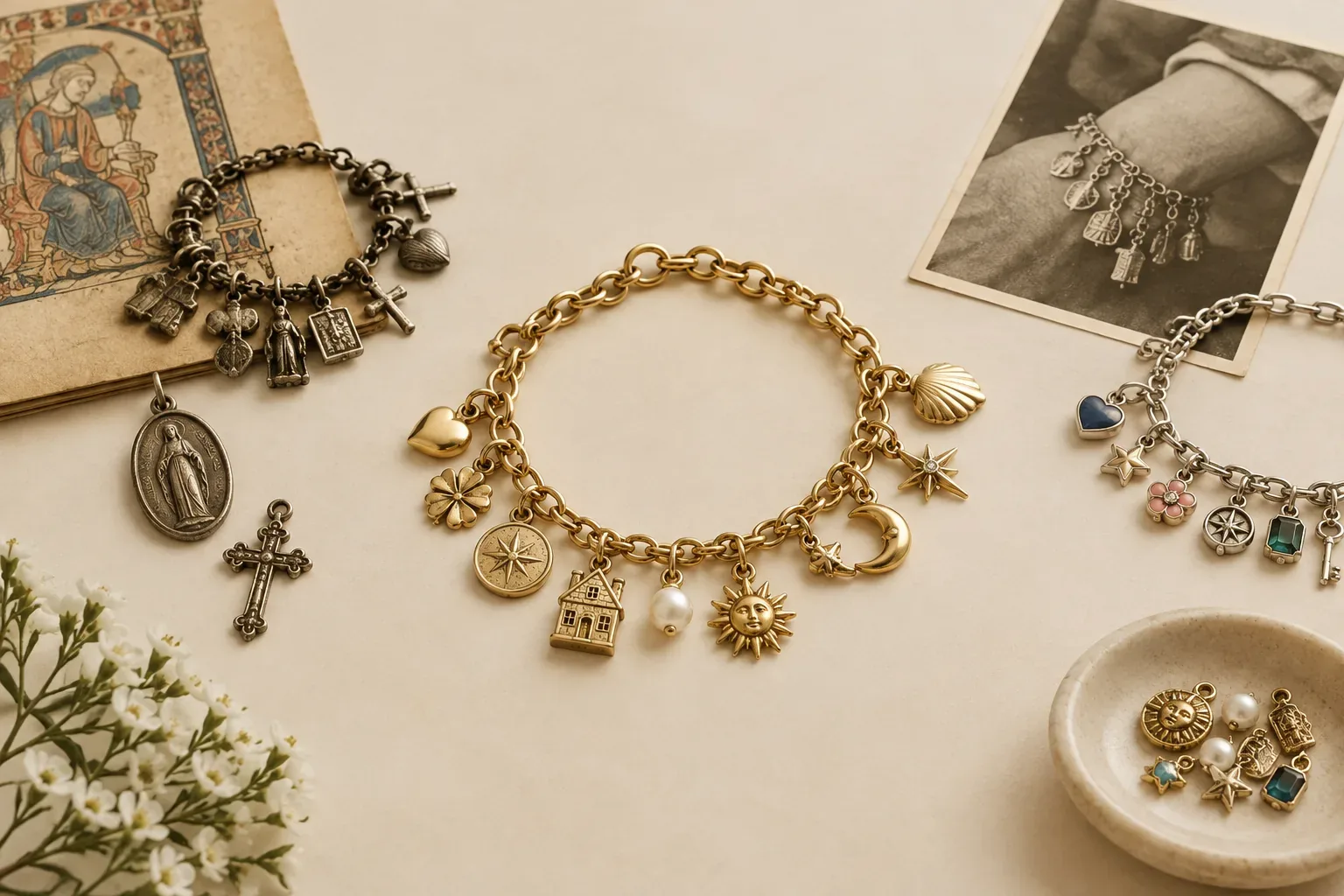
Meaning at a glance
This article explains documented historical contexts for charm-like jewellery, separates cultural or religious evidence from later popular meanings, and provides a practical checklist for assessing a charm bracelet’s construction, comfort, and durability plus guidance for selection and gifting.
How history helps us evaluate charm bracelets
Museum research shows that personal, wearable objects used as markers of identity and memory appear repeatedly in different cultures and periods. The Victoria and Albert Museum notes that jewellery with attached personal elements—what we now call charms—appears in collections from ancient Egypt and the classical Mediterranean, and that later periods such as Victorian Britain revived and reshaped those sentimental practices in new social contexts (Victoria and Albert Museum).
Knowing this history matters for quality assessment because surviving historic examples reveal long-standing technical solutions and aesthetic priorities: secure attachments and protective settings were important when pieces were worn daily, and decorative techniques evolved to balance ornament with wearability. The V&A’s overview of jewellery history emphasizes changing social contexts and uses, which helps explain why construction and comfort are consistent concerns across time (Victoria and Albert Museum).
Gemstones and other materials also carry historical usage patterns that affect modern expectations. For background on how particular gems were used and valued across cultures, the Victoria and Albert Museum’s gem guide offers descriptions of stones and historic contexts useful for assessing whether a bracelet’s stones are appropriate for everyday wear or require special care (Victoria and Albert Museum).
Documented historical meanings versus modern personal interpretations
Documented historical meanings are those supported by museum records, inventories, or contemporary accounts. For example, museums record that certain forms of wearable amulets and pendants were used in ancient cultures for identity, status, or protective purposes—claims based on collections and scholarship rather than modern marketing interpretations (Victoria and Albert Museum).
Modern personal interpretations are individual or community-based meanings assigned to charms today. A charm of a particular motif may be worn because it represents a memory, a hobby, or a personal milestone; these uses are legitimate but distinct from claims that a motif had a single, fixed meaning in all historic contexts. Treat modern symbolism as layered on top of, not identical to, the historical record.
When assessing a charm bracelet, separate what can be documented about a motif’s historical use from contemporary sentiment. If cultural or religious significance is claimed for a specific motif, ask for sources—museum catalogues or academic citations—rather than relying on generalized statements. If the charm has a private or family meaning, that modern interpretation is valid for the wearer but should not be presented as a replacement for the documented history.
Where motifs, gemstones, and traditions appear in charm bracelets
Motifs on charm bracelets can be engraved, cast as small figures, inlaid, painted, or represented by cut gemstones. Historically, motifs appeared in lockets, intaglios, and small pendants; in contemporary charm bracelets they appear as stamped or cast charm elements, enamelled charms, or gemstone-set mounts. The particular technique affects durability: cast and soldered attachments are typically stronger than glued-on components.
Gemstones are used as decorative focal points or symbolic markers. The Victoria and Albert Museum’s A–Z of Gemstones describes how different stones have been valued and worked across history and notes technical considerations such as hardness and cleavage that affect suitability for daily wear (Victoria and Albert Museum). Softer or more brittle stones require protective settings or may be better reserved for occasional-wear bracelets.
Traditional techniques that appear on modern charm bracelets include chain link varieties, soldered jump rings, bezel and prong settings for stones, and enamel detailing. How a motif is executed—its setting, attachment, and protective features—determines both how the motif will age and how it should be cared for.
The charm bracelet quality checklist: construction
Materials and hallmarks: Confirm the metal content (for example, sterling silver, 9k/14k/18k gold) either by hallmark or vendor disclosure. Solid metals will wear differently than plated finishes; ask whether base metal plating is present and what thickness was applied. For stones, request identification and disclosure of treatments per consumer-protection guidance (Federal Trade Commission).
Chain and link construction: Check whether main links and jump rings are soldered closed. Unsoldered or poorly closed jump rings are the most common failure point when charms catch on clothing. A durable bracelet will use properly soldered jump rings or welded chain links for load-bearing connections.
Clasp and safety features: Evaluate the primary clasp (lobster, spring ring, box clasp) for strength and smooth operation. A secondary safety chain or locking mechanism is a practical addition on charm bracelets that carry heavier or sentimental charms.
Charm attachment: Look at how charms attach to the bracelet. Charms should be secured using soldered split rings or solid links rather than glued bails. Consider whether charms move freely or create local stress on single links; evenly distributed weight reduces strain on individual links.
Stone settings and enamel: For any set stones, inspect prongs and bezels for smooth, secure seating. Enamel should be flush with the metal and free of hairline cracks. Fragile surface decoration should be protected by design, not merely superficial.
The charm bracelet quality checklist: comfort
Proper sizing and fit: A bracelet that fits close to the wrist will present charms differently than a looser bracelet; try the bracelet on and move your wrist to test for comfort. Leave room for natural movement—some wearers prefer a snug fit while others want a looser drop.
Weight distribution: Test how the bracelet sits when all charms are attached. Heavier clusters can cause twisting and pulling. Insist on trying the bracelet with the typical number and type of charms you expect to wear.
Edge finishing and tactile comfort: Check for any sharp edges on charms, clasps, or links. Comfort comes from smooth finishes and rounded edges where metal contacts skin. Consider how charms behave under sleeves—do they snag fabric?
Noise and movement: Some wearers are sensitive to sound from charms clinking. If noise is a concern, evaluate charm spacing and consider threaded or fixed charms that reduce rattle.
The charm bracelet quality checklist: durability and care
Metal durability and plating: Understand whether the piece is solid metal or plated. Plating will wear over time especially at high-contact points. If plating is present, ask about the base metal and expected wear characteristics. The Federal Trade Commission advises that sellers disclose treatments and imitations for gems and metals, which applies here to plating and filled metals (Federal Trade Commission).
Stone toughness and setting security: Choose stones appropriate to everyday wear. Harder gems like sapphires and diamonds tolerate more abrasion; softer gems may require protective settings. Inspect settings for tightness and ask about routine maintenance.
Repairability: Durable designs use components that a jeweller can repair or replace, such as standard-sized jump rings, clasps, and settings. Avoid one-piece constructions that force full replacement if one element fails.
Cleaning and storage: Ask the seller how to clean the specific metals and stones used. Some gemstones are porous or treated and require special care. Store charm bracelets flat or in individual compartments to avoid tangling and abrasion.
Selecting and gifting — practical and respectful guidance
Assess the recipient’s daily activities and style before choosing materials and motifs. If the wearer is active, choose low-maintenance metals and protected stone settings. If the bracelet is meant as a keepsake, prioritize repairable construction and secure attachments so the pieces last across years.
Respect cultural and religious meaning. If a charm has a cultural, religious, or historic significance, ask the giver or seller for provenance and context, and avoid assuming a motif’s significance without checking documented sources. When in doubt, choose a neutral or clearly personal motif and offer information about the symbol’s meaning alongside the gift.
Consider long-term care and transparency. When gifting a piece with gemstones, ask the seller to provide written detail about stone identity and any treatments in keeping with the consumer-protection information the Federal Trade Commission recommends. Provide care instructions with the gift so the recipient knows how to preserve the bracelet.
Personalization versus historic replication: If you want a historically inspired charm, look for makers who describe their sources and techniques. For sentimental gifts, a modern motif that has personal significance is often preferable to an alleged 'authentic' historic symbol whose original meaning may be complex or contested.
Maintenance, inspection, and when to seek professional care
Inspect charm bracelets periodically for worn jump rings, loose prongs, or thinning chains. Minor repairs—soldering a ring closed, tightening a prong, replacing a clasp—are routine and extend life significantly.
Seek a qualified professional jeweller for any soldering or stone-setting repairs. Avoid home fixes that could further damage settings or thin plated finishes. If the bracelet contains historically significant components or fragile gemstones, consult a specialist who understands conservation as well as repair.
Document sentimental pieces with photos and written notes about provenance. For pieces intended as family heirlooms, preserving background about when and why charms were added keeps the object meaningful for future owners.
Final note
A practical charm bracelet quality checklist blends technical inspection with respect for historical context and personal meaning. Use documented museum research to understand how forms and materials were used in different cultures and periods, rely on consumer-protection guidance for material disclosure, and prioritize construction choices that make the bracelet comfortable, durable, and easy to maintain.
Frequently asked questions
What is the single most important construction check for a charm bracelet?
Verify that load-bearing jump rings and chain links are soldered or welded closed rather than merely twisted or glued. These joints are the most common failure points when charms snag or wear under tension.
How can I tell if a gemstone in a charm is treated or an imitation?
Ask the seller for written disclosure of the gem’s identity and any treatments, and request a lab report for high-value stones; the Federal Trade Commission advises sellers to disclose treatments and imitations.
Are plated bracelets durable for everyday wear?
Plated bracelets can be worn daily but plating will wear at contact points over time. If longevity is a priority, choose solid precious metal or thicker plating on a suitable base metal and be prepared for potential re-plating.
How do I choose a comfortable charm bracelet fit?
Try the bracelet on with likely charms attached, move your wrist, and check for snagging or excessive swinging. Leave a small allowance for wrist movement—comfort is subjective, so prioritize the wearer’s preference.
Should I worry about historical or cultural meanings when gifting a charm?
Yes, respectfully check whether a motif has cultural or religious significance and verify provenance before gifting. If the recipient values cultural authenticity, provide documented context; otherwise prefer neutral or clearly personal motifs.
Sources and further reading
- Bedazzled: A History of Jewellery — Victoria and Albert Museum
- An A-Z of Gemstones — Victoria and Albert Museum
- Buying Gemstones, Diamonds, and Pearls — Federal Trade Commission