Meaning at a glance
This charm bracelet buying guide explains the documented history and shifting contexts of charm bracelets (as described by the Victoria and Albert Museum), separates historical meanings from modern personal interpretations, and gives practical, respectful guidance on choosing materials, assessing quality, and understanding price and gemstone disclosures (with FTC guidance on treatments and imitations).
What historians document about charm bracelets
Museums and curators treat charm jewellery as a long-standing form of personal ornament that changes meaning across time and place. The Victoria and Albert Museum frames jewellery history as evidence of shifting social contexts and fashions rather than a single, fixed symbolism, and it documents how people in different periods used small wearable objects for memory, identity, status, protection, and decoration.
For example, objects that function like charms appear in multiple cultures and periods in the V&A’s collections and exhibitions: in some eras jewellery served explicitly sentimental or commemorative roles, while in others small pendants and talismans signalled social rank, profession, or allegiance. The V&A’s overview of gemstones also traces how particular stones were valued and worked into ornament across times and regions, demonstrating that both motif and material reflect changing tastes and technologies rather than a single, static meaning.
Identifying cultures and periods in the record
When you read about a charm’s ‘‘meaning’’ in historical sources, note which culture and period the claim refers to. The V&A treats jewellery as evidence from archaeological and historical collections, so references to a motif’s role should be tied to the specific object’s origin in the museum’s cataloguing or exhibition text. A motif used in a continental European court during the 18th century, for example, should not be assumed to have the same meaning as a similar-looking object from an Asian or African context.
Curators emphasize that motifs migrate and are reinterpreted. A symbol that visually resembles a protective talisman in one period may have been ornamental or heraldic in another. Likewise, the ways gemstones were cut, set, and understood evolved as lapidary techniques and trade networks changed. Treat historical attributions as context-specific claims rather than universal explanations.
Documented meanings versus modern personal interpretations
Documented historical meanings are those supported by contemporary records, inventories, inscriptions, or curator interpretation of object provenance. The V&A and similar institutions base claims about original use and significance on such evidence. For example, a charm worn as a mourning token in a documented 19th-century context can be described as a commemorative object for that time and place.
Modern personal interpretations are how wearers and gift-givers assign current emotional, aesthetic, or identity-based value to charms and gemstones. These modern meanings are valid for the wearer but are not the same as documented historical uses. A contemporary wearer might adopt a historic motif for its style, romanticized story, or symbolic resonance; that modern meaning is a living layer on top of the object’s original context, not a verified continuation of past beliefs.
How motifs, gemstones, and traditions appear in charm bracelets
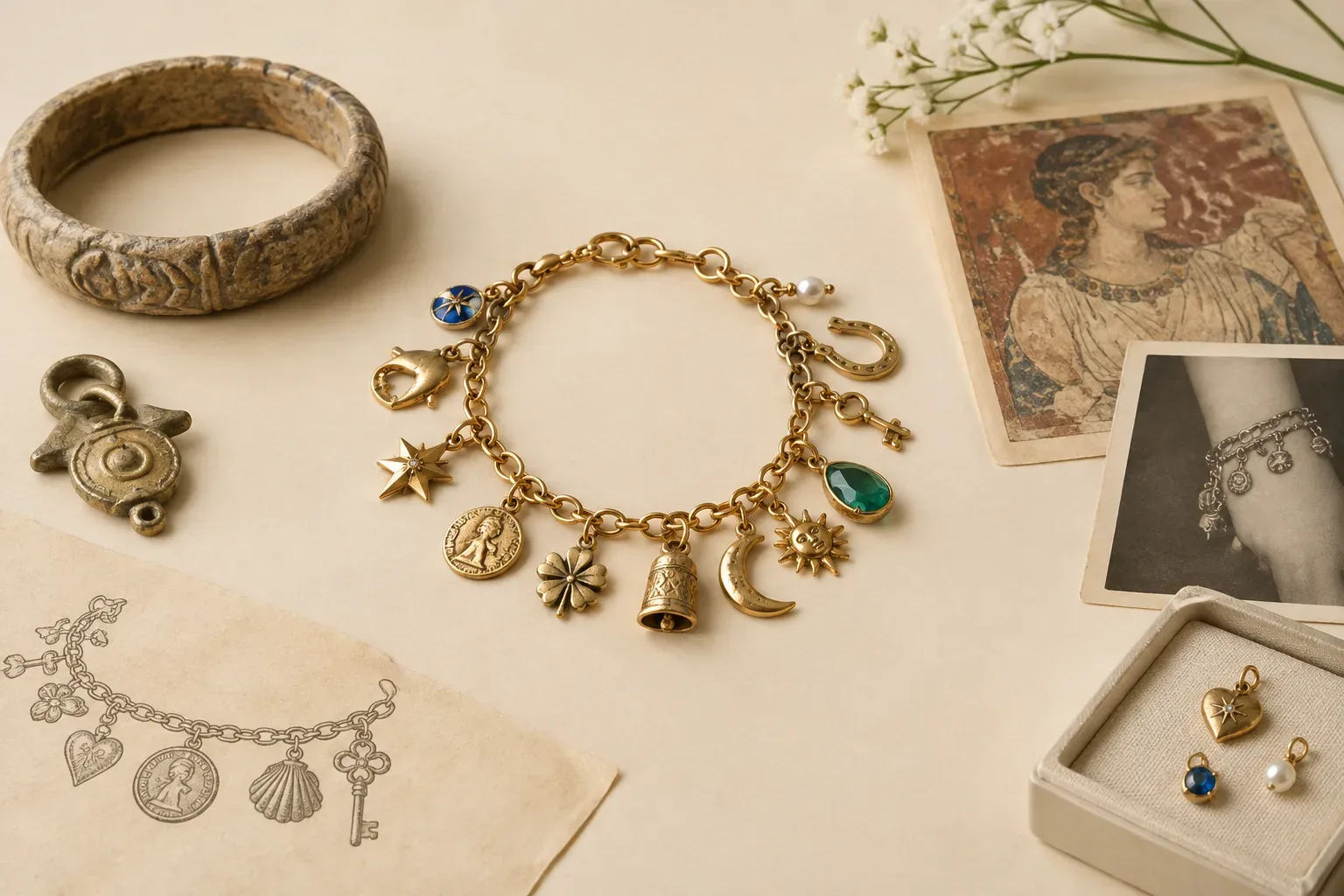
Motifs appear in charm bracelets as cast or stamped metal shapes, enameled miniatures, intaglio or cameo pendants, and sculpted figures. Curators at the V&A show how craft techniques—enamelling, engraving, gem-setting, and casting—allow motifs to be reproduced at small scale and worn as personal tokens. The same motif can be rendered in metal alone or combined with gemstones for color and status.
Gemstones are used both for visual effect and historically as marks of value or identity. The V&A’s A–Z of Gemstones explains how different stones were prized in different contexts and were cut and set according to contemporary lapidary practices. In charm bracelets, stones commonly appear as small cabochons, faceted accents, or inlaid panels, and the choice of stone often reflects fashion, availability, and personal preference rather than a single fixed symbolism.
Quality, materials, and what to ask sellers
Start by asking straightforward questions about metal content and gemstone origin. Sellers should be able to tell you the metal type (for example, sterling silver or marked gold), whether gemstones are natural, treated, synthetic, or simulant, and whether any enhancements have been applied. The Federal Trade Commission advises consumers to ask about treatments and imitations and for clear disclosure when gems or metals are not what they appear to be; that guidance helps buyers avoid surprises and compare prices responsibly.
Inspect construction: check jump rings, clasp strength, and link soldering because a charm bracelet’s longevity depends on connections as much as on individual charms. Look for hallmarks or maker’s marks where present, and ask about repairs or alterations. Weigh aesthetic priorities against durability—for daily wear choose robust links and secure settings; for occasional wear you can prioritize delicate craft details.
Price considerations and value trade-offs
Price reflects a mix of factors: metal purity, gemstone quality and rarity, maker reputation, craftsmanship, and condition. Museum and market histories show that value fluctuates with fashion and cultural interest; a motif that is popular in one era can be less prized in another. Use the seller’s disclosures about materials and any gemstone treatments (as the FTC recommends) to assess whether a price aligns with material value.
Remember that provenance and maker can add to cost independent of intrinsic materials. A well-documented historic charm or a piece by a recognized maker may command higher prices because of rarity and documented context. If you’re buying as a wearable object rather than a collectible, weigh the emotional or aesthetic value you place on a charm against its market price.
Respectful selection and gifting guidance
When choosing motifs that come from a culture, religion, or community that is not your own, take time to research the symbol’s context using reliable sources and consider whether wearing or gifting it could be insensitive. The V&A’s approach to jewellery history highlights that objects have specific cultural and historical meanings; a symbol that is decorative in one context may be sacred or socially significant in another. If you are unsure, choose a motif that is neutral in origin or ask someone from the relevant community for guidance.
For gifting, match the bracelet’s durability to the recipient’s lifestyle and be explicit about the piece’s meaning. If the charm is meant to mark a life event, say so; if it’s chosen for its historic resonance, explain the provenance you know. Personalization—adding a charm that reflects an interest or relationship milestone—is commonly meaningful, but avoid asserting historical meanings as fact if they are modern reinterpretations.
Care, repair, and long-term considerations
Care needs depend on materials. Softer metals and certain gemstones require gentler handling; mixed-material combinations (for example, enamel with stones) may need specialist cleaning. When in doubt, consult a professional conservator or a jeweller with experience in the relevant materials rather than relying on unverified DIY methods.
If you intend to add or remove charms over time, plan for maintenance: regular checks of jump rings and clasps will reduce the chance of loss. For historic or collectible pieces, seek professional advice before altering the object; removing elements can diminish historical value and provenance.
Conclusion
A careful charm bracelet purchase balances respect for documented history with the buyer’s personal taste. Use museum-based histories as contextual guides, not as prescriptive meanings, and rely on seller disclosure—especially about gemstone treatments and imitations, as the FTC advises—when judging price. Choose construction and materials that match intended wear, research cultural origins before adopting symbolic motifs, and prioritize transparent information about materials and provenance.
Frequently asked questions
How can I tell if gemstones in a charm are treated or synthetic?
Ask the seller to disclose whether gemstones are natural, treated, synthetic, or simulants. The Federal Trade Commission advises clear disclosure of treatments and imitations to help buyers evaluate price and value. If a seller cannot or will not provide this information, seek a written description or an independent appraisal.
What metal should I choose for everyday wear?
Select a durable metal and solid construction for daily wear; sterling silver and marked gold alloys are common durable options, but metal choice also depends on budget, color preference, and any metal sensitivities. Ask about metal content and any plating, since plated finishes wear differently over time.
Are historic charm motifs appropriate to wear or give as gifts?
Historic motifs can be meaningful but check their specific cultural or religious origins before adopting them. Museum documentation shows that symbols can have very different meanings in different contexts, so research provenance and, when in doubt, choose a neutral or well-understood design or consult members of the relevant community.
How should I care for a charm bracelet with mixed materials?
Care depends on the most delicate component. Enamel, soft stones, and plated finishes often require gentler cleaning. When unsure, follow professional jeweller guidance rather than abrasive home methods, especially for pieces with historic value.
Does provenance affect price for charm bracelets?
Yes. Pieces with documented provenance or maker attribution can command higher prices independent of intrinsic material value, because collectors value rarity and historical context. If provenance matters to you, request any documentation the seller can provide.
Can I add or remove charms from an antique bracelet?
Altering an antique can reduce its historical or market value. If the piece is collectible, consult a qualified conservator or an experienced jeweller before making changes. For modern bracelets made for customization, adding or removing charms is usually planned for in the design.
What should I check on arrival when buying online?
Confirm that metal marks or hallmarks match the seller’s description, inspect jump rings and clasps for solid construction, verify the stated gemstone type and treatment disclosure, and keep purchase documentation in case a jeweller’s appraisal is needed later.
How do I balance sentimental meaning with documented history?
Treat documented history and personal sentiment as complementary. Use museum-based context to understand an object’s original role, and allow personal interpretation to add contemporary meaning for the wearer without claiming that modern sentiment is the same as historical use.
Sources and further reading
- Bedazzled: A History of Jewellery — Victoria and Albert Museum
- An A-Z of Gemstones — Victoria and Albert Museum
- Buying Gemstones, Diamonds, and Pearls — Federal Trade Commission