Meaning at a glance
This guide explains documented historical contexts for chains and necklaces, distinguishes those records from modern personal meanings, and gives safe, practical advice for cleaning, storing, selecting and gifting chain necklaces.
Quick answer
Chain necklaces cleaning and storage should be guided by two combined aims: protect the metal and any attached gemstones or pearls, and preserve the social or sentimental value you assign to the piece. Historically, chains have carried clear social meanings documented in museum collections; today many meanings are personal. Clean gently with mild soap and water for most solid gold and silver chains, avoid harsh abrasives on plated or porous stones, use dedicated soft storage to prevent tangles and kinks, and follow product disclosures when buying treated gemstones. This article explains the historical record, separates documented meanings from later interpretations, and gives step-by-step safe methods plus common mistakes to avoid.
What history and museum evidence tell us about chains and necklaces
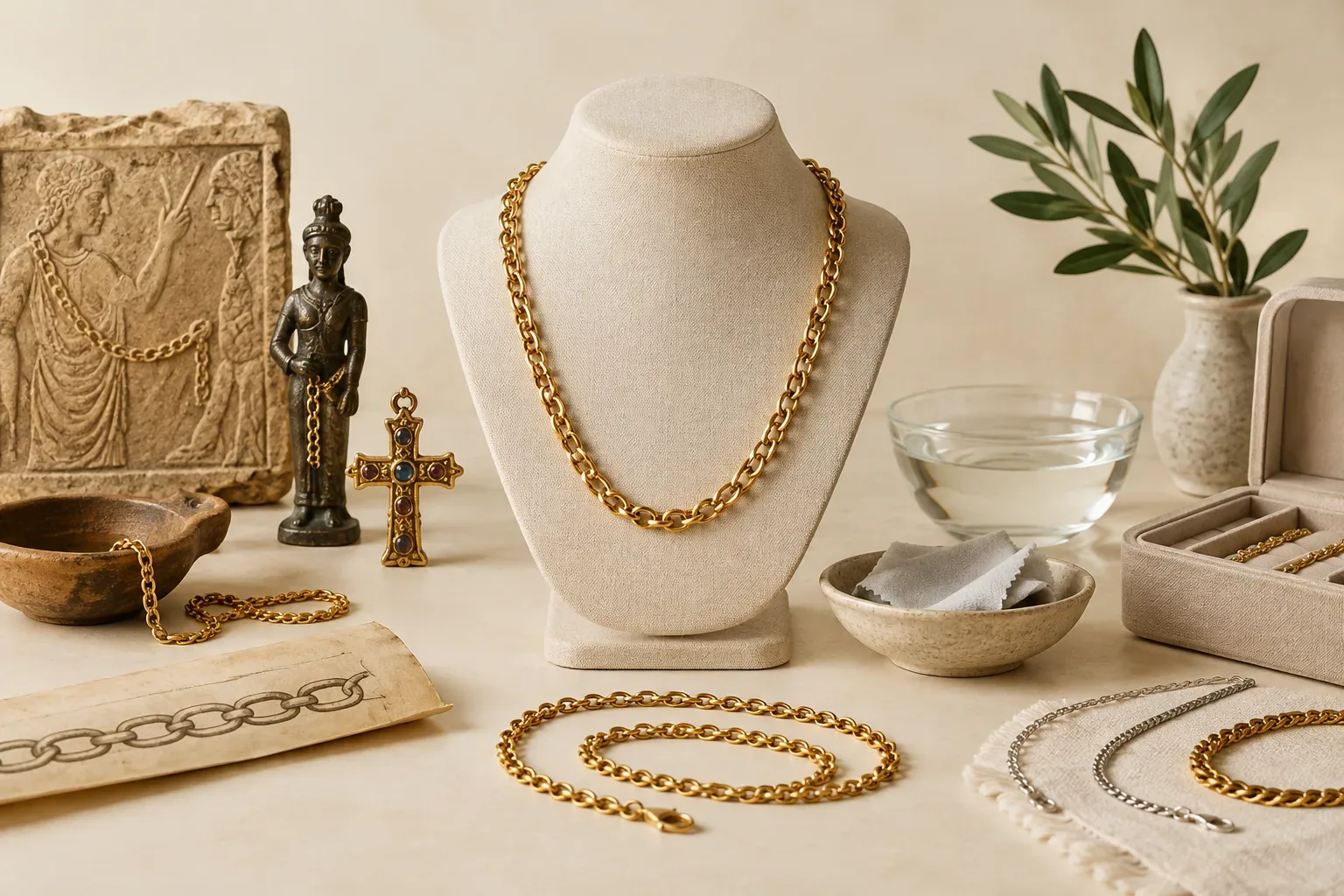
The Victoria and Albert Museum frames jewelry as an art form whose function and meaning change over time and across cultures. The museum’s materials place chains and necklaces within a long sequence of social uses rather than a single universal meaning; examples come from precise periods such as ancient Egypt, classical antiquity, medieval and Renaissance Europe, and later Victorian Britain (Victoria and Albert Museum).
Museum documentation shows that chains appear in different guises: heavy gold collars and chains of office signalled rank and authority in many pre-modern societies, while fine link chains supported pendants, lockets and religious symbols used for personal devotion or memorial practice. The V&A’s broad surveys emphasize that the same object type—here, the chain—served decorative, social and functional roles that shifted with fashion, technology and social structure (Victoria and Albert Museum).
Documented historical meanings versus modern interpretations
Documented historical meanings are those recorded in collections, inventories, court portraiture and object labels that museums like the V&A present as evidence of how a piece was used or regarded. The V&A records chains as markers of status and ceremony in multiple periods and as supports for lockets, reliquaries and symbolic pendants used in devotional and commemorative contexts (Victoria and Albert Museum). Those are historical claims grounded in material culture and archival evidence.
Modern interpretations include meanings people attach today—friendship, empowerment, identity or fashion statements. These contemporary readings are valid for the wearer but are not the same as historic, documented uses. Treat modern meanings as personal or cultural trends rather than universal fact. For example, wearing a chain with a small pendant today might express intimacy or minimalism for one person and heirloom continuity for another; neither replaces the historical record.
How the chain motif, gemstones and traditions appear in jewelry
Chains exist as both the structural element that carries a pendant and as a decorative object in their own right. Common historical and modern chain types include curb, cable, box, rope and figaro links; each link style alters how a chain looks and how it wears. Chains also vary in thickness, weight and whether they are hollow or solid—choices that affect durability and price.
Gemstones and pearls appear on chains as hung pendants, set-in bezels incorporated into the linkwork, or threaded beads. The Victoria and Albert Museum’s A–Z of Gemstones explains how different stones have been valued and used in settings and how properties such as hardness and porosity influence how they were set historically (Victoria and Albert Museum). For example, more fragile or porous materials have traditionally been used in protected settings or for occasional wear rather than daily chains.
Traditions tied to chains include lockets for memorial portraiture, chains of office in civic or academic contexts, and devotional pendants in numerous religions. These traditions are recorded in museum collections as instances of social practice rather than as universal symbolic rules.
Safe cleaning methods for common chain materials
Start by identifying the metal and any attached gemstones. For consumer protection, the Federal Trade Commission advises buyers to check disclosures about gemstone treatments and metal plating before purchase (Federal Trade Commission). That same care in identification helps you choose a safe cleaning method.
Solid gold chains: Most solid gold (14k, 18k) can be cleaned with warm water, a drop of mild dish soap, and a soft toothbrush to reach tight links. Rinse thoroughly and pat dry with a lint-free cloth. Do not use baking soda or abrasive cleaners on higher-carat gold, as repeated abrasion can dull polished surfaces.
Sterling silver chains: Use mild soap and water for routine cleaning and a soft polishing cloth to remove tarnish. For heavier tarnish use a silver-specific cleaner according to the product instructions, and rinse well. Avoid leaving silver in solutions for too long or using homemade acidic dips on plated items.
Plated and vermeil chains: Clean plated items gently with a soft cloth and occasional mild soapy water. Avoid vigorous scrubbing, strong chemical dips or ultrasonic cleaners, as these will remove plating and expose base metal.
Chains with gemstones or pearls: Treat attached gems individually. Hard stones such as diamonds and sapphires generally tolerate mild soap and water, but porous or soft stones like pearls, opal, turquoise and amber require great care. Use a barely damp cloth for pearls and avoid soaking; never use steam or harsh chemicals. When in doubt, consult a jeweler.
Storage strategies that preserve chains and prevent damage
Prevent tangles and kinks by storing each chain flat or hanging, ideally on a soft-lined hook or in a compartmentalized jewelry tray. For travel, place a chain in a thin cloth or a soft pouch and close the clasp so the chain cannot tangle with itself or other pieces. Keep heavier chains separate from delicate chains to avoid abrasion.
To minimize tarnish, store silver separately in anti-tarnish bags or wrap in an acid-free tissue. Avoid storing jewelry in humid bathrooms. A small silica gel packet in a jewelry box can reduce moisture but do not apply any baking soda or other household desiccants directly to metals or gems.
Certain stored conditions can harm porous materials: pearls and some organic stones benefit from a small amount of ambient humidity because they can crack if stored permanently bone-dry. If you own such pieces, keep them in a soft pouch inside a main jewelry box rather than in airtight plastic for long periods.
Common mistakes to avoid
Avoid using toothpaste, household bleach, or abrasive cleaners on jewelry; these are common home remedies that can damage plating, remove patina, or etch softer gemstones. Do not assume ultrasonic cleaners are safe for all pieces; they can loosen settings and crack fragile stones. Avoid sleeping, showering, or swimming while wearing everyday chains, because body oils, chlorine and saltwater accelerate wear and corrosion.
Do not store many chains together in one small space. Tangled chains are easily kinked when you force them apart, and kinks often require professional repair. Do not use paper towels or tissues for prolonged storage because acids in some papers can affect metals over time.
Choosing and gifting chain necklaces: practical and respectful guidance
When selecting or gifting a chain necklace, consider the recipient’s lifestyle and metal sensitivities. Solid metals are better for daily wear; vermeil or heavy plating can be cost-effective but will show wear on active bodies. Check whether a piece is hollow or solid if durability is important. The Federal Trade Commission recommends checking disclosure about treatments and materials when buying gemstones and precious metals; request that information from sellers prior to purchase (Federal Trade Commission).
Consider length and clasp type for comfort and safety: shorter chains suit pendants close to the throat while longer lengths work with layered looks. Lobster and spring-ring clasps are common; some wearers with limited hand mobility prefer magnetic or toggle designs, but note magnetic clasps may be less secure. For heirloom gifting, include care instructions and provenance if known; that respects the object’s history and helps future caretakers preserve it properly.
Be mindful of cultural or religious significance. If a chain carries a devotional symbol, insignia or a tradition linked to a community, present it respectfully and, if appropriate, learn and explain its context. Museum sources like the V&A show that many such pieces have specific historical roles, so avoid assuming any single meaning applies universally (Victoria and Albert Museum).
When to seek professional help
A jeweler should handle chains that are deeply soiled, heavily tarnished, kinked, or include fragile settings or porous stones. Professionals can test metals and identify treatments, tighten settings, replate or solder broken links safely. If provenance or documented historical value is at stake—such as an antique chain—consult a conservator or reputable jeweler before any cleaning or repair to preserve both material and historical integrity.
Final practical checklist
Identify metal and gemstones before cleaning, follow mild soap-and-water as a default for solid metals and hard stones, avoid abrasive and acidic home remedies on plated or porous materials, store chains individually to prevent tangles and use anti-tarnish storage for silver. When buying, ask sellers about treatments and materials disclosures as recommended by the Federal Trade Commission, and when caring for pieces with potential historical value, follow museum best practice by consulting qualified professionals (Federal Trade Commission; Victoria and Albert Museum).
Frequently asked questions
How often should I clean a chain necklace?
Clean frequently worn chains every few months with mild soap and water; clean less-used or delicate pieces only as needed. Silver may need more frequent polishing to slow tarnish. If a piece includes porous gems or historic value, limit cleaning and consult a professional.
Can I use an ultrasonic cleaner on my chain?
Avoid ultrasonic cleaners for plated chains, fragile settings, and porous or soft gemstones such as pearls, opal and turquoise. Ultrasonic machines are generally safe for hard stones like diamonds when the setting is secure, but when in doubt, ask a reputable jeweler.
What’s the easiest way to untangle a knotted chain?
Lay the chain on a flat surface, use a pin or needle to loosen the knot gently, and apply a drop of light oil (such as sewing machine oil) to help slide links apart. Work patiently to avoid kinking; if the knot resists, a jeweler can often repair kinks safely.
How should I store chains to avoid tarnish and kinks?
Store chains individually in soft pouches or compartment trays, close clasps, and hang delicate chains when possible. Use anti-tarnish bags or cloths for silver, keep items away from humidity, and avoid storing in bathroom humidity.
What should I ask a seller when buying a chain necklace?
Ask about metal content (solid gold versus plated), whether gemstones are natural or treated, and any repairs or restorations. The Federal Trade Commission recommends requesting material and treatment disclosures before purchase.
Sources and further reading
- Bedazzled: A History of Jewellery — Victoria and Albert Museum
- An A-Z of Gemstones — Victoria and Albert Museum
- Buying Gemstones, Diamonds, and Pearls — Federal Trade Commission